Reliance Resumes Venezuelan Oil Imports Amid Evolving US Sanctions
Source:The Hindu ↗
Why It Matters
Understanding how unilateral sanctions (like those by the US) impact global supply chains and India's bilateral trade is crucial for GS2. It also touches upon GS3 (Energy Security), demonstrating how India navigates geopolitical constraints to secure discounted crude oil, vital for its economic stability given its high import dependence.
Summary
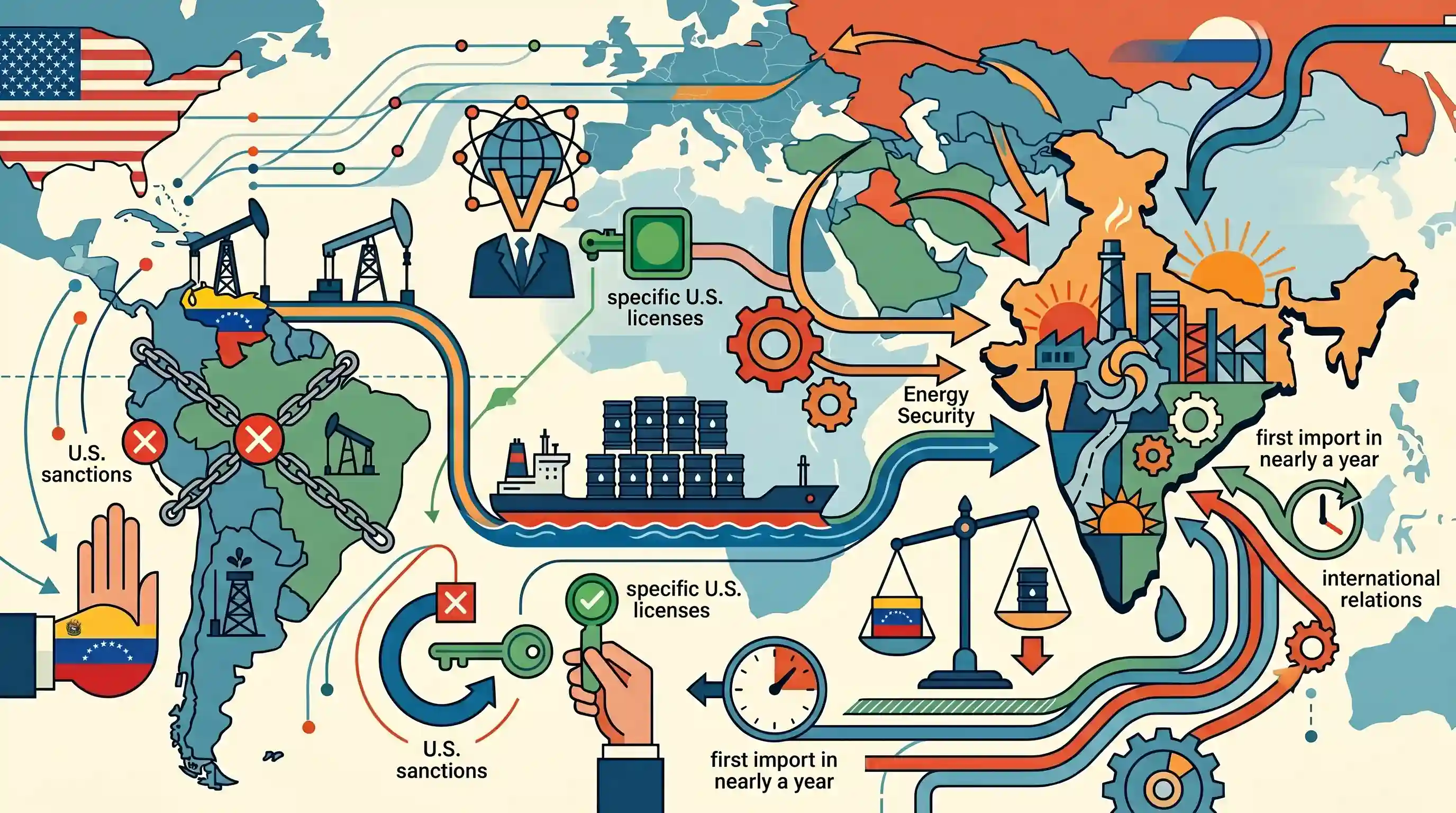
Reliance Industries has resumed buying Venezuelan crude oil, purchasing a 2-million-barrel cargo through the trading house Vitol. This marks the company's first import from the South American nation in nearly a year, facilitated by specific U.S. licenses granted to certain trading firms despite broader ongoing U.S. sanctions against the regime of President Nicolas Maduro. Secured at a $6.5-$7 per barrel discount to Brent, the purchase highlights India's continuous strategy to secure cost-effective energy resources and diversify its import basket in a complex geopolitical landscape.
Key Points
- Reliance Industries has acquired 2 million barrels of Venezuelan crude oil from trading firm Vitol, marking its first such purchase in nearly a year.
- The transaction utilizes specific U.S. licences recently granted to trading houses (Vitol and Trafigura), despite broader U.S. sanctions remaining on Venezuela's oil sector.
- The Venezuelan crude was purchased at a significant discount of $6.5-$7 per barrel compared to the ICE Brent benchmark.
- This development underscores India's strategic imperative to diversify its energy import basket and capitalize on discounted crude oil amid global geopolitical shifts.
Important Terms
Energy Security

The uninterrupted availability of energy sources at an affordable price. For India, it involves diversifying imports and expanding domestic production to ensure strategic autonomy and economic growth.
UPSC context
GS-III: Economy & Energy. Tests understanding of India's import dependence, strategic reserves, and the impact of geopolitics on national development.
Brent Crude
A major trading classification and global benchmark for light sweet crude oil prices. It serves as the reference for two-thirds of the world's oil trade, including India's import basket.
UPSC context
GS-III: Economic Development. Crucial for understanding inflation, the Current Account Deficit (CAD), and fiscal health linked to global commodity fluctuations.
ONGC Videsh (OVL)
The international arm of ONGC and a Navratna Central Public Sector Enterprise. It secures India's energy needs by acquiring and managing oil and gas assets in 15+ countries.
UPSC context
GS-II & GS-III: International Relations and Energy. Tests the role of State-led 'energy diplomacy' in securing long-term overseas hydrocarbon assets.
Reliance Industries (RIL)
India's largest private sector refiner, operating the world's largest refinery complex at Jamnagar. It is a key player in navigating global oil markets and sanctions to secure feedstock.
UPSC context
GS-III: Indian Economy. Significant as a private entity that influences India's trade patterns and energy security through large-scale global procurement.
Vitol
One of the world's largest independent energy trading houses. It acts as a global intermediary, facilitating the trade of oil and gas between producers and refiners, often under specific international licenses.
UPSC context
GS-III: Economic Geography/Trade. Illustrates the role of global commodity traders in navigating international sanctions and maintaining supply chains.
Indian Oil (IOCL)
India's largest public sector refiner and a Maharatna company. It manages a major share of domestic fuel supply and is increasingly forming global trading ventures to optimize procurement.
UPSC context
GS-III: Infrastructure and Energy. Tests the role of PSUs in ensuring domestic fuel stability and their evolution into global market participants.
Prelims Trap
"Saudi Arabia possesses the world's largest proven crude oil reserves."
While Saudi Arabia is a top producer, Venezuela actually holds the world's largest proven oil reserves (>300 billion barrels), largely concentrated in the Orinoco Belt as extra-heavy crude.
Static Concepts Connected
What are the primary global crude oil benchmarks?
- Brent Crude: Sourced from the North Sea; a light, sweet crude serving as the pricing reference for roughly two-thirds of globally traded oil, including India's imports.
- West Texas Intermediate (WTI): Extracted primarily in the U.S.; lighter and sweeter than Brent. It serves as the main benchmark for the North American oil market.
- Dubai/Oman Benchmark: A medium sour crude benchmark used to price oil exports from the Middle East to the Asia-Pacific region.
How do U.S. secondary sanctions impact third-party countries like India?
- Mechanism: Unlike primary sanctions, secondary sanctions target non-U.S. entities (like Indian firms) doing business with a sanctioned state, threatening to cut them off from the U.S. financial system.
- Impact on India: They severely limit India's energy diversification. Indian entities must halt imports, find alternative payment routes, or rely on specific U.S. OFAC waivers/licenses to avoid punitive dollar-clearing restrictions.
Cross-Topic Patterns
Sanctions & Currency Internationalization
Repeated U.S. secondary sanctions on key energy suppliers (Iran, Russia, Venezuela) act as a primary catalyst for India's macroeconomic push towards Rupee-denominated trade and the operationalization of Special Vostro accounts.
Geography of Heavy Crude Refining
Venezuela's Orinoco Belt yields extra-heavy, viscous crude. India imports this because private refiners like Reliance possess highly advanced coking technology capable of processing lower-grade, heavily discounted crude into high-value distillates.

Expect a Prelims multi-statement question on crude benchmarks (Brent vs WTI) linked to the geography of proven oil reserves (Venezuela).
Linked PYQs · 3
Linked PYQs · 3
- 2012MainsGS2
How have the US sanctions against Iran affected India's bilateral relations with Iran?
- 2024PrelimsGS1
Consider the following statements : Statement-I : Recently, Venezuela has achieved a rapid recovery from its economic crisis and succeeded in preventing its people from fleeing/emigrating to other countries. Statement-II : Venezuela has the world's largest oil reserves. Which one of the following is correct in respect of the above statements?
- 2009PrelimsGS1
Other than Venezuela, which one among the following from South America is a member of OPEC?
