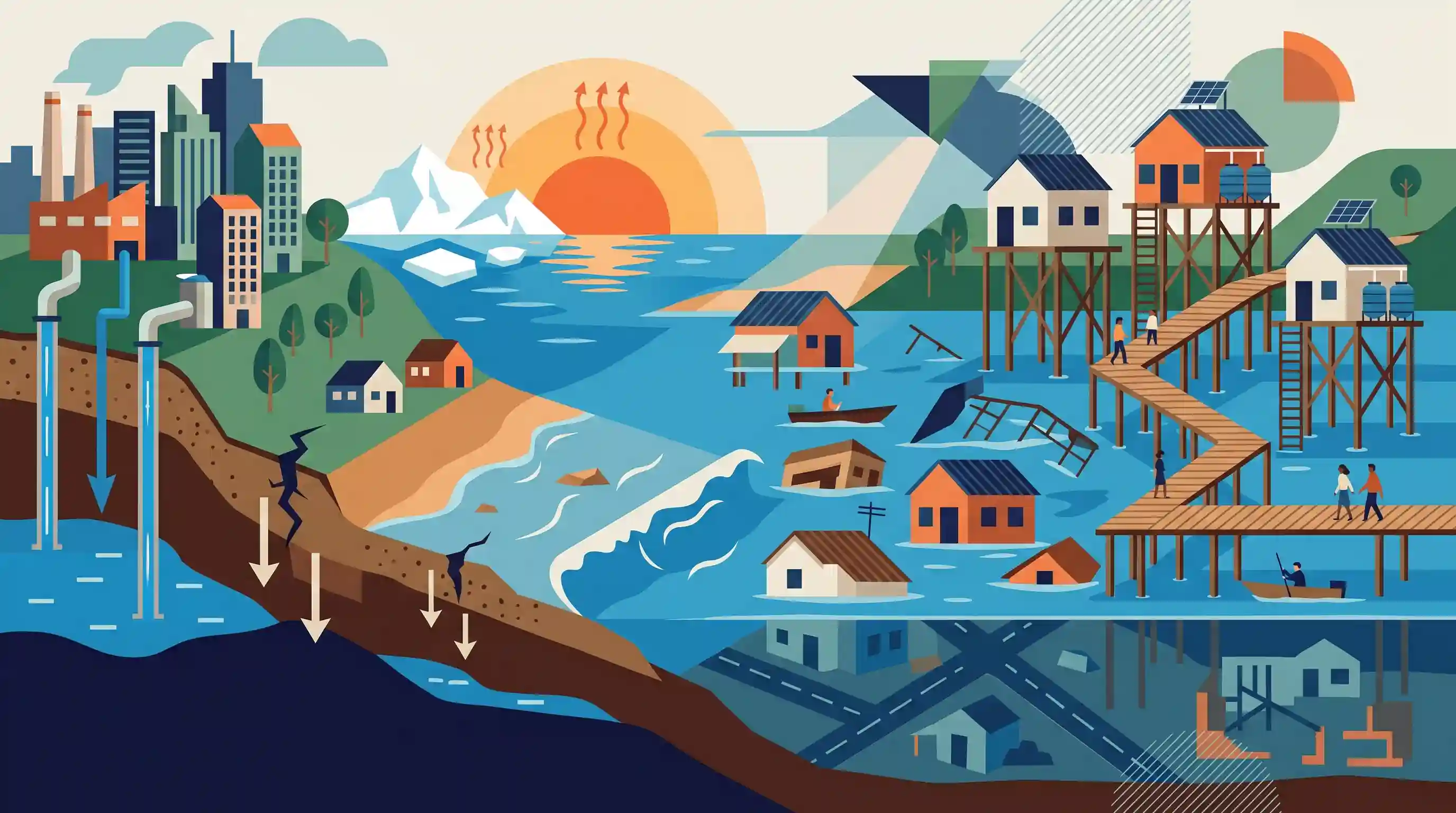
Groundwater depletion and sea level rise impact on coastal villages
Source:The Hindu ↗
Why It Matters
Provides a compelling, real-world case study of the catastrophic impacts of sea-level rise and human-induced land subsidence on coastal communities. It is highly relevant for GS-1 (Geography/Impact on Island Nations) and GS-3 (Environment/Disaster Management) when discussing climate adaptation, coastal erosion, and the consequences of excessive groundwater exploitation.
Summary
The article highlights the existential crisis faced by Rejosari Senik, a coastal village in Indonesia's Demak region, which is rapidly sinking due to a lethal combination of extreme land subsidence and global sea-level rise. Driven largely by unregulated groundwater extraction and climate change, the persistent flooding has permanently inundated the area. In response, the local community is demonstrating remarkable resilience by adapting their living environment—elevating homes on wooden stilts and building raised walkways over submerged infrastructure. The situation provides a grim preview of the future for vulnerable coastal zones and island nations, underlining the urgent need for comprehensive coastal management, groundwater regulation, and climate resilience measures.
Key Points
- Rejosari Senik, a coastal village in the Demak region of Indonesia, is facing severe, permanent inundation due to extreme land subsidence and climate change-induced sea-level rise.
- The rapid sinking of the land is primarily driven by excessive groundwater extraction for industrial and domestic purposes, compounding the global sea-level rise crisis.
- To cope with the daily tidal floods, residents are physically 'rising above the water' by elevating their houses on stilts and replacing submerged roads with raised wooden walkways.
- The environmental disaster has devastated local livelihoods, destroyed agricultural lands, and raised the prospect of forced displacement or managed retreat for the remaining population.
- The village serves as a dire warning and a live case study of the vulnerabilities faced by coastal and island nations, emphasizing the need for sustainable groundwater management and robust climate adaptation strategies.
Prelims Trap
Coastal inundation in Southeast Asian regions is exclusively driven by global climate-induced sea-level rise.
Land subsidence from excessive groundwater extraction often outpaces absolute sea-level rise in regions like Demak and Jakarta, heavily magnifying local coastal inundation.
Static Concepts Connected
How does excessive groundwater extraction cause coastal land subsidence?
- Aquifer compaction: Removal of groundwater reduces internal pore pressure in the aquifer, causing overlying clay and silt layers to collapse under their own weight.
- Irreversible sinking: Once the sediment layers are compacted, the aquifer permanently loses its original water-holding capacity, making the land sink irreversible.
- Relative sea-level rise: As the land sinks, it creates a higher 'relative' sea-level rise, compounding the effects of eustatic (global) sea-level increases and causing faster inundation.
What is 'Managed Retreat' in the context of climate adaptation?
- Strategic relocation: The purposeful, coordinated movement of people, infrastructure, and settlements away from highly vulnerable coastal or riverine hazards.
- Alternative to armoring: It marks a shift away from 'hard engineering' solutions (like building seawalls or embankments) when areas become fundamentally uninhabitable.
- Socio-economic hurdles: It presents severe implementation challenges, including complex land-rights issues, loss of ancestral lands, and immense resettlement costs for developing states.
Cross-Topic Patterns
Himalayan vs. Coastal Land Subsidence
While Himalayan subsidence (like Joshimath) is driven by tectonic fragility and unplanned construction, coastal subsidence (like Demak or Jakarta) is primarily anthropogenic, driven heavily by rapid aquifer depletion and industrial groundwater extraction.
Subsidence, Salinization and Delta Agriculture
Sinking coastlines directly exacerbate saltwater intrusion into freshwater aquifers. This creates a vicious cycle threatening food security in deltaic regions (e.g., Indian Sundarbans, Kuttanad) and forcing occupational displacement.

Expect a GS-3 Mains question comparing 'hard engineering' (seawalls) vs 'managed retreat' for India's sinking coastal cities by 2026.
Linked PYQs · 3
Linked PYQs · 3
- 2025MainsGS1
How are climate change and the sea level rise affecting the very existence of many island nations? Discuss with examples.
- 2023MainsGS3
The Intergovernmental Panel on Climate Change (IPCC) has predicted a global sea level rise of about one metre by AD 2100. What would be its impact in India and the other countries in the Indian Ocean region?
- 2022MainsGS3
Explain the causes and effects of coastal erosion in India. What are the available coastal management techniques for combating the hazard?
