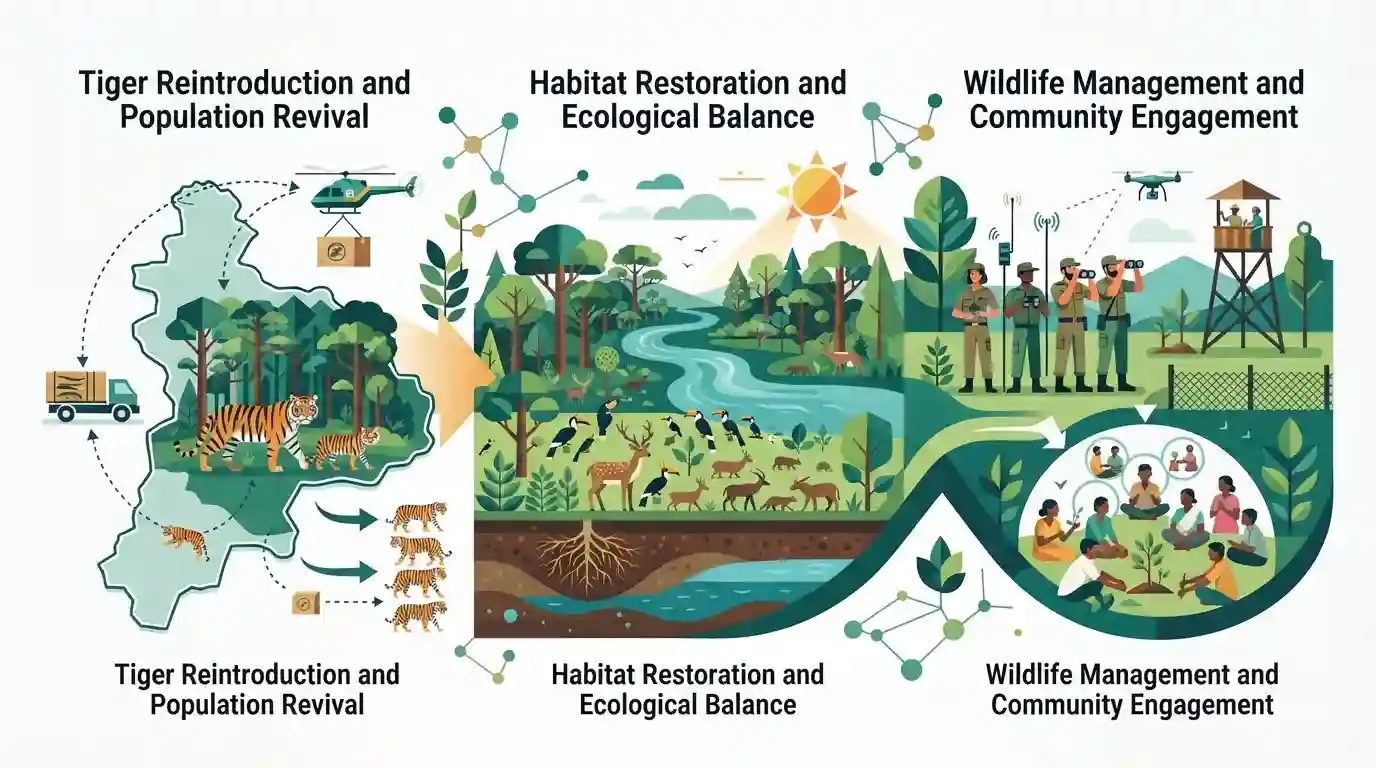
Tiger Reintroduction in Buxa Boosts Ecological Restoration
Source:The Hindu ↗
આ શા માટે મહત્વનું છે
Important for understanding wildlife management strategies, tiger conservation programs, and challenges in habitat restoration and reintroduction of apex predators in India.
સારાંશ
An explanatory overview of the tiger reintroduction initiative in Buxa Tiger Reserve, detailing its implications for biodiversity conservation, habitat restoration, and wildlife management in India.
મુખ્ય મુદ્દા
- The reintroduction of tigers in Buxa Tiger Reserve (West Bengal) marks a significant step for wildlife conservation and ecological restoration in the region.
- Tiger reintroduction programs require careful habitat management, monitoring of prey base, and mitigation of human-wildlife conflict.
- Such initiatives help restore degraded ecosystems and enhance connectivity across fragmented landscapes.
મહત્વપૂર્ણ શબ્દો
Wildlife Protection Act 1972

India's core umbrella legislation for protecting wild animals, birds, and plants, establishing protected areas like national parks and wildlife sanctuaries, and regulating hunting and trade.
UPSC context
UPSC GS Paper III (Environment & Ecology): Tests knowledge of environmental laws, statutory bodies, and conservation frameworks.
National Tiger Conservation Authority
A statutory body under the Ministry of Environment, Forest and Climate Change, established under the Wildlife Protection Act, 1972, to oversee tiger conservation and project implementation in India.
UPSC context
UPSC GS Paper III (Environment & Ecology): Tests understanding of statutory conservation bodies and Project Tiger governance.
NTCA
Abbreviation for the National Tiger Conservation Authority, responsible for formulating guidelines, approving tiger conservation plans, and monitoring translocation and reintroduction programs across India's tiger reserves.
UPSC context
UPSC GS Paper III (Environment & Ecology): Frequently tested acronym in biodiversity conservation, protected areas, and species recovery programs.
પ્રિલિમ્સ ટ્રેપ
Tiger reintroduction programs are primarily successful through direct species translocation without requiring preparatory habitat or prey-base augmentation.
Aspirants often assume tiger reintroduction only involves physical translocation of big cats, overlooking the mandatory prerequisite of prey-base augmentation and grassland restoration.
સંલગ્ન સ્થિર ખ્યાલો
What are the statutory mandates and powers of the National Tiger Conservation Authority (NTCA)?
- Statutory Basis: Established under the Wildlife (Protection) Act, 1972, following the Tiger Task Force recommendation.
- Conservation Plans: Approves the Tiger Conservation Plan prepared by State Governments under Section 38V.
- Project Tiger: Provides statutory authority to Project Tiger and addresses livelihood concerns of local people.
આંતર-વિષય પેટર્ન
Tiger Corridors + Transboundary Conservation Diplomacy
Buxa's location in the Eastern Himalayan foothills linking India and Bhutan highlights how transboundary conservation corridors facilitate gene flow across fragmented landscapes.
Trophic Cascades + Wildlife Protection Act
Reintroducing apex predators like tigers mandates prior prey-base augmentation, illustrating core principles of trophic cascade management in Indian wildlife laws.

Expect a statement-based prelims question pairing Buxa's ecological features with NTCA guidelines on tiger translocation prerequisites.
સંલગ્ન PYQ · 3
સંલગ્ન PYQ · 3
- 2026PrelimsGS1
With reference to Madhav National Park, which of the following statements is/are correct ? 1. It was declared a Tiger Reserve in India in 2025. 2. Sakhya Sagar, which is designated as a Ramsar Site, is situated within this National Park. 3. Its area is shared between Madhya Pradesh and Rajasthan. Select the answer using the code given below :
- 2019PrelimsGS1
Which of the following are in Agasthyamala Biosphere Reserve?
- 2017PrelimsGS1
In India, if a species of tortoise is declared protected under Schedule I of the Wildlife (Protection) Act, 1972, what does it imply?
