Landscape approach needed for sustainable green economy transition
Source:The Hindu ↗
Why It Matters
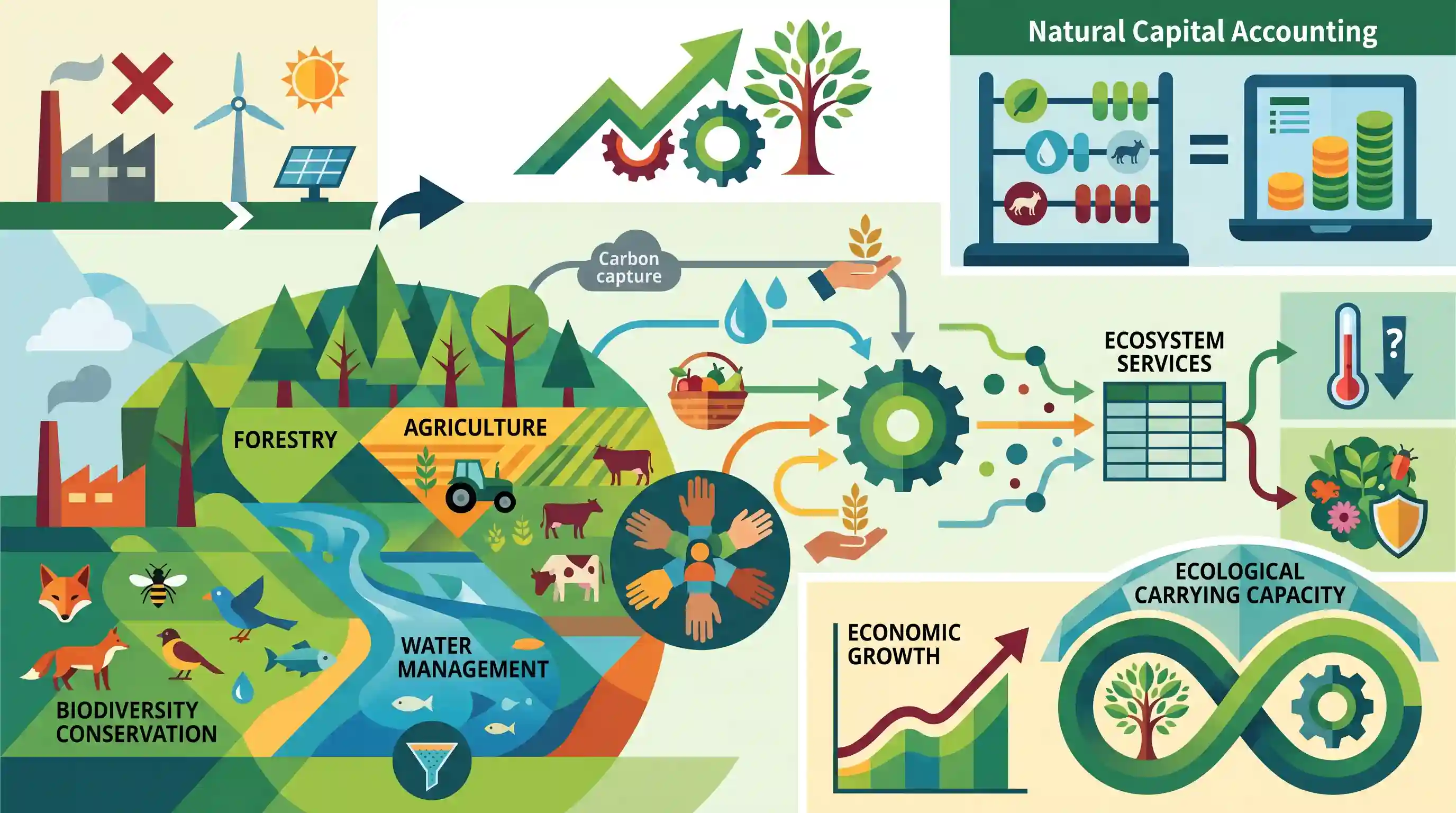
The concept of a 'green economy' is a vital topic for GS3 Environment and Economy. The landscape approach provides a more nuanced, holistic framework for Mains answers, highlighting the limitations of an exclusively emissions-focused strategy and the necessity of natural capital accounting and community-level ecosystem management.
Summary
The article argues that the transition to a 'green economy' must move beyond merely decarbonizing industries and adopting renewable energy, to embracing a holistic 'landscape approach'. This perspective integrates forestry, agriculture, water management, and biodiversity conservation to maintain the ecological integrity of land while supporting local livelihoods. By valuing natural capital and incorporating ecosystem services into economic planning, policymakers can address both climate change and biodiversity loss simultaneously. A landscape-driven green economy ensures that environmental sustainability is rooted in community-led land stewardship and robust natural capital accounting, aligning long-term economic growth with ecological carrying capacity.
Key Points
- A carbon-centric approach to the green economy is insufficient; it must be broadened to include biodiversity, ecosystem services, and sustainable land use.
- The 'landscape approach' provides a holistic framework for managing natural resources by integrating agricultural production, rural livelihoods, and environmental conservation within a unified geographical area.
- Sustainable landscapes enhance natural capital, provide vital ecological services, and act as natural buffers to build community resilience against climate change impacts.
- Transitioning to a landscape-led green economy requires re-imagining economic metrics, incorporating natural capital accounting to reflect the true socio-economic value of ecosystems beyond traditional GDP.
- Policy shifts must incentivize community-led conservation and sustainable land-use practices to align economic development with long-term ecological balance.
Important Terms
Green Economy

An economic model that improves human well-being and social equity while significantly reducing environmental risks and ecological scarcities through low-carbon, resource-efficient, and socially inclusive growth.
UPSC context
GS Paper 3: Economics/Environment; tests understanding of sustainable growth models and the transition away from traditional carbon-heavy development.
Sustainable Development Goals (SDGs)
A set of 17 interconnected global objectives adopted by the UN in 2015 to end poverty and protect the planet, notably Goal 15 (Life on Land).
UPSC context
GS Paper 2 & 3: Governance and Environment; essential for assessing India's progress on international sustainability commitments and indices.
Paris Agreement
A legally binding 2015 international treaty aiming to limit global warming to well below 2°C, preferably 1.5°C, through country-specific Nationally Determined Contributions (NDCs).
UPSC context
GS Paper 3: Environment; a high-frequency topic for Prelims and Mains regarding climate mitigation, adaptation, and India's Net-Zero targets.
Kunming-Montreal Global Biodiversity Framework
A landmark 2022 agreement to halt and reverse biodiversity loss by 2030, featuring the '30x30' target to protect 30% of global land and oceans.
UPSC context
GS Paper 3: Conservation; crucial for understanding the post-2020 global biodiversity targets and their implementation in national policies.
Natural Capital Accounting (NCA)
A framework to measure the stocks and flows of natural resources (soil, water, biodiversity) to integrate ecosystem services into national economic planning and Green GDP.
UPSC context
GS Paper 3: Economic Development/Environment; relevant for questions on environmental valuation and the MoSPI-led NCAVES project in India.
Landscape Approach
An integrated management strategy that addresses the physical, biological, and social aspects of an entire region to balance ecological integrity with community-led livelihoods.
UPSC context
GS Paper 3: Environment and Agriculture; tests holistic resource management, watershed development, and place-based climate adaptation strategies.
United Nations Environment Programme (UNEP)
The leading global environmental authority that sets the environmental agenda, promotes sustainable development, and pioneered the conceptual framework for the inclusive Green Economy.
UPSC context
GS Paper 2 & 3: International Organizations; tests knowledge of global environmental governance and flagship reports like the Emissions Gap Report.
International Union for Conservation of Nature (IUCN)
A global authority on the status of the natural world, known for the Red List of Threatened Species and promoting nature-based solutions for conservation.
UPSC context
GS Paper 3: Biodiversity; critical for Prelims (species classification) and Mains (collaborative conservation frameworks).
Prelims Trap
Natural Capital Accounting (NCA) replaces traditional GDP as the primary economic metric under UN frameworks.
NCA frameworks, such as the UN's SEEA, create 'satellite accounts' to complement existing System of National Accounts (SNA). They supplement rather than replace traditional GDP.
Static Concepts Connected
What are the 4 categories of Ecosystem Services (Millennium Ecosystem Assessment)?
- Provisioning Services: Products obtained from ecosystems, such as food, fresh water, wood, fiber, and genetic resources.
- Regulating Services: Benefits obtained from the regulation of ecosystem processes, including climate regulation, natural hazard regulation, and water purification.
- Supporting Services: Services necessary for the production of all other ecosystem services, such as soil formation, nutrient cycling, and primary production.
- Cultural Services: Non-material benefits people obtain through spiritual enrichment, cognitive development, recreation, and aesthetic experiences.
What is the System of Environmental-Economic Accounting (SEEA)?
- Global Standard: It is the accepted international statistical standard for environmental-economic accounting, adopted by the UN Statistical Commission.
- Data Integration: It integrates environmental and economic data to show how the environment contributes to the economy and how the economy impacts the environment.
- Indian Application: India's MoSPI has initiated compiling environmental accounts under the 'EnviStats India' publication using the SEEA framework.
Cross-Topic Patterns
Ecosystem Services + Fiscal Federalism
The Finance Commission's use of 'Forest and Ecology' as a criteria for horizontal tax devolution is a practical Indian application of valuing ecosystem services and natural capital.
Landscape Approach + Tribal Rights (FRA)
The 'landscape approach' heavily intersects with the Forest Rights Act (FRA), where Community Forest Resource (CFR) rights empower local tribes to become primary stewards of the ecological landscape.

Expect a multi-statement question linking Kunming-Montreal GBF targets (specifically Target 14) with SEEA natural capital accounting.
Linked PYQs · 4
Linked PYQs · 4
- 2018PrelimsGS1
The Partnership for Action on Green Economy (PAGE), a UN mechanism to assist countries transition towards greener and more inclusive economies, emerged at
- 2019MainsGS3
Define the concept of carrying capacity of an ecosystem as relevant to an environment. Explain how understanding this concept is vital while planning for sustainable development of a region.
- 2020MainsGS3
Explain intra-generational and inter-generational issues of equity from the perspective of inclusive growth and sustainable development.
- 2018MainsGS3
What is wetland? Explain the Ramsar concept of 'wise use' in the context of wetland conservation. Cite two examples of Ramsar sites from India.
