Artificial Intelligence in Environmental Health Management
Source:The Hindu ↗
Why It Matters
UPSC frequently asks questions on the intersection of emerging technologies (like AI) and pressing global challenges. Understanding how AI can be leveraged for environmental monitoring and public health is highly relevant for GS Paper 3 (S&T and Environment) and GS Paper 2 (Health Governance).
Summary
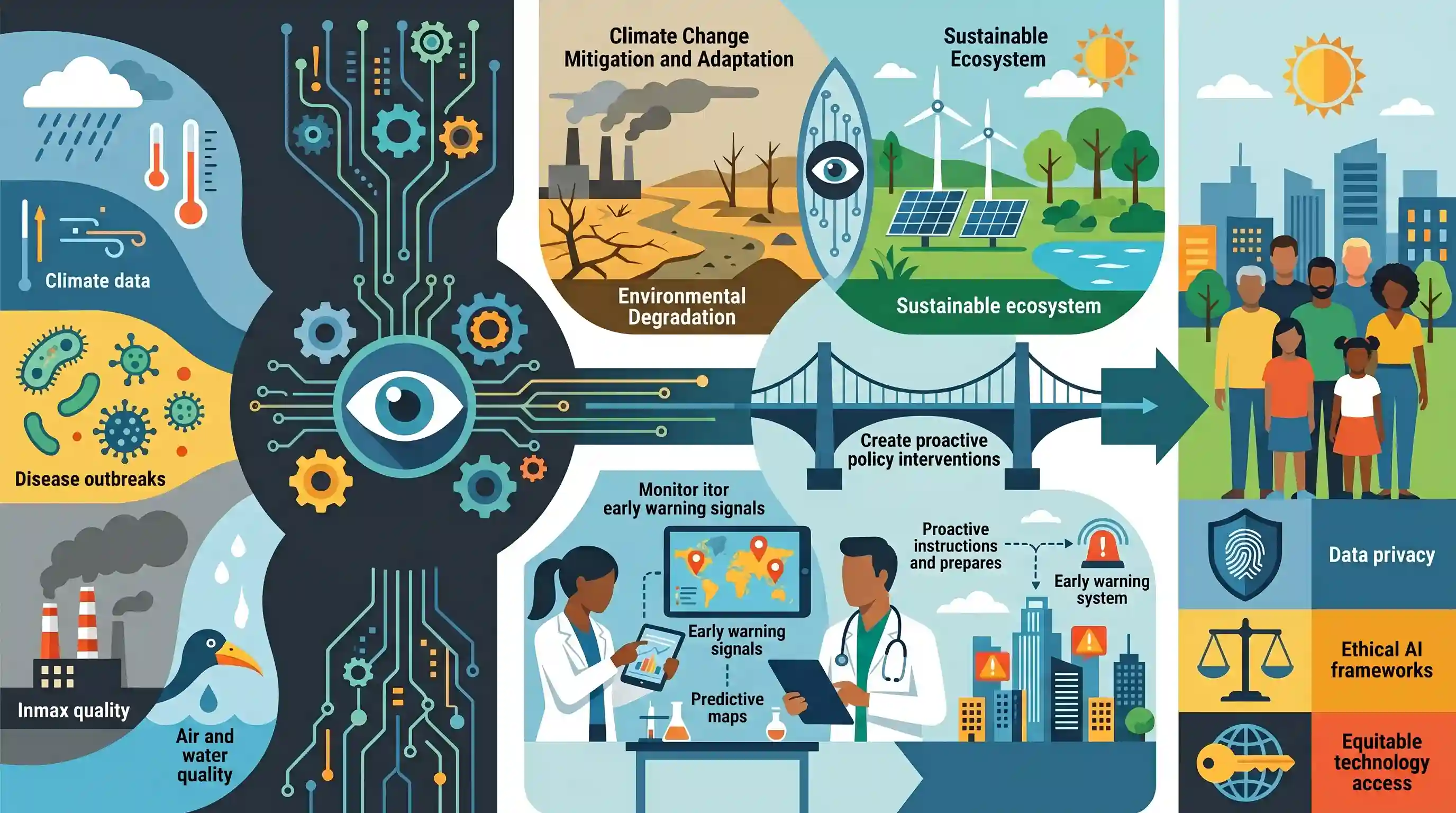
The article explores the transformative role of Artificial Intelligence (AI) in advancing environmental health management. It highlights how AI tools like predictive modeling and machine learning can analyze vast datasets concerning air and water quality, climate change, and disease outbreaks. By bridging the gap between environmental monitoring and public healthcare delivery, AI enables early warning systems and proactive policy interventions. However, realizing this potential requires navigating challenges related to data privacy, ethical AI frameworks, and equitable technology access to protect vulnerable populations from climate-induced health risks.
Key Points
- AI-driven predictive analytics can forecast environmental health crises by analyzing patterns in climate change, air quality, and water safety.
- Machine learning models enhance disease surveillance, particularly for vector-borne diseases whose spread is accelerated by environmental shifts.
- The integration of AI facilitates early warning systems that help governments deploy proactive public health measures instead of reactive ones.
- While AI offers immense potential, challenges such as data privacy, algorithmic biases, and digital infrastructure disparities must be addressed for equitable health outcomes.
Important Terms
One Health Approach

An integrated, unifying approach that aims to sustainably balance and optimize the health of people, animals, and ecosystems, recognizing their fundamental interlinkages.
UPSC context
GS Paper II (Public Health) and GS III (Biodiversity). Essential for analyzing pandemic preparedness and zoonotic disease management.
Predictive Modeling
The use of statistical techniques and machine learning to analyze historical data and forecast future outcomes, such as disease outbreaks or pollution spikes.
UPSC context
GS Paper III (Science & Technology). Tests application of AI in proactive governance and healthcare delivery.
Early Warning Systems (EWS)
Integrated systems for hazard monitoring, forecasting, and communication that provide timely alerts to help individuals and communities reduce risks from disasters.
UPSC context
GS Paper III (Disaster Management). Critical for climate change adaptation and reducing socio-economic losses.
Ethical AI Frameworks
Principles ensuring AI deployment is transparent, accountable, and fair, aiming to mitigate algorithmic bias and protect data privacy in public services.
UPSC context
GS Paper IV (Ethics) and GS Paper III (Tech Governance). Tests ability to evaluate moral challenges in emerging technologies.
Climate-induced health risks
Health threats like heat stress, respiratory illnesses, and shifting vector-borne disease patterns (e.g., Dengue) directly aggravated by changing climatic conditions.
UPSC context
GS Paper III (Environment). Relevant for understanding climate change as a 'threat multiplier' for public health.
Environmental Health
The branch of public health concerned with how all aspects of the natural and built environment impact human health and well-being.
UPSC context
GS Paper II (Social Justice/Health). Tests understanding of socio-ecological determinants and the 'Exposome' concept.
Prelims Trap
The 'One Health' approach is exclusively concerned with preventing zoonotic disease spillover from animals to humans.
The 'One Health' framework explicitly integrates human, animal, AND environmental ecosystems. Environmental health (climate, pollution) is a core pillar, not a secondary factor.
Static Concepts Connected
What are the foundational pillars of the 'One Health' approach?
- Human Health: Tackling zoonotic diseases, addressing antimicrobial resistance (AMR), and ensuring general public health.
- Animal Health: Focusing on livestock management, veterinary care, and wildlife conservation to prevent pathogen spillover.
- Ecosystem Health: Monitoring climate change, habitat degradation, and pollution that act as catalysts for emerging infectious diseases.
What is Federated Learning in AI, and why is it critical for public healthcare?
- Decentralized Training: It trains algorithms across multiple local devices or servers holding data samples, without exchanging the actual raw data.
- Data Privacy: It safeguards sensitive patient medical records and genomic data from centralized cyberattacks and unauthorized surveillance.
- Collaborative Modeling: Hospitals and research institutes can collaboratively build smarter AI models for disease prediction while complying with data localization laws.
Cross-Topic Patterns
AI in Climate Adaptation vs. Mitigation
While AI optimizing smart grids is climate mitigation, its use in disease prediction and early warning systems aligns heavily with climate adaptation and disaster resilience strategies.
Digital Public Infrastructure (DPI) + Exposomics
AI-driven exposomics requires massive longitudinal datasets, linking directly to the interoperable health records generated under India's Ayushman Bharat Digital Mission (ABDM) and associated privacy debates.

A 2026 GS-3 question will likely ask to evaluate AI's role in the 'One Health' approach, emphasizing data privacy and federated learning.
Linked PYQs · 2
Linked PYQs · 2
- 2023MainsGS3
Introduce the concept of Artificial Intelligence (AI). How does Al help clinical diagnosis? Do you perceive any threat to privacy of the individual in the use of Al in healthcare?
- 2024MainsGS2
In a crucial domain like the public healthcare system the Indian State should play a vital role to contain the adverse impact of marketisation of the system. Suggest some measures through which the State can enhance the reach of public healthcare at the grassroots level.
