Artificial Intelligence in Environmental Health and Surveillance
Source:The Hindu ↗
Why It Matters
The intersection of emerging technologies (AI) and public/environmental health is highly relevant for GS-3. UPSC frequently tests the real-world applications of technology in solving socio-economic challenges, along with the ethical and privacy concerns they entail.
Summary
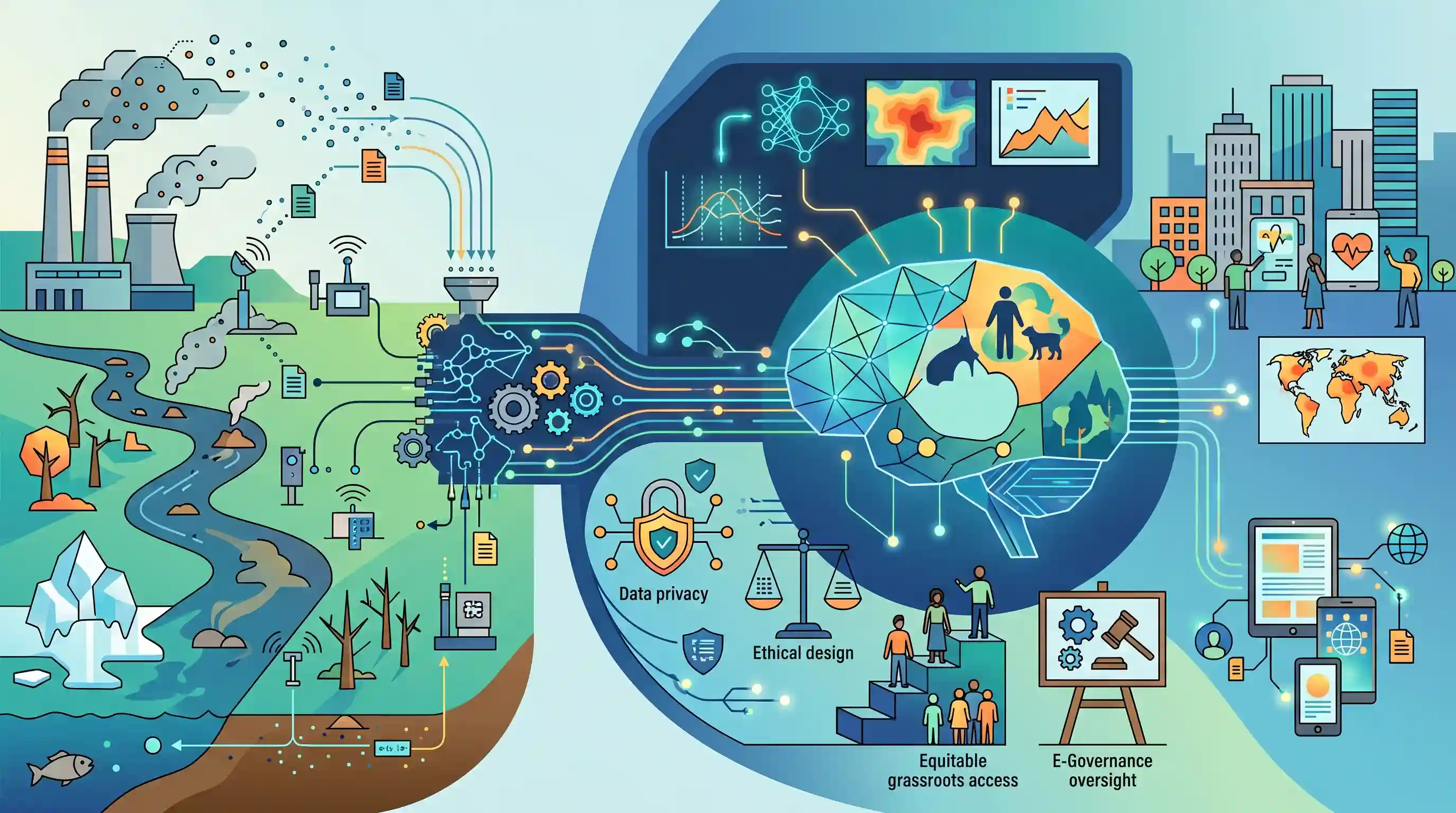
This article explores the transformative potential of Artificial Intelligence (AI) in addressing complex challenges in environmental health. By leveraging big data analytics and predictive modeling, AI systems can proactively monitor environmental quality, map exposure risks, and forecast disease outbreaks linked to ecological and climate changes. This technological integration bridges the gap between environmental science and public health, actively supporting a 'One Health' approach. However, unlocking AI's full potential requires navigating significant governance hurdles, particularly concerning health data privacy, ethical algorithmic design, and ensuring these interventions reach the grassroots level equitably.
Key Points
- AI enhances environmental monitoring through hyper-local tracking of pollution (like PM2.5) and toxin exposures, enabling real-time early warning systems.
- Predictive modeling strengthens epidemiological surveillance by forecasting outbreaks of zoonotic and vector-borne diseases driven by climate change and environmental degradation.
- AI integration accelerates the 'One Health' approach by synthesizing massive datasets across human, animal, and ecosystem health variables.
- Widespread deployment of AI in health raises critical governance challenges, including the threat to data privacy, algorithmic bias, and the need for equitable access to digital health infrastructure.
Prelims Trap
"The 'One Health' approach exclusively focuses on preventing zoonotic diseases transferring from animals to humans."
One Health is a triad. It integrates human, animal, AND ecosystem health, comprehensively addressing antimicrobial resistance, climate impacts, and environmental toxins—not just zoonotic spillovers.
Static Concepts Connected
What are the core components of the 'One Health' approach?
- Triad concept: It is an integrated, unifying approach that aims to sustainably balance and optimize the health of people, animals, and ecosystems.
- Broad Scope: Beyond zoonotic diseases, it addresses antimicrobial resistance (AMR), food safety, vector-borne diseases, and environmental health/pollution.
- Global bodies: It is globally championed by the Quadripartite alliance comprising the WHO, FAO, UNEP, and WOAH.
How do zoonotic and vector-borne diseases differ?
- Zoonotic diseases: Infections that are naturally transmitted from vertebrate animals to humans (e.g., Rabies, Nipah, Brucellosis).
- Vector-borne diseases: Infections transmitted to humans and animals by arthropods like mosquitoes, ticks, and fleas (e.g., Dengue, Malaria).
- The intersection: Some diseases are both, involving animal reservoirs and insect vectors for transmission (e.g., Kyasanur Forest Disease, Scrub Typhus).
Cross-Topic Patterns
AI Bias & Social Justice
AI systems trained on non-representative datasets can misallocate medical resources, turning a pure technology issue into a GS2 governance, equity, and fundamental rights challenge.
Climate Change & Epidemiology
Ecological degradation and shifting weather patterns expand vector habitats, linking GS3 environmental conservation directly to national disease burdens and epidemiological surveillance.

Expect a multi-statement question testing the 'One Health' triad definition alongside AI applications in disease prediction and data bias.
Linked PYQs · 2
Linked PYQs · 2
- 2023MainsGS3
Introduce the concept of Artificial Intelligence (AI). How does Al help clinical diagnosis? Do you perceive any threat to privacy of the individual in the use of Al in healthcare?
- 2024MainsGS2
In a crucial domain like the public healthcare system the Indian State should play a vital role to contain the adverse impact of marketisation of the system. Suggest some measures through which the State can enhance the reach of public healthcare at the grassroots level.
