Delimitation Post-2026 Threatens Federal Balance and Representation
Source:The Hindu ↗
Why It Matters
The freeze on delimitation ends after 2026, making this one of the most pressing constitutional challenges of the decade. UPSC frequently tests the tensions within Indian federalism, especially regarding resource allocation and political representation (e.g., Finance Commission criteria and demographic performance). The Delimitation debate perfectly encapsulates the friction between democratic representation and federal equity.
Summary
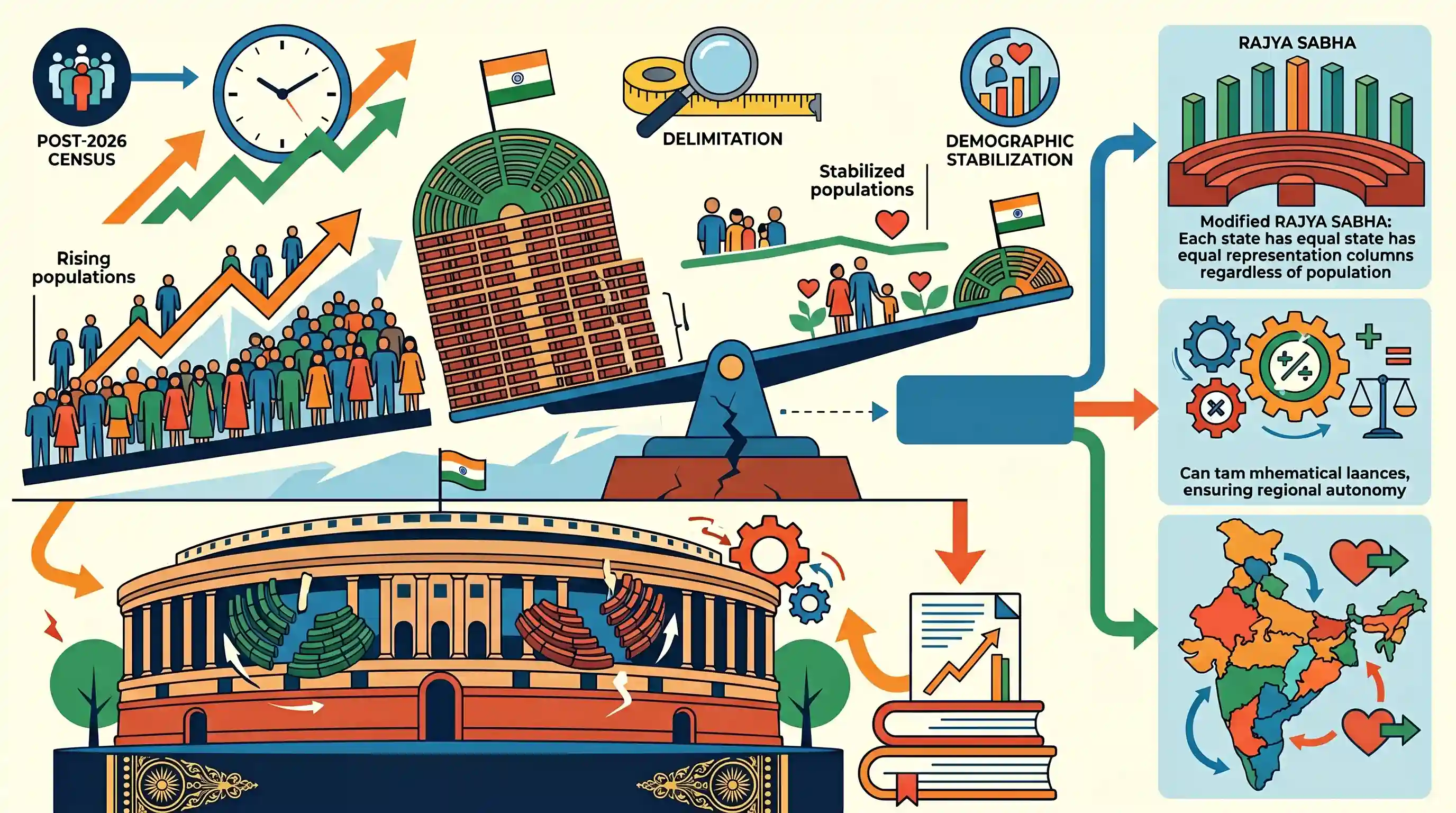
The article examines the looming constitutional and federal crisis surrounding the upcoming delimitation of parliamentary constituencies in India, which is set to be based on the first census post-2026. Because seat allocation is primarily tied to population size, states that have successfully stabilized their demographics—predominantly in the South—risk a significant reduction in their share of national political power compared to Northern states with higher population growth. The author argues that this demographic divergence necessitates a reimagining of the delimitation exercise to protect federalism. Proposed solutions include balancing the 'one person, one vote' democratic ideal with the need to protect regional autonomy, potentially by restructuring the Rajya Sabha or finding new formulas that do not penalize states for effective governance and family planning.
Key Points
- The impending delimitation of Lok Sabha constituencies, frozen until the first census post-2026, threatens to skew political representation in favour of populous northern states.
- Southern states face a paradoxical penalty of losing parliamentary seats due to their successful implementation of national population control and development policies.
- Strict adherence to the 'one person, one vote' principle solely based on current population metrics could severely strain India's federal structure and create a North-South political divide.
- There is an urgent need to 'reimagine' the delimitation process—potentially by reforming the Rajya Sabha to offer equal state representation or exploring structural compromises that decouple absolute seat counts from mere demographic growth.
Important Terms
42nd Constitutional Amendment Act

1976 legislation that froze Lok Sabha and State Assembly seat allocations at 1971 Census levels until 2000 to reward states for population control efforts.
UPSC context
GS-II (Polity/Federalism). Essential for understanding the historical origins of the current demographic-political imbalance between states.
84th Constitutional Amendment Act
2001 legislation that extended the freeze on the total number of legislative seats until the first census post-2026, while allowing internal boundary readjustments.
UPSC context
GS-II (Elections). Tests knowledge of the specific legal timeline (2026) that triggers the upcoming federal representation crisis.
Delimitation Commission
An independent, high-powered body appointed by the President to redraw constituency boundaries; its orders carry the force of law and are immune to judicial review.
UPSC context
GS-II (Statutory/Constitutional Bodies). Tests understanding of the body's quasi-judicial status and its role in upholding "one vote, one value."
Delimitation Commission Act
The legislative framework (e.g., 2002 Act) enacted under Article 82 that empowers the Union to constitute a commission for seat readjustment based on census results.
UPSC context
GS-II (Governance). Relevant for knowing the statutory procedure required to initiate electoral boundary changes and its interplay with constitutional articles.
Election Commission of India
The constitutional body that collaborates with the Delimitation Commission; the Chief Election Commissioner serves as one of the Commission's three key members.
UPSC context
GS-II (Constitutional Bodies). Tests knowledge of inter-agency cooperation in the electoral process and the technical execution of delimitation.
Prelims Trap
"Orders of the Delimitation Commission can be challenged in the Supreme Court on grounds of constitutional validity."
Delimitation Commission orders have the force of law and cannot be questioned in any court. Even Parliament cannot modify the orders once laid.
Static Concepts Connected
How is the Delimitation Commission constituted and what are its powers?
- Constitutional mandate: Article 82 requires Parliament to enact a Delimitation Act after every census to readjust constituencies.
- Composition: Appointed by the President; typically includes a serving/retired Supreme Court Judge, the CEC or an Election Commissioner, and State Election Commissioners.
- Binding nature: Its orders are final, have the force of law, and cannot be modified by Parliament or State legislatures.
How does India's Rajya Sabha representation differ from symmetric federalism models?
- Population-based allocation: The Fourth Schedule allocates Rajya Sabha seats based on state population, rather than granting equal representation to all states (like the US Senate).
- Federal structural vulnerability: Because both Lok Sabha and Rajya Sabha seats are tied to population, states with higher population growth gain disproportionate influence in both Houses.
Cross-Topic Patterns
Fiscal vs. Political Demographic Penalties
The 15th Finance Commission mitigated the demographic penalty by introducing a 'Demographic Performance' weight (12.5%) for tax devolution. Political delimitation currently lacks a similar constitutional safeguard to reward population control.
Inter-State Council and Federal Frictions
The impending seat-share shift compounds existing federal frictions over GST compensation and language politics, elevating the need for active dispute resolution via the Inter-State Council (Article 263).

Expect a 15-marker in GS2 analyzing the 'demographic penalty' on Southern states, linking Delimitation, Upper House reform, and the 15th FC.
Linked PYQs · 3
Linked PYQs · 3
- 2024PrelimsGS1
How many Delimitation Commissions have been constituted by the Government of India till December 2023?
- 2023PrelimsGS1
Consider the following: 1. Demographic performance 2. Forest and ecology 3. Governance reforms 4. Stable government 5. Tax and fiscal efforts For the horizontal tax devolution, the Fifteenth Finance Commission used how many of the above as criteria other than population area and income distance?
- 2022MainsGS2
“While the national political parties in India favour centralisation, the regional parties are in favour of State autonomy.” Comment.
