Delimitation and Federal Concerns in Women Reservation
Source:The Hindu ↗
Why It Matters
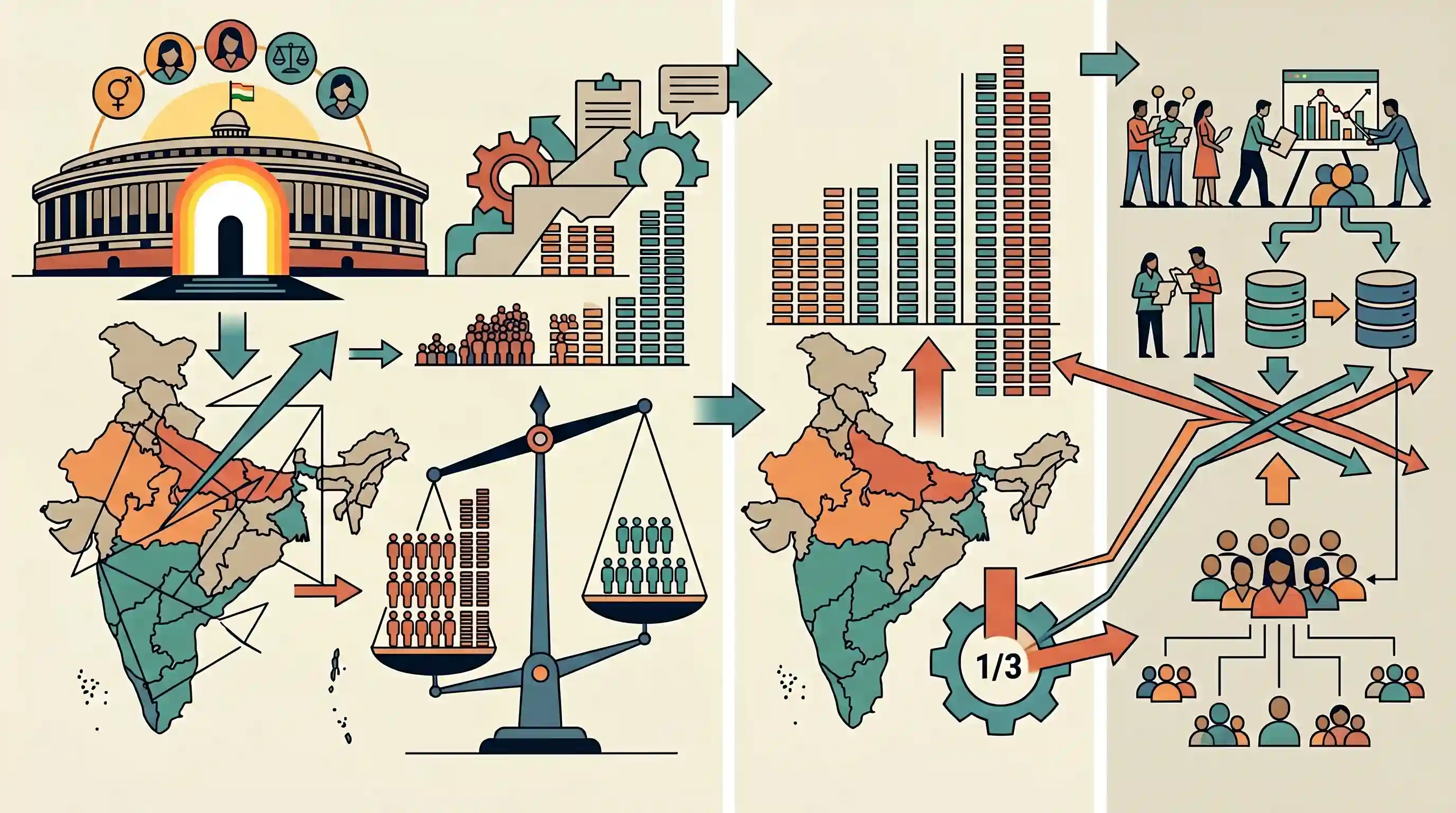
The linkage between the upcoming delimitation exercise and the implementation of the women's reservation law raises critical federal issues. Population-based reapportionment of Lok Sabha seats risks penalizing Southern states for their successful demographic management, bringing the democratic principle of equal representation into direct conflict with federal equity.
Summary
The impending implementation of the Nari Shakti Vandan Adhiniyam (women's reservation law) for the 2029 Lok Sabha elections has sparked a federal debate over the associated delimitation exercise. The Congress party warns that using population figures to redraw constituencies will create a 'regional imbalance,' penalizing Southern states for effective population control while increasing the political heft of the more populous Hindi-belt states. One reported compromise involves a uniform 50% increase in Lok Sabha seats across all states, raising the total strength to around 816, with a third reserved for women. Concurrently, demands for a caste census and sub-quotas for marginalized communities within the women's reservation remain a contentious political issue.
Key Points
- The Union government plans to conduct a delimitation exercise based on the 2011 Census to implement the Nari Shakti Vandan Adhiniyam (women's reservation law) by the 2029 Lok Sabha elections.
- The Congress party has raised alarms over potential 'regional imbalance,' arguing that reapportioning seats by population will unfairly penalize Southern states that have successfully curbed population growth, while rewarding Northern states.
- To prevent federal friction, a proposed alternative is a uniform 50% increase in seats across all states, raising the Lok Sabha's strength from 543 to approximately 816 seats.
- Of these 816 seats, exactly one-third (approx. 272) would be reserved for women under the new quota law.
- The Congress continues to demand a caste census and explicit sub-quotas for OBCs, SCs, and STs within the overarching 33% women's reservation framework.
Important Terms
Nari Shakti Vandan Adhiniyam

The Constitution (106th Amendment) Act, 2023, which reserves one-third of all seats in the Lok Sabha, State Assemblies, and the Delhi Assembly for women for 15 years.
UPSC context
GS-II (Polity/Governance - Women's Empowerment). Significant for questions on legislative attempts at gender parity and its implementation challenges.
Delimitation
The statutory process of redrawing the boundaries of Lok Sabha and State Assembly constituencies based on population changes to ensure equitable representation.
UPSC context
GS-II (Electoral Reforms). Key to understanding the constitutional mandate for proportional representation and the Delimitation Commission's role.
84th Constitutional Amendment Act
The 2001 legislation that extended the freeze on the total number of seats in the Lok Sabha and State Assemblies until the first census after 2026.
UPSC context
GS-II (Constitutional Amendments). Essential for discussing the historical 'pause' on seat reallocation and its impact on federal representation.
Regional Imbalance (in Representation)
The political disparity where states with lower population growth (typically Southern) risk losing representation relative to high-growth states (Northern), threatening federal stability.
UPSC context
GS-II (Federalism). Tests analysis of democratic proportionality vs. protecting states that successfully implement national goals like population control.
Article 82
The constitutional provision mandating that Parliament enact a Delimitation Act after every decennial census to readjust seat allocation and constituency boundaries.
UPSC context
GS-II (Indian Constitution). Fundamental article governing the periodic redrawing of India’s electoral map.
Caste Census
A demographic survey to record the caste-wise population, used to assess socio-economic disparities and determine the need for internal sub-quotas within reservation policies.
UPSC context
GS-II (Social Justice). Relevant for debates on OBC reservation, sub-categorization, and data-driven policymaking for marginalized groups.
Prelims Trap
The Nari Shakti Vandan Adhiniyam secures a 33% quota for women, including sub-categorised quotas for OBC, SC, and ST women.
The 106th CAA (Nari Shakti Vandan Adhiniyam) provides sub-quotas only for SC and ST women. There is no constitutional provision for OBC political reservation in the Lok Sabha (Article 330).
Static Concepts Connected
How is the Delimitation Commission constituted and what are its powers?
- Statutory Body: Constituted by the President of India under the Delimitation Commission Act, drawing authority from Article 82 of the Constitution.
- Composition: Typically comprises a retired Supreme Court judge as Chairperson, the Chief Election Commissioner, and respective State Election Commissioners.
- Absolute Finality: Its orders have the force of law, take effect on a date specified by the President, and cannot be challenged in any court.
Which Constitutional Amendments govern the freeze on Lok Sabha seat allocations?
- 42nd Amendment (1976): Froze the total number of Lok Sabha seats allocated to each state based on the 1971 Census until the year 2000.
- 84th Amendment (2001): Extended the freeze on the total number of seats to the publication of the first census post-2026, preserving the 1971 baseline.
- 87th Amendment (2003): Allowed for the readjustment of internal territorial constituencies (without altering the state's total seats) based on the 2001 Census.
Cross-Topic Patterns
Finance Commission vs. Delimitation
The friction over delimitation mirrors the debates surrounding the 15th and 16th Finance Commissions, where Southern states argued their successful demographic management was being penalized in vertical tax devolution.
Panchayat quotas vs. National quotas
The national deadlock contrasts sharply with the 73rd and 74th Amendments (1992), which smoothly institutionalized a 33% baseline women's quota in Panchayats and Municipalities without triggering interstate federal disputes.

Expect a GS-2 Mains question on how post-2026 delimitation tests Indian federalism, alongside a Prelims Q on Articles 82, 330, and 334A.
Linked PYQs · 2
Linked PYQs · 2
- 2019MainsGS2
“The reservation of seats for women in the institutions of local self-government has had a limited impact on the patriarchal character of the Indian Political Process.” Comment.
- 2023MainsGS2
Discuss the contribution of civil society groups for women's effective and meaningful participation and representation in state legislatures in India.
