Gujarat High Court Rules On Lijjat Papad ESI Dispute
Source:verdictum ↗
Why It Matters
This ruling is significant for GS Paper 2 as it touches upon the intersection of social security legislation (ESI Act) and unique women's empowerment models (like Lijjat Papad). It raises important governance questions about the classification of home-based gig/informal workers, the definition of an 'employee' versus a 'co-owner', and the applicability of industrial labour laws to cooperative institutions.
Summary
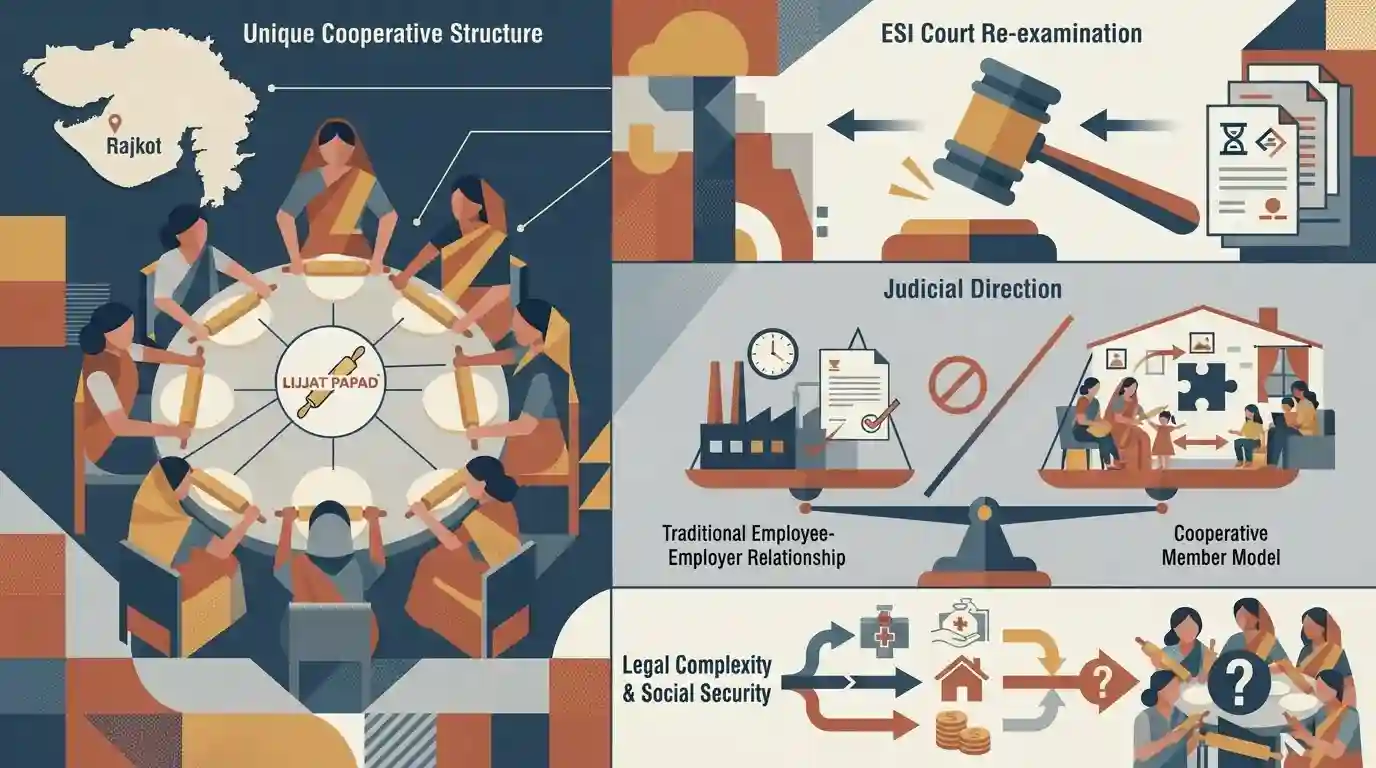
The Gujarat High Court has directed the ESI Court in Rajkot to re-examine whether women engaged in rolling papads for Shree Mahila Gruh Udyog Lijjat Papad can be classified as 'employees' under the Employees' State Insurance (ESI) Act, 1948. The High Court found that the ESI Court had previously failed to consider a key 1999 Supreme Court ruling regarding the unique structural model of Lijjat Papad, where women function as members or co-owners rather than traditional employees working under a master-servant relationship. The case highlights the legal complexities in applying standard labour laws to cooperative, home-based, and informal work models, emphasizing the need for nuanced interpretations of employer-employee definitions in social security legislations.
Key Points
- The Gujarat High Court set aside an order by the ESI Court, Rajkot, and remanded a dispute involving Shree Mahila Gruh Udyog Lijjat Papad for fresh consideration.
- The core legal issue is whether women rolling papads at home for the organization qualify as 'employees' under Section 2(9) of the ESI Act, 1948, and whether the institution is an 'establishment' under Section 2(12).
- The High Court observed that the lower court ignored a pivotal 1999 Supreme Court judgment (Shri Mahila Griha Udyog Lijjat Papad v. Union of India) which examined the unique cooperative nature of the institution and the status of its members.
- The applicant organization argued there is no 'master-servant' relationship, as the women take dough home, roll papads without supervision, and are treated as co-owners rather than wage-earning employees.
- The ESI Corporation had earlier issued a recovery certificate demanding ESI contributions from the organization, prompting the legal challenge.
Important Terms
Shree Mahila Gruh Udyog Lijjat Papad

A prominent Indian women's worker cooperative founded in 1959, famous for manufacturing "Lijjat" papad. It serves as a benchmark model for female entrepreneurship, rural-urban cottage industries, and women's self-reliance in India.
UPSC context
GS Paper II (Social Justice - SHGs/NGOs) and GS Paper III (Inclusive Growth), testing understanding of grassroots cooperative models.
Employees' State Insurance (ESI) Act, 1948
A self-financing social security and health insurance legislation in India that provides medical, sickness, maternity, disability, and dependent benefits to formal and semi-formal workers earning below a prescribed wage ceiling.
UPSC context
GS Paper II (Welfare Schemes, Labour Laws), testing knowledge of social security frameworks and their application to the informal workforce.
Employees' State Insurance Corporation (ESIC)
A statutory body established under the ESI Act, 1948, under the Ministry of Labour and Employment, responsible for administering and managing the integrated social security scheme for organized and semi-organized sector workers.
UPSC context
GS Paper II (Statutory, Regulatory and Quasi-judicial Bodies), testing understanding of executive organizations administering social security.
Societies Registration Act, 1860
A British-era central legislation in India that provides a legal framework for registering, managing, and dissolving non-profit, literary, scientific, and charitable societies to promote arts, literature, science, and public welfare.
UPSC context
GS Paper II (Development Processes and the Development Industry - NGOs, SHGs), testing civil society governance structures and historic regulatory frameworks.
Bombay Public Trust Act, 1950
A state legislation designed to regulate, supervise, and administer public, religious, and charitable trusts. It protects public trust properties and ensures their proper management under the oversight of a Charity Commissioner.
UPSC context
GS Paper II (Polity and Governance - Religious Autonomy), testing knowledge of state-level regulation of charitable and religious institutions.
Prelims Trap
The ESI Act, 1948 automatically covers all home-based and cooperative manual laborers under its definition of employees.
The ESI Act 1948 requires a distinct 'master-servant' relationship under the control test; home-based cooperative co-owners do not automatically qualify as employees.
Static Concepts Connected
What is the 'Control Test' in Indian labour jurisprudence?
- Core Objective: It is a judicial standard used to establish the existence of a formal master-servant (employer-employee) relationship.
- Key Determinant: It determines whether the employer controls not only what work is done, but also the manner and execution of the work.
- Statutory Link: Traditional social security laws like ESI and EPF depend heavily on this test to determine liability.
What are the key Constitutional provisions for Cooperatives in India?
- Article 43 (DPSP): Directs the State to promote cottage industries on an individual or cooperative basis in rural areas.
- Article 19(1)(c): Guarantees citizens the fundamental right to form cooperative societies.
- Part IXB: Inserted by the 97th Amendment Act, 2011 to run cooperative societies democratically and professionally.
Cross-Topic Patterns
Cooperatives vs. formal labour laws
Applying rigid industrial-era labour laws to self-managed women's cooperatives can disrupt their democratic, profit-sharing economic models and jeopardize grassroots financial viability.
Social Security Code transition
While legacy laws like ESI 1948 exclude home-based workers due to the 'control test,' the 2020 Social Security Code aims to bridge this gap for informal workers.

GS-2/3 likely to test how legacy 'master-servant' definitions underperform in protecting gig and home-based cooperative workers.
Linked PYQs · 1
Linked PYQs · 1
- 2024GPSC_PRELIMSGS1
The Constitution upholds the rights of labours and ensures labour welfare in which of the following ways via Directive Principles? 1. It makes provision for just and humane conditions for work and maternity relief. 2. It exhorts the government to take steps to secure the participation of workers in the management of industries. Which of the above statements is/are correct?
