IB Ministry Directs Media Against Live Coverage Of Defense Operations
Source:Indian Express ↗
Why It Matters
This issue illustrates the critical intersection between press freedom and national security. For UPSC aspirants, understanding the statutory provisions (Cable TV Networks Rules) that impose reasonable restrictions on media coverage during anti-terror operations is crucial for answering questions on internal security challenges and the regulatory role of the state.
Summary
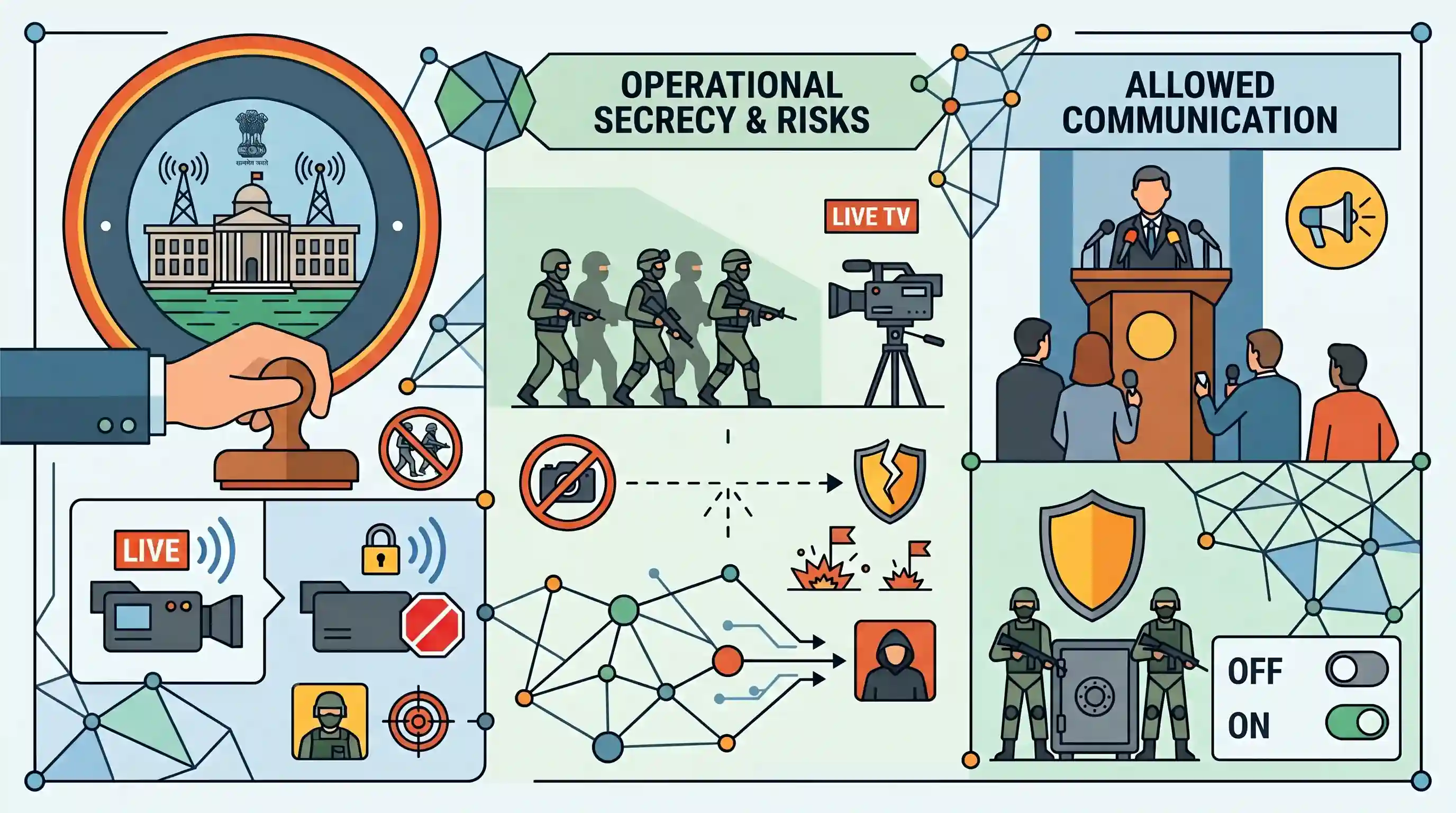
The Ministry of Information and Broadcasting has issued an advisory directing media channels to refrain from airing live coverage of counter-terrorism operations and the movement of security forces. Triggered by recent media coverage of the Pahalgam terror attack, the directive cites the severe risks to operational secrecy, troop safety, and national security—echoing past compromises during the 26/11 attacks and the Kargil war. The Ministry reminded broadcasters to strictly comply with Rule 6(1)(p) of the Cable Television Networks (Amendment) Rules, 2021, and the Programme Code, which restrict reporting of ongoing anti-terror operations to official periodic briefings.
Key Points
- The I&B Ministry issued a strict advisory to media channels against broadcasting live coverage of defense and counter-terrorism operations following the Pahalgam terror attack.
- The advisory highlighted past instances like the 26/11 Mumbai attacks, Pathankot, and Kargil, where live reporting compromised operational secrecy and endangered security personnel.
- Media outlets were directed to adhere to Rule 6(1)(p) of the Cable Television Networks (Amendment) Rules, 2021, which strictly bars live coverage of anti-terror operations.
- Reporting on such operations is legally restricted to periodic briefings provided by designated officers until the operation concludes.
Important Terms
Cable Television Networks (Amendment) Rules, 2021

2021 update to the 1994 Rules, establishing a statutory three-tier grievance redressal mechanism to ensure broadcasters' adherence to the Programme and Advertising Codes.
UPSC context
GS Paper 2 (Governance) and GS Paper 3 (Internal Security); tests knowledge of regulatory frameworks and media accountability.
Programme Code
A set of standards under the Cable Television Networks (Regulation) Act, 1995, prohibiting content that incites violence, offends national integrity, or disrupts public order.
UPSC context
GS Paper 2 (Regulatory bodies) and Media Ethics; fundamental for questions on media regulation and censorship.
Rule 6(1)(p)
A specific clause under the Cable TV Rules prohibiting live coverage of ongoing anti-terrorist operations; it restricts reporting to periodic official briefings until operations conclude.
UPSC context
GS Paper 3 (Internal Security); critical for topics on communication networks and challenges to internal security.
Ministry of Information and Broadcasting (I&B)
The nodal Union ministry responsible for regulating broadcasting, film, and press; it enforces media compliance with national security guidelines and the CTN Act.
UPSC context
GS Paper 2 (Ministries and Departments); tests understanding of the executive’s role in managing information and security.
Media as an Internal Security Challenge
The security risk where real-time reporting of troop movements and tactical operations provides actionable intelligence to hostile elements, compromising national safety.
UPSC context
GS Paper 3 (Internal Security); a core syllabus topic regarding the role of media in security management.
Prelims Trap
"Live broadcast of anti-terror ops by TV channels is prohibited under the IT Rules 2021."
Television news broadcasts are regulated by the Cable Television Networks Act and its Rules, whereas digital news and OTT platforms fall under the IT Rules 2021. Aspirants often conflate the two.
Static Concepts Connected
How are television broadcasts regulated in India?
- Cable TV Act 1995: Governs traditional broadcasters. The Act allows the government to regulate or prohibit the transmission of certain programmes.
- Programme Code: Outlines content standards. Rule 6(1)(p) specifically restricts live coverage of anti-terror operations to official periodic briefings.
- Three-Tier Redressal: A 2021 amendment introduced a statutory mechanism: broadcaster self-regulation, industry body oversight, and an Inter-Departmental Committee.
How does Article 19(2) apply to media reporting on national security?
- Implicit Right: Freedom of the press is not explicitly mentioned but is implicit in Article 19(1)(a) guaranteeing freedom of speech and expression.
- Security Exception: "Security of the State" is a recognized constitutional ground for imposing reasonable restrictions on this freedom.
- Reasonable Restriction: Banning live operational coverage is legally viewed as a reasonable restriction to prevent loss of life and tactical compromise.
Cross-Topic Patterns
Media as a tactical tool for terrorists
The 26/11 attacks demonstrated how unregulated live coverage provides tactical intelligence to handlers. This directly links GS2 media regulation mechanisms with GS3 internal security threat management.
Traditional broadcast vs. Digital media regulations
While the Cable TV Networks Rules govern traditional television broadcasts, the IT Rules 2021 established a parallel three-tier grievance redressal architecture for OTT platforms and digital news publishers.

Rule 6(1)(p) of the Cable TV Rules and Art 19(2) "Security of State" exceptions are prime targets for a 2026 Prelims polity statement.
Linked PYQs · 4
Linked PYQs · 4
- 2024MainsGS3
Social media and encrypting messaging services pose a serious security challenge. What measures have been adopted at various levels to address the security implications of social media? Also suggest any other remedies to address the problem.
- 2021MainsGS3
Analyse the complexity and intensity of terrorism, its causes, linkages and obnoxious nexus. Also suggest measures required to be taken to eradicate the menace of terrorism.
- 2014MainsGS2
What do you understand by the concept "freedom of speech and expression"? Does it cover hate speech also ? Why do the films in India stand on a slightly different plane from other forms of expression ? Discuss.
- 2013MainsGS3
What are social networking sites and what security implications do these sites present ?
