Civil Services Conduct Rules and Social Media Restrictions
Source:Indian Express ↗
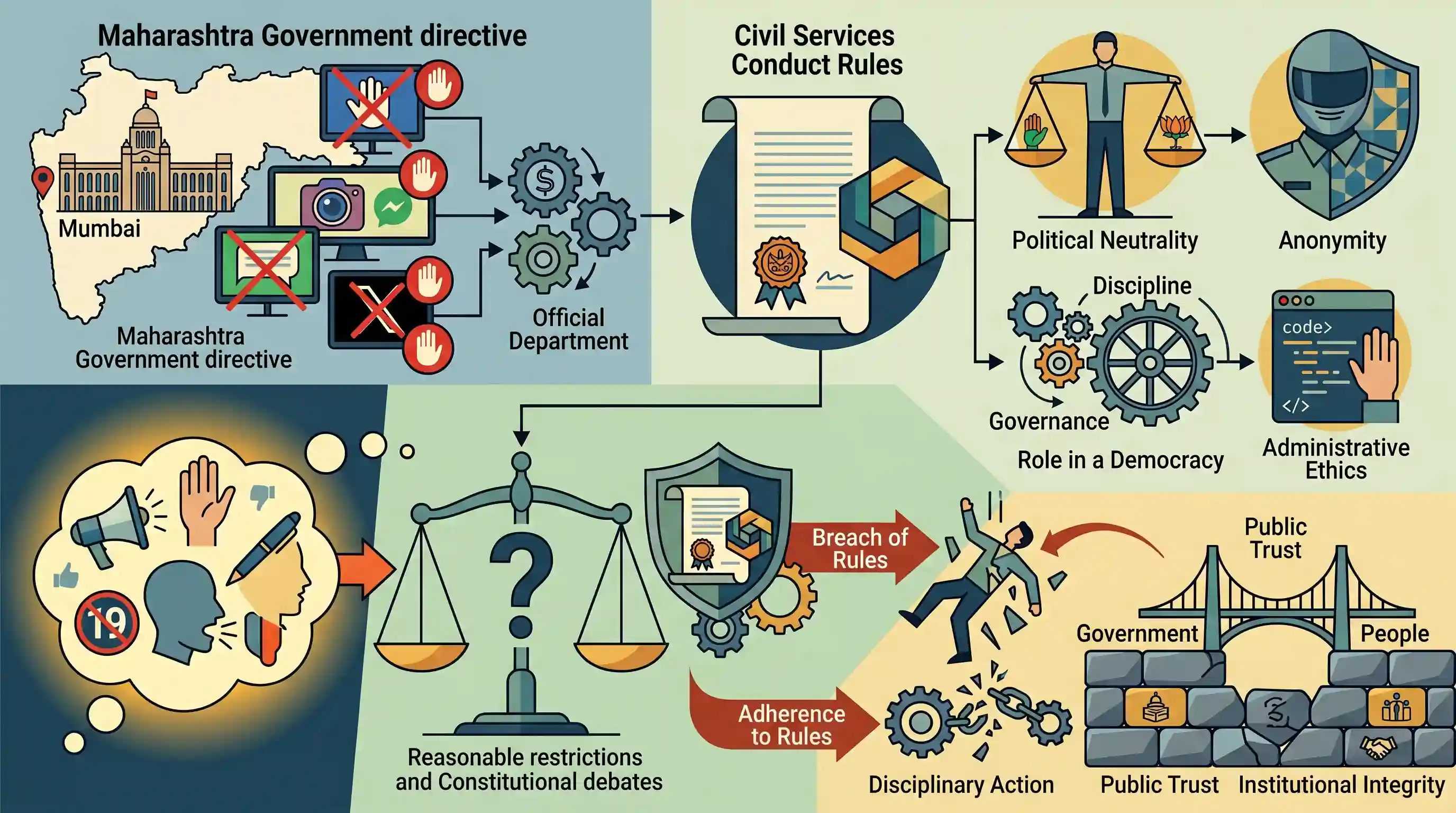
Why It Matters
It highlights the essential conflict between individual constitutional rights and professional codes of conduct, illustrating the critical principles of civil service neutrality, anonymity, and discipline required in democratic governance.
Summary
The Maharashtra government has directed its employees to refrain from criticizing official government policies on social media. This directive aligns with established civil service conduct rules across India, which require government personnel to maintain political neutrality, discipline, and anonymity in the public sphere. Such measures often raise constitutional debates regarding the extent to which a public servant's fundamental right to freedom of speech and expression (Article 19) can be reasonably restricted to ensure institutional integrity and public trust in governance.
Key Points
- The Maharashtra government issued directives prohibiting its employees from criticizing government policies on social media platforms.
- This restriction is rooted in the Civil Services (Conduct) Rules, which mandate that government servants must not make public statements or opinions that adversely criticize state or central policies.
- The directive sparks a debate over balancing a government employee's fundamental right to freedom of speech and expression (Article 19(1)(a)) with the necessity for administrative discipline and neutrality.
- Enforcing such rules is intended to preserve public trust in the administration by ensuring that civil servants are perceived as committed, objective, and politically impartial.
Important Terms
Maharashtra Civil Services (Conduct) Rules, 1979

Statutory framework governing the behavior and discipline of Maharashtra state employees, requiring political neutrality and recently restricting social media criticism of government policies to maintain institutional integrity.
UPSC context
GS Paper II & IV. Tests knowledge of state administrative rules and the balance between service discipline and fundamental rights.
Article 19(1)(a)
A fundamental right under the Indian Constitution granting citizens the freedom to express views through speech, writing, or digital media, including the right to propagate ideas.
UPSC context
GS Paper II (Fundamental Rights). Crucial for understanding the constitutional protections of speech and their application to public servants.
Reasonable Restrictions
Grounds under Article 19(2) permitting the State to limit free speech in the interest of sovereignty, security, public order, decency, or morality, provided the curbs are proportionate.
UPSC context
GS Paper II. Tests the ability to analyze how the state justifies curbs on liberties to protect broader national interests.
Political Neutrality
A core civil service value requiring officials to remain impartial and non-partisan, serving the elected government with fidelity regardless of its political ideology.
UPSC context
GS Paper IV (Ethics). Essential for the topic 'Role of Civil Services in a Democracy' and administrative impartiality.
Central Civil Services (Conduct) Rules, 1964
A comprehensive conduct code for central employees prohibiting unauthorized public criticism of policy and political affiliation to ensure discipline and public trust.
UPSC context
GS Paper IV. Used to discuss the ethical and legal standards expected from India’s permanent executive.
Administrative Ethics
Moral principles and professional standards, such as integrity and anonymity, guiding public officials to ensure transparent, fair, and accountable governance.
UPSC context
GS Paper IV. Central to 'Probity in Governance' and the ethical challenges of modern administration.
Prelims Trap
The Constitution empowers Parliament under Article 33 to restrict the fundamental rights of all civil servants.
Article 33 specifically applies to Armed Forces, police, and intelligence. Restrictions on regular civil servants flow from service rules under Article 309 and general Article 19(2) reasonable restrictions.
Static Concepts Connected
What are the key constitutional provisions governing civil servants in India?
- Article 309: Empowers Parliament and State Legislatures to regulate the recruitment and conditions of service of appointed persons.
- Article 310: Establishes the Doctrine of Pleasure, meaning civil servants hold office during the pleasure of the President or Governor.
- Article 311: Provides constitutional safeguards, ensuring no dismissal by an authority subordinate to the appointing authority or without fair inquiry.
What are the foundational ethical principles restricting civil servant speech?
- Political Neutrality: Bureaucrats must remain objectively unbiased and avoid political controversies, ensuring they can serve any ruling party with equal commitment.
- Principle of Anonymity: Civil servants must operate behind the scenes, leaving public defense of policies and parliamentary accountability to elected Ministers.
Cross-Topic Patterns
Conduct Rules vs Whistleblower Protection
The prohibition on criticizing government policies often clashes with a civil servant's duty to expose corruption, creating a tension tested in GS4 case studies involving the Whistleblowers Protection Act.
The 'Bureaucrat Influencer' phenomenon
Unregulated social media use by officers for personal branding undermines administrative anonymity. This connects to recent Election Commission crackdowns on officers filming Instagram reels during active duty.

Expect a Prelims statement comparing restriction of Fundamental Rights for armed forces (Art 33) versus regular civil servants (Art 309).
Linked PYQs · 4
Linked PYQs · 4
- 2024MainsGS2
The Doctrine of Democratic Governance makes it necessary that the public perception of the integrity and commitment of civil servants becomes absolutely positive. Discuss.
- 2020MainsGS2
Institutional quality is a crucial driver of economic performance". In this context suggest reforms in Civil Service for strengthening democracy.
- 2014MainsGS2
What do you understand by the concept "freedom of speech and expression"? Does it cover hate speech also ? Why do the films in India stand on a slightly different plane from other forms of expression ? Discuss.
- 2021MainsGS4
Identify five ethical traits on which one can plot the performance of a civil servant. Justify their inclusion in the matrix.
