Reforms 3.0 targets inclusive growth for Bharat economy
Source:The Hindu ↗
Why It Matters
The debate around 'Reforms 3.0' and shifting to a 'Bharat' growth model is central to GS Paper 3 (Economic Development), as it outlines the structural and policy shifts required for India to achieve sustained high growth rates while ensuring inclusivity and employment generation.
Summary
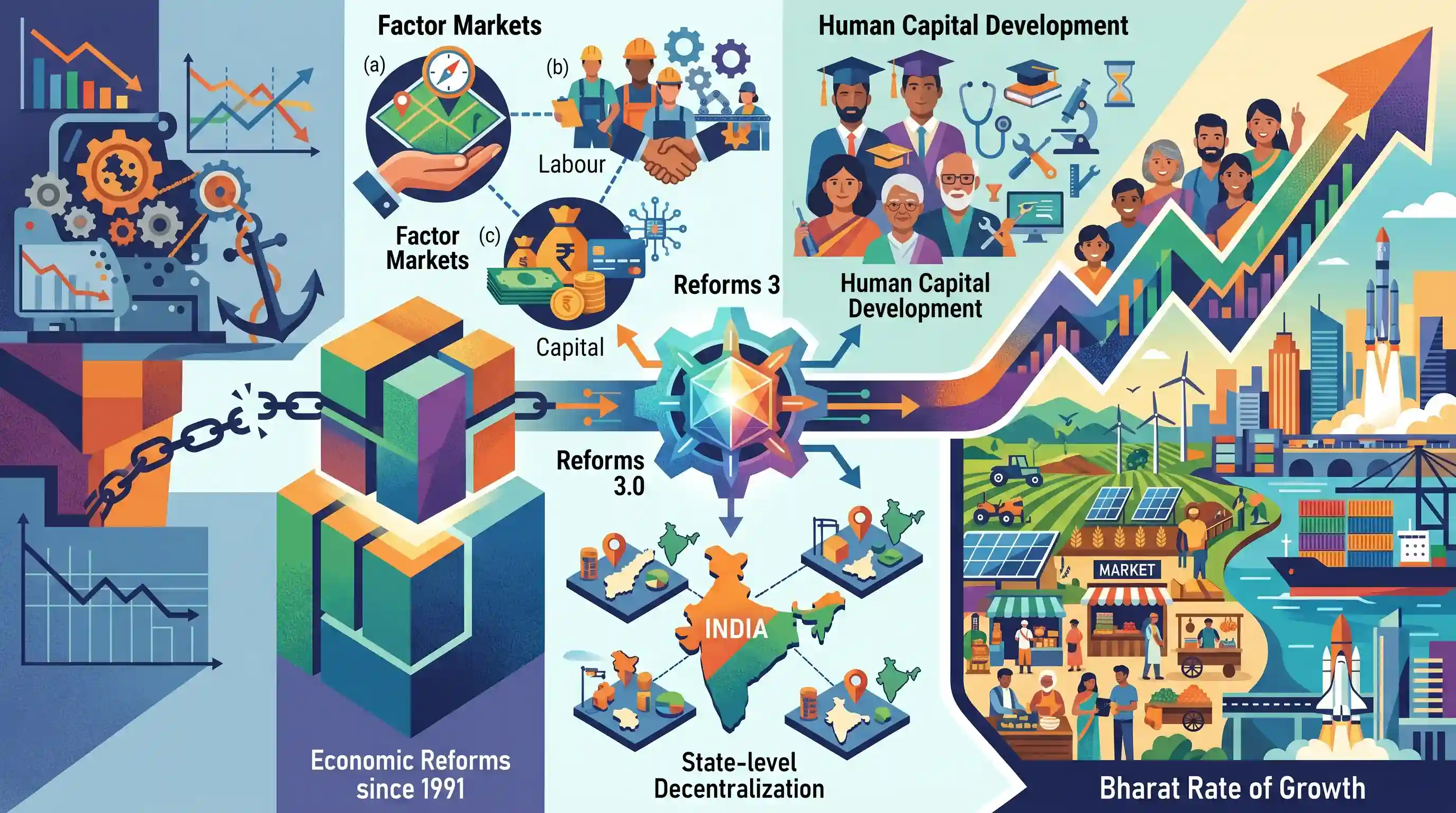
The article discusses the transition towards a 'Bharat rate of growth', a high and inclusive economic trajectory that moves past historical growth constraints. Achieving this requires 'Reforms 3.0', which focuses on factor market reforms (land, labour, and capital), human capital development, and state-level decentralisation. Emphasizing the rural and informal sectors ('Bharat'), these next-generation reforms aim to ensure that economic growth is not only robust but also broad-based and equitable.
Key Points
- The concept of a 'Bharat rate of growth' contrasts with the historical 'Hindu rate of growth', symbolising India's aspiration for a sustained, high, and inclusive economic growth trajectory.
- Reforms 3.0 represents the next generation of economic reforms necessary to achieve this potential, moving beyond product market liberalization to factor market reforms (land, labor, and capital).
- A critical component of this growth paradigm is bridging the urban-rural and formal-informal divides, ensuring that growth is generated by and benefits 'Bharat' (rural and agrarian India).
- State-level and decentralized reforms are essential, as the execution of factor market and governance reforms largely falls under the purview of state governments.
- Human capital development, including health, education, and skilling, is foundational to Reforms 3.0, enabling the demographic dividend to effectively participate in the modern economy.
Prelims Trap
The 1991 LPG reforms successfully deregulated both product and factor markets in India.
The 1991 reforms focused primarily on product markets (de-licensing, trade). Factor market reforms (land, labour) remain largely incomplete. UPSC often tricks candidates into attributing factor deregulation to 1991.
Static Concepts Connected
What distinguishes Factor Market reforms from Product Market reforms?
- Product Markets: Markets for final goods and services. Deregulated largely during the 1991 LPG reforms via industrial de-licensing and trade liberalization.
- Factor Markets: Markets for basic production inputs: land, labour, and capital. They remain heavily regulated in India, hindering manufacturing and formalization.
- Constitutional Hurdle: Reforming factor markets requires complex state-level consensus, as Land is a State subject and Labour is on the Concurrent List.
What does the 'Hindu Rate of Growth' signify in Indian economic history?
- Definition: A term coined by economist Raj Krishna to describe India's stagnant GDP growth rate of roughly 3.5% from the 1950s to the 1980s.
- Root Causes: Attributed to inward-looking, socialist-inspired import substitution policies and the heavy regulations of the License Raj.
- Per Capita Impact: Coupled with rapid population growth, this resulted in a dismal per capita income growth of just ~1.3% annually during this period.
Cross-Topic Patterns
Reforms 3.0 + Cooperative Federalism
Because land is on the State List and labour is on the Concurrent List, next-generation economic reforms mandate Centre-State coordination, shifting the execution burden to sub-national levels.
Structural transformation bottleneck
Agriculture employs ~46% of the workforce but yields only ~18% of GDP. Without factor reforms to absorb this disguised unemployment into manufacturing, India's demographic dividend risks becoming a demographic burden.

Expect a GS-3 question contrasting 1991 product market reforms with the decentralized factor market reforms required for Reforms 3.0.
Linked PYQs · 3
Linked PYQs · 3
- 2022MainsGS3
Is inclusive growth possible under market economy ? State the significance of financial inclusion in achieving economic growth in India.
- 2017MainsGS3
What are the salient features of 'inclusive growth'? Has India been experiencing such a growth process? Analyse and suggest measures for inclusive growth.
- 2017MainsGS3
Among several factors for India's potential growth, savings rate is the most effective one. Do you agree? What are the other factors available for growth potential?
