India Assumes Leadership of Multinational Maritime Task Force
Source:Indian Express ↗
Why It Matters
India's role in the Combined Maritime Forces reflects its increasing strategic footprint as a 'net security provider' in the Indian Ocean Region and the Middle East. It is highly relevant for GS2 (Bilateral/Multilateral groupings) and GS3 (Maritime Security).
Summary
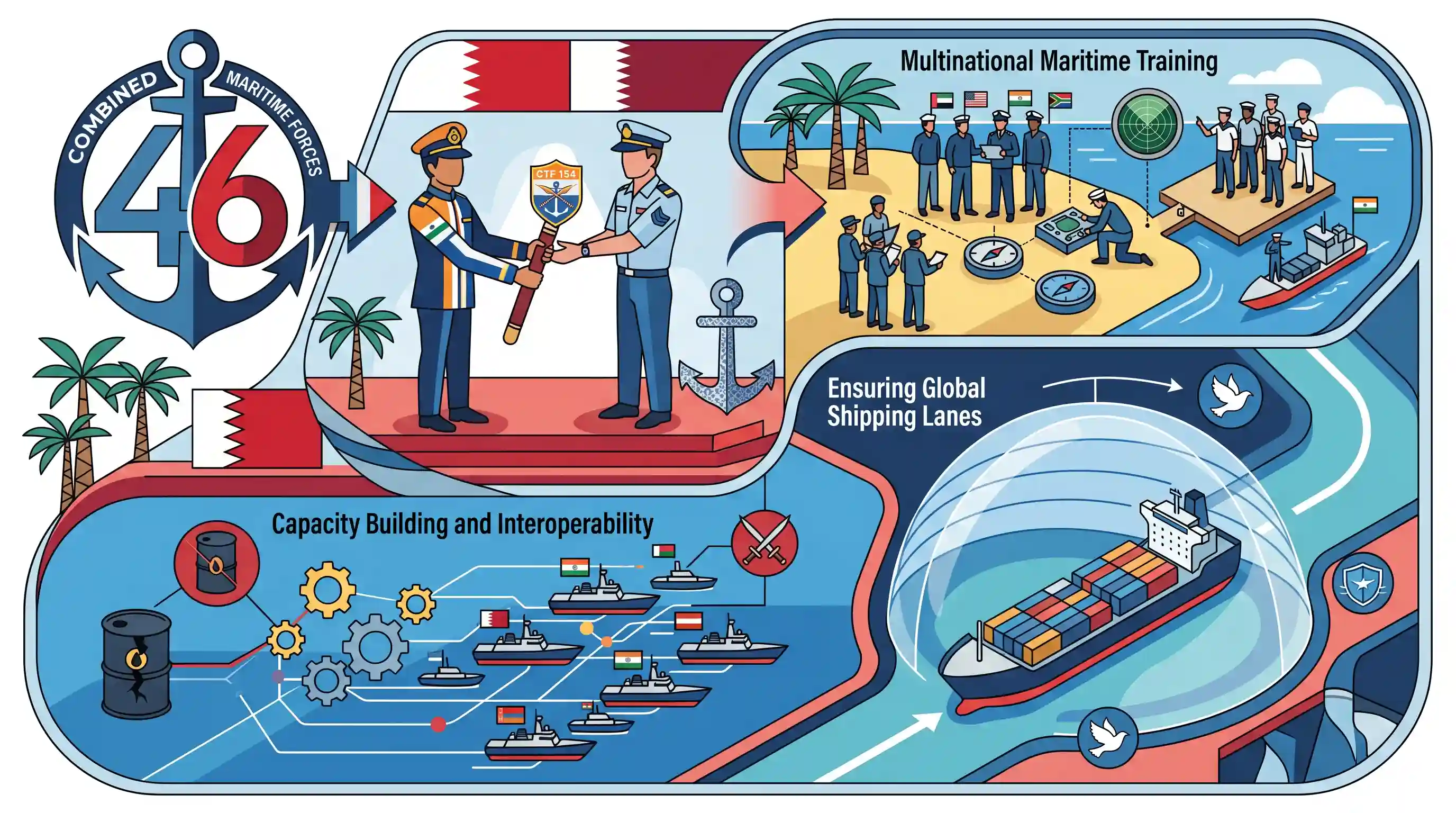
India has taken command of the Combined Task Force 154 (CTF 154), a multinational training task force operating under the 46-nation Combined Maritime Forces (CMF) based in Bahrain. This development underscores India's dedication to collaborative maritime security, capacity building, and ensuring interoperability among partner nations to protect vital global shipping lanes and maintain stability in the region.
Key Points
- The Indian Navy has assumed command of the Combined Task Force 154 (CTF 154), a multinational training task force.
- CTF 154 is a specialized unit under the Combined Maritime Forces (CMF), a 46-nation naval partnership headquartered in Bahrain.
- The task force is dedicated to enhancing maritime security, building capacity, and improving interoperability among partner naval forces in the region.
- The move highlights India's commitment to collaborative maritime security and its role in protecting vital global shipping lanes in the Middle East and surrounding waters.
Important Terms
Combined Maritime Forces (CMF)

The world's largest voluntary multinational naval partnership (47 nations), based in Bahrain, focused on counter-piracy, counter-narcotics, and upholding the international rules-based order at sea.
UPSC context
GS Paper II (International Relations); key multinational grouping for maritime diplomacy and security cooperation in the Indian Ocean Region.
Combined Task Force 154 (CTF 154)
A specialized training task force under the CMF, established in May 2023, dedicated to multinational maritime training and capacity building among partner nations.
UPSC context
GS Paper III (Internal Security); tests understanding of India's role in global maritime security and defense interoperability.
Maritime Domain Awareness (MDA)
The effective understanding of activities in the maritime domain that impact safety, security, or the environment; a core pillar of CTF 154's training programs.
UPSC context
GS Paper III (Security); critical for coastal security, intelligence sharing, and monitoring threats like piracy and illegal trafficking.
Preferred Security Partner
India's strategic status in the Indian Ocean and Middle East, signifying international trust in its naval capabilities and commitment to regional stability and capacity building.
UPSC context
GS Paper II (IR); relates to India's 'SAGAR' policy and its leadership role in the Indo-Pacific.
Interoperability
The ability of multinational military forces to operate together using shared standards, communication systems, and procedures to achieve common mission objectives.
UPSC context
GS Paper III (Defense); focuses on military modernization and effectiveness during joint exercises and multinational operations.
Prelims Trap
"CTF 154 is an operational combat force deployed for counter-piracy."
CTF 154 focuses exclusively on maritime training and capacity building. Operational combat and counter-piracy duties fall under other CMF task forces like CTF 151.
Static Concepts Connected
What are the key maritime chokepoints in the CMF's area of operation?
- Strait of Hormuz: Connects the Persian Gulf to the Gulf of Oman; a critical global oil transit route.
- Bab-el-Mandeb: Connects the Red Sea to the Gulf of Aden; a chokepoint highly vulnerable to regional instability (e.g., Houthi attacks).
- Suez Canal: Connects the Mediterranean Sea to the Red Sea, enabling the shortest direct maritime trade route between Europe and Asia.
What frameworks does India use to act as a Net Security Provider in the IOR?
- Capacity Building: Multinational coalitions (like the 46-nation CMF) where India trains partner navies to ensure interoperability and regional self-reliance.
- Information Fusion: Hosting the Information Fusion Centre for Indian Ocean Region (IFC-IOR) to share white-shipping data and improve regional maritime domain awareness.
- Regional Forums: The Indian Ocean Naval Symposium (IONS), a voluntary initiative seeking to increase maritime cooperation among the littoral states of the Indian Ocean Region.
Cross-Topic Patterns
US-India 2+2 Defense expansion
India's CMF membership originated from the 2022 India-US 2+2 dialogue, illustrating how bilateral defense diplomacy paves the way for India's integration into broader US-led multilateral security architectures.
SAGAR Doctrine and Capacity Building
Commanding a training-specific task force operationalizes India's SAGAR vision, shifting its role from routine patrols to institutionalized capacity building and establishing it as a Net Security Provider.

Expect a paired-matching question linking specific CMF task forces to their distinct roles (e.g., CTF 154 = training, CTF 151 = piracy).
Linked PYQs · 3
Linked PYQs · 3
- 2025MainsGS3
Why is maritime security vital to protect India's sea trade? Discuss maritime and coastal security challenges and the way forward.
- 2022MainsGS3
What are the maritime security challenges in India ? Discuss the organisational, technical and procedural initiatives taken to improve the maritime security.
- 2024MainsGS2
Discuss the geopolitical and geostrategic importance of Maldives for India with a focus on global trade and energy flows. Further also discuss how this relationship affects India's maritime security and regional stability amidst international competition ?
