Environmental Impacts of Computing Infrastructure and Green AI
Source:The Hindu ↗
Why It Matters
As AI becomes integral to global economies and governance, its rising environmental costs contradict global climate commitments. Understanding the intersection of digital technology and environmental sustainability is crucial for policymakers tasked with aligning tech-driven growth with net-zero targets.
Summary
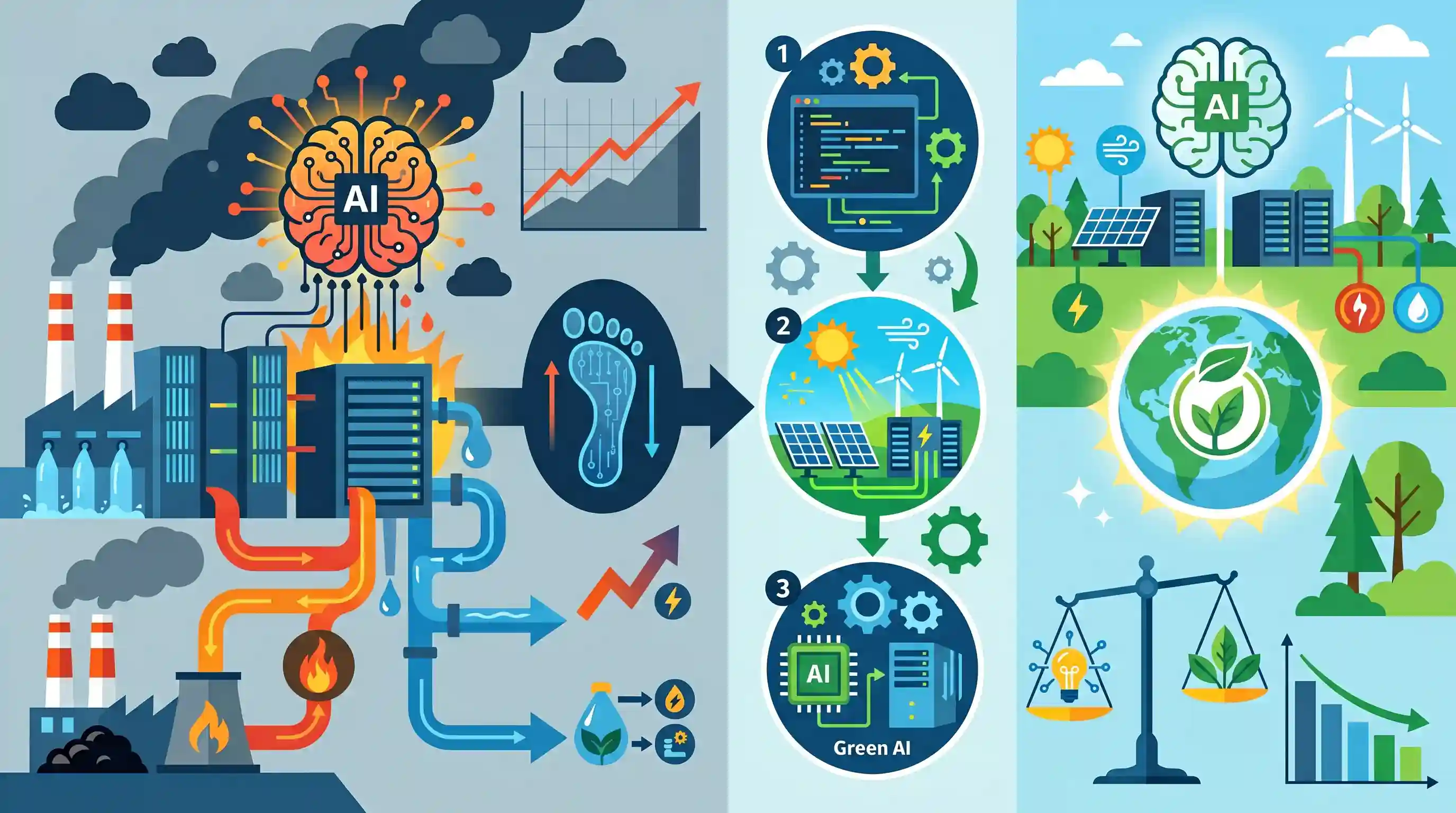
The rapid expansion of Artificial Intelligence (AI), particularly generative models, has brought its massive energy and resource consumption into sharp focus. Training and deploying these models require energy-intensive computing infrastructure and vast amounts of water for cooling data centers, substantially increasing the tech sector's carbon footprint. The article highlights the urgent need to address this environmental impact by shifting towards 'Green AI'—which entails optimizing algorithms, utilizing renewable energy, and designing energy-efficient hardware. Balancing digital innovation with global climate commitments is imperative to ensure that technological growth does not derail net-zero emission targets.
Key Points
- High Compute Intensity: Training and running modern AI models, especially large language models (LLMs), require significantly more computing power and electricity than traditional software processes.
- Data Center Emissions: The proliferation of AI applications is driving a massive expansion of data centers globally, leading to higher greenhouse gas emissions and straining local electricity grids.
- Water Footprint: AI infrastructure relies heavily on fresh water to cool servers, exacerbating regional water scarcity and presenting an often-overlooked environmental cost.
- Green AI Imperative: Mitigating the climate impact of AI necessitates optimizing algorithms for energy efficiency, utilizing specialized hardware, and powering data centers with renewable energy sources.
- Policy Alignment: There is a critical need for regulatory frameworks that mandate transparent environmental reporting for tech companies and incentivize the development of sustainable digital infrastructure to meet global net-zero targets.
Important Terms
Green AI

An approach to artificial intelligence development that prioritizes energy efficiency, resource optimization, and sustainability throughout the model's lifecycle to minimize its carbon and environmental footprint.
UPSC context
GS Paper 3 (Science & Tech/Environment). Tests awareness of sustainable innovation and the 'Green-in-AI' versus 'Green-by-AI' paradigms.
Generative AI (GenAI)
AI models capable of creating new content (text, images, video) based on learned data patterns. Their training and 'inference' phases demand massive computational power and cooling resources.
UPSC context
GS Paper 3 (Science & Tech). Examines the socio-environmental costs of emerging technologies and their impact on energy infrastructure.
Data Centers
Critical physical infrastructure housing servers and storage systems for the digital economy. They are high-intensity consumers of electricity and water, often likened to 21st-century 'refineries.'
UPSC context
GS Paper 3 (Infrastructure). Tests understanding of digital economy foundations and the 'resource-stress' they place on energy grids and water tables.
Net Zero Emissions
A state of carbon neutrality where the amount of greenhouse gases emitted into the atmosphere is balanced by an equivalent amount removed through sinks or technology.
UPSC context
GS Paper 3 (Environment). Vital for understanding India's 'Panchamrit' commitments (2070 target) and global climate mitigation strategies.
Paris Agreement
A legally binding 2015 international treaty aiming to limit global warming to well below 2°C. It relies on a bottom-up system of voluntary Nationally Determined Contributions (NDCs).
UPSC context
GS Paper 3 (Environment/Governance). Tests knowledge of international climate diplomacy and India's progress toward its self-determined climate goals.
Kyoto Protocol
A 1997 international treaty that set top-down, legally binding emission reduction targets primarily for industrialized nations, based on the principle of 'common but differentiated responsibilities.'
UPSC context
GS Paper 3 (Environment). Tests historical perspective on climate treaties and the shift from mandatory targets to universal participation.
Prelims Trap
Green AI focuses strictly on powering artificial intelligence operations with renewable energy sources.
It is a trap because Green AI also involves optimizing algorithms, adopting Small Language Models (SLMs), and designing energy-efficient hardware to reduce overall compute demand.
Static Concepts Connected
What are the primary metrics used to assess data center sustainability?
- Power Usage Effectiveness: Measures the ratio of total facility energy to IT equipment energy. An ideal PUE is 1.0, indicating all energy goes directly to computing.
- Carbon Usage Effectiveness: Quantifies the greenhouse gas emissions produced per unit of IT energy consumed, helping track the direct carbon footprint of data operations.
- Water Usage Effectiveness: Assesses the liters of water used for cooling equipment per kilowatt-hour of IT energy consumed, crucial for tracking water footprints.
Why is the extraction of Rare Earth Elements (REEs) environmentally hazardous?
- Toxic wastewater: Refining REEs generates highly toxic, often radioactive wastewater that can severely contaminate local soil and groundwater if not strictly managed.
- High water consumption: The extraction and separation processes require immense quantities of fresh water, often worsening regional water scarcity in mining areas.
- E-waste crisis: The rapid obsolescence of AI hardware (GPUs) limits REE recycling viability, compounding toxic electronic waste disposal challenges.
Cross-Topic Patterns
AI data centers + Urban water stress
India's major tech hubs like Bengaluru face acute water scarcity. The massive cooling requirements of AI data centers will increasingly conflict with urban drinking water needs.
AI hardware + Critical minerals geopolitics
The short 2-3 year lifecycle of high-performance GPUs accelerates demand for rare earth elements, tying AI's growth to vulnerabilities in global critical mineral supply chains dominated by China.

Expect a 2026 prelims question linking AI data center metrics (PUE, WUE) with urban water stress or India's critical mineral policies.
Linked PYQs · 4
Linked PYQs · 4
- 2020PrelimsGS1
With the present state of development, Artificial Intelligence can effectively do which of the following? 1. Bring down electricity consumption in industrial units 2. Create meaningful short stories and songs 3. Disease diagnosis 4. Text-to-Speech Conversion 5. Wireless transmission of electrical energy Select the correct answer using the code given below:
- 2023MainsGS3
Introduce the concept of Artificial Intelligence (AI). How does Al help clinical diagnosis? Do you perceive any threat to privacy of the individual in the use of Al in healthcare?
- 2022MainsGS3
Discuss global warming and mention its effects on the global climate. Explain the control measures to bring down the level of greenhouse gases which cause global warming, in the light of the Kyoto Protocol, 1997.
- 2022MainsGS3
Do you think India will meet 50 percent of its energy needs from renewable energy by 2030 ? Justify your answer. How will the shift of subsidies from fossil fuels to renewables help achieve the above objective ? Explain.
