GDP Base Year Revision and Fiscal Consolidation Impact
Source:Indian Express ↗
Why It Matters
Base year revisions profoundly alter the official narrative regarding India's economic scale and fiscal health. Understanding the mathematical relationship between the absolute GDP (denominator) and critical ratios like the fiscal deficit and debt-to-GDP is essential for answering GS3 questions on government budgeting and fiscal policy.
Summary
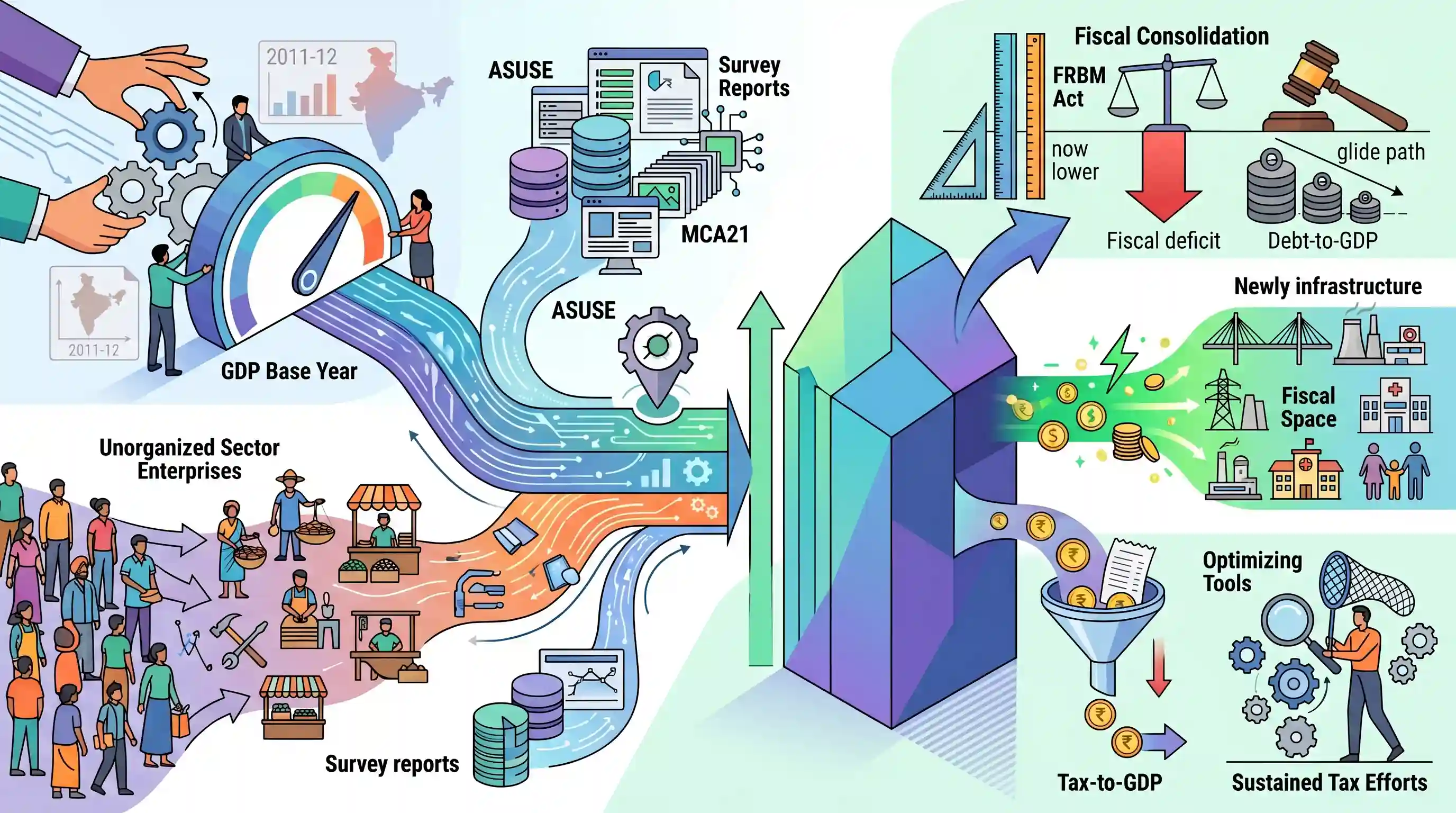
The impending revision of India’s GDP base year—expected to be implemented around 2026—will structurally alter the country's macroeconomic and fiscal landscape. By shifting the base year from 2011-12 and integrating comprehensive new datasets like the Annual Survey of Unincorporated Sector Enterprises (ASUSE) and the MCA21 database, the absolute size of India's nominal GDP is projected to increase. This reset will serve as a 'fiscal game changer' because a larger GDP denominator automatically reduces the fiscal deficit and debt-to-GDP ratios. Consequently, the government will secure additional fiscal space to fund capital and social expenditures while comfortably adhering to the consolidation glide path outlined by the FRBM Act. However, this statistical expansion will also mechanically lower the tax-to-GDP ratio, requiring sustained policy efforts to improve actual tax collections.
Key Points
- India is preparing for a macroeconomic reset around 2026 with an anticipated revision of the GDP base year from 2011-12 to a more recent baseline (likely 2022-23 or 2023-24).
- The revised computation will integrate newer, broader data sources including the Annual Survey of Unincorporated Sector Enterprises (ASUSE), the Household Consumption Expenditure Survey (HCES), and the MCA21 corporate database, capturing more informal and undocumented economic activity.
- Because this broader measurement will expand the absolute size of the nominal GDP, it acts as a larger denominator for macroeconomic ratios, making the revision a major 'fiscal game changer'.
- The expanded GDP denominator will mathematically shrink the fiscal deficit-to-GDP and debt-to-GDP ratios, easing the government's path to fiscal consolidation and compliance with the FRBM Act targets without demanding steep expenditure cuts.
- Conversely, the tax-to-GDP ratio will appear mechanically lower, emphasizing the need for the government to maintain structural tax buoyancy rather than relying on statistical optics.
Important Terms
Fiscal Responsibility and Budget Management (FRBM) Act

A 2003 law mandating fiscal discipline in India by setting targets for reducing fiscal deficits and public debt to ensure long-term macroeconomic stability.
UPSC context
GS Paper III: Fiscal Policy. Tests understanding of deficit targets, consolidation glide paths, and 'escape clauses' during economic shocks.
Annual Survey of Unincorporated Sector Enterprises (ASUSE)
A MoSPI survey measuring economic characteristics (GVA, employment) of unincorporated non-agricultural enterprises, providing crucial data for estimating the contribution of India's informal economy to GDP.
UPSC context
GS Paper III: Indian Economy and Informal Sector. Essential for understanding data-driven policy for the unorganized sector.
MCA21 Database
An e-governance platform of the Ministry of Corporate Affairs that captures electronic financial filings from companies, serving as a primary data source for calculating the organized sector's GDP.
UPSC context
GS Paper III: GDP Calculation Methodology. Relevant for debates on the accuracy and reliability of modern economic indicators.
Base Year Revision
The benchmark year used as a reference to calculate real GDP; periodic shifts (e.g., to 2022-23) help capture structural changes and new economic activities.
UPSC context
GS Paper III: National Income Accounting. Tests conceptual clarity on real vs nominal GDP and statistical accuracy.
Fiscal Consolidation
Government strategies aimed at reducing fiscal deficits and stabilizing public debt through revenue enhancement and expenditure rationalization to improve sovereign creditworthiness.
UPSC context
GS Paper III: Government Budgeting. Vital for analyzing the balance between growth-oriented spending and fiscal stability.
Debt-to-GDP Ratio
A metric comparing a country's public debt to its total economic output; it indicates the government's ability to pay back its debt without further borrowing.
UPSC context
GS Paper III: Macroeconomic Indicators. Critical for assessing debt sustainability and the impact of GDP rebasing on fiscal health.
Prelims Trap
An upward revision of the GDP base year mechanically increases the tax-to-GDP ratio.
It actually lowers the tax-to-GDP ratio. Because nominal GDP (the denominator) expands while absolute tax collections remain unchanged, the resulting fraction mathematically shrinks.
Static Concepts Connected
Why are GDP base years periodically revised by MoSPI?
- Structural reflection: To capture changing economic structures, new products, and integrate modernized datasets (like MCA21 for corporates or ASUSE for the informal sector).
- Real vs Nominal: To reset the price index reference, ensuring 'Real GDP' accurately reflects volume growth without extreme historical price distortions.
- Global standards: To align national accounting practices with the latest UN System of National Accounts (SNA) guidelines.
What is the 'Denominator Effect' in fiscal consolidation?
- The Math: Fiscal indicators like debt and deficit are expressed as a percentage of nominal GDP. A larger GDP denominator mathematically shrinks these ratios.
- FRBM compliance: It allows the government to meet strict FRBM Act deficit targets on paper without actually cutting absolute capital or welfare expenditure.
- Tax optics: Conversely, a larger denominator artificially lowers the tax-to-GDP ratio, meaning governments must achieve higher structural tax buoyancy to compensate.
Cross-Topic Patterns
National Accounts + Unorganized Sector
Integrating the Annual Survey of Unincorporated Sector Enterprises (ASUSE) into national accounts links GDP computation to formalization themes like e-Shram, Udyam, and MSME credit gaps.
Denominator Effect + Finance Commission
A mechanically lowered tax-to-GDP ratio impacts the narrative of state vs. center fiscal capacity, indirectly influencing the 16th Finance Commission's tax devolution calculus.

Expect a 2026 prelims multi-statement question isolating the 'denominator effect' of the new GDP base year on tax, debt, and fiscal ratios.
Linked PYQs · 5
Linked PYQs · 5
- 2021MainsGS3
Explain the difference between computing methodology of India's Gross Domestic Product (GDP) before the year 2015 and after the year 2015.
- 2018PrelimsGS1
Consider the following statements: 1. The Fiscal Responsibility and Budget Management (FRBM) Review Committee Report has recommended a debt to GDP ratio of 60% for the general (combined) government by 2023, comprising 40% for the Central Government and 20% for the State Governments. 2. The Central Government has domestic liabilities of 21% of GDP as compared to that of 49% of GDP of the State Governments. 3. As per the Constitution of India, it is mandatory for a State to take the Central Government's consent for raising any loan if the former owes any outstanding liabilities to the latter. Which of the statements given above is/are correct?
- 2020PrelimsGS1
Along with the Budget, the Finance Minister also places other documents before the Parliament which include 'The Macro Economic Framework Statement'. The aforesaid document is presented because this is mandated by
- 2013MainsGS3
What were the reasons for the introduction of Fiscal Responsibility and Budget Management (FRBM) Act, 2003 ? Discuss critically its salient features and their effectiveness.
- 2015PrelimsGS1
With reference to Indian economy, consider the following statements : 1. The rate of growth of Real Gross Domestic Product has steadily increased in the last decade. 2. The Gross Domestic Product at market prices (in rupees) has steadily increased in the last decade. Which of the statements given above is/are correct?
