Red Fort Blast and NIA Probe into CrossBorder Terror Networks
Source:Indian Express ↗
Why It Matters
Understanding cross-border terrorism and the role of agencies like the NIA is a core component of the GS3 Internal Security syllabus. The article provides a contemporary example of how external state and non-state actors orchestrate attacks on symbolic targets and how India's counter-terrorism apparatus responds.
Summary
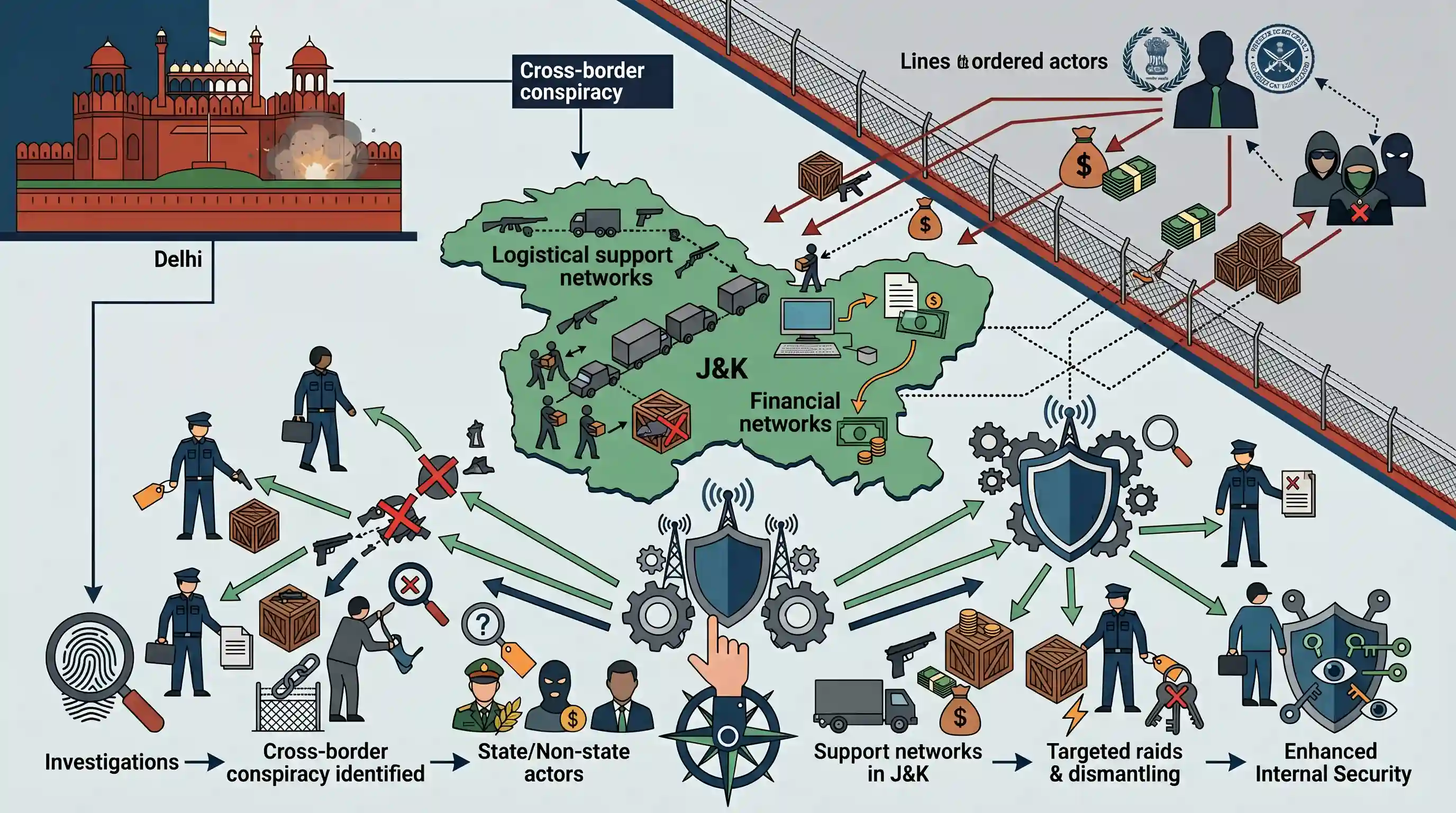
The National Investigation Agency (NIA) conducted multiple raids across Jammu and Kashmir as part of its ongoing investigation into the Red Fort blast. The probe has revealed a larger cross-border conspiracy, highlighting the persistent threat of state and non-state actors operating from outside the country. By targeting logistical and financial networks in J&K, the NIA aims to dismantle the infrastructure supporting these terror activities. The development emphasizes the critical role of central agencies in safeguarding India's internal security from externally sponsored terrorism.
Key Points
- The National Investigation Agency (NIA) has been carrying out extensive raids across Jammu and Kashmir regarding the Red Fort blast probe.
- Investigations indicate a larger cross-border conspiracy aimed at destabilizing internal security and targeting significant national heritage sites.
- The raids focus on dismantling terror networks, sleeper cells, and logistical support systems facilitating such cross-border terrorist activities.
- This underscores the crucial role of federal agencies like the NIA in countering externally sponsored terrorism and protecting India's sovereignty.
Important Terms
National Investigation Agency (NIA)

India’s premier central counter-terrorism agency established under the Ministry of Home Affairs. It investigates offences affecting national sovereignty, security, and integrity without requiring state government permission.
UPSC context
GS Paper III (Internal Security); essential for questions on the mandate and role of central security agencies.
NIA Act
The 2008 law establishing the NIA, amended in 2019 to grant extraterritorial jurisdiction and include cyber-terrorism, human trafficking, and counterfeit currency as scheduled offences.
UPSC context
GS Paper II (Governance) and III (Security); tests knowledge of legal frameworks for national security.
Unlawful Activities (Prevention) Act (UAPA)
India’s primary anti-terror law (1967) used to prosecute "unlawful activities" and "terrorist acts." It allows the designation of individuals as terrorists and provides for extended detention.
UPSC context
GS Paper II and III; tests understanding of anti-terror legislation and its impact on fundamental rights.
Cross-border Terrorism
A form of terrorism where militants receive training, funding, or sanctuary in one country to carry out attacks in another, often as a proxy war strategy.
UPSC context
GS Paper III (Internal Security); critical for analyzing security threats in Jammu & Kashmir and border regions.
Non-State Actors
Individuals or groups (e.g., terrorist outfits, insurgent groups) that operate independently of any sovereign state but significantly impact national and international security.
UPSC context
GS Paper III (Internal Security); tests the ability to categorize multi-dimensional threats to the state.
Prelims Trap
"The NIA requires the prior consent of the respective State Government to investigate cases."
Under the NIA Act, 2008, the agency has concurrent jurisdiction and can take suo motu cognizance of scheduled offenses anywhere in India without prior state consent.
Static Concepts Connected
What are the key features of the NIA (Amendment) Act, 2019?
- Extraterritorial reach: Empowers the agency to investigate scheduled offenses committed outside India, subject to international treaties and domestic laws of other countries.
- Expanded offenses: Added human trafficking, counterfeit currency, manufacture/sale of prohibited arms, cyber-terrorism, and Explosive Substances Act offenses to the schedule.
- Special Courts: Allows the Central and State governments to designate Sessions Courts as Special Courts for conducting faster trials of NIA cases.
How do Over Ground Workers (OGWs) sustain cross-border terrorism?
- Logistical backbone: They provide safe houses, arrange transport, and manage weapons caches for active militants, seamlessly blending into society to avoid direct security radar.
- Funding conduits: They facilitate terror financing by routing money through hawala networks, shell businesses, and cross-border narco-trade operations.
- Tactical intelligence: They act as local eyes and ears, monitoring security force movements and identifying soft targets for future strikes.
Cross-Topic Patterns
NIA powers vs Asymmetric Federalism
The NIA's suo motu jurisdiction without state consent frequently triggers GS2 center-state relations debates, contrasting sharply with the CBI's general consent requirements under the DSPE Act.
Heritage sites as terror targets
Attacking symbols of sovereignty like the Red Fort bridges GS3 Internal Security with GS1 Architecture, highlighting the psychological warfare tactics of cross-border terror modules.

Expect a 2026 Prelims question comparing the statutory backing, state consent rules, and extraterritorial powers of NIA, ED, and CBI.
Linked PYQs · 4
Linked PYQs · 4
- 2021MainsGS3
Analyse the multidimensional challenges posed by external state and non-state actors, to the internal security of India. Also discuss measures required to be taken to combat these threats.
- 2020MainsGS3
Analyze internal security threats and transborder crimes along Myanmar, Bangladesh and Pakistan borders including Line of Control (LoC). Also discuss the role played by various security forces in this regard.
- 2019MainsGS3
Indian Government has recently strengthened the anti-terrorism laws by amending the Unlawful Activities (Prevention) Act (UAPA), 1967 and the NIA Act. Analyze the changes in the context of prevailing security environment while discussing the scope and reasons for opposing the UAPA by human rights organizations.
- 2025MainsGS3
Terrorism is a global scourge. How has it manifested in India? Elaborate with contemporary examples. What are the counter measures adopted by the State? Explain.
