Red Fort Blast Investigation and Drone Technology Threat
Source:The Hindu ↗
Why It Matters
The incident illustrates the evolving nature of terrorism, specifically the weaponization of commercial technology like drones by non-state actors. It is highly relevant for GS Paper 3 questions regarding internal security threats, asymmetric warfare, and the mandate/efficacy of specialized counter-terrorism agencies like the NIA in mitigating such emerging risks.
Summary
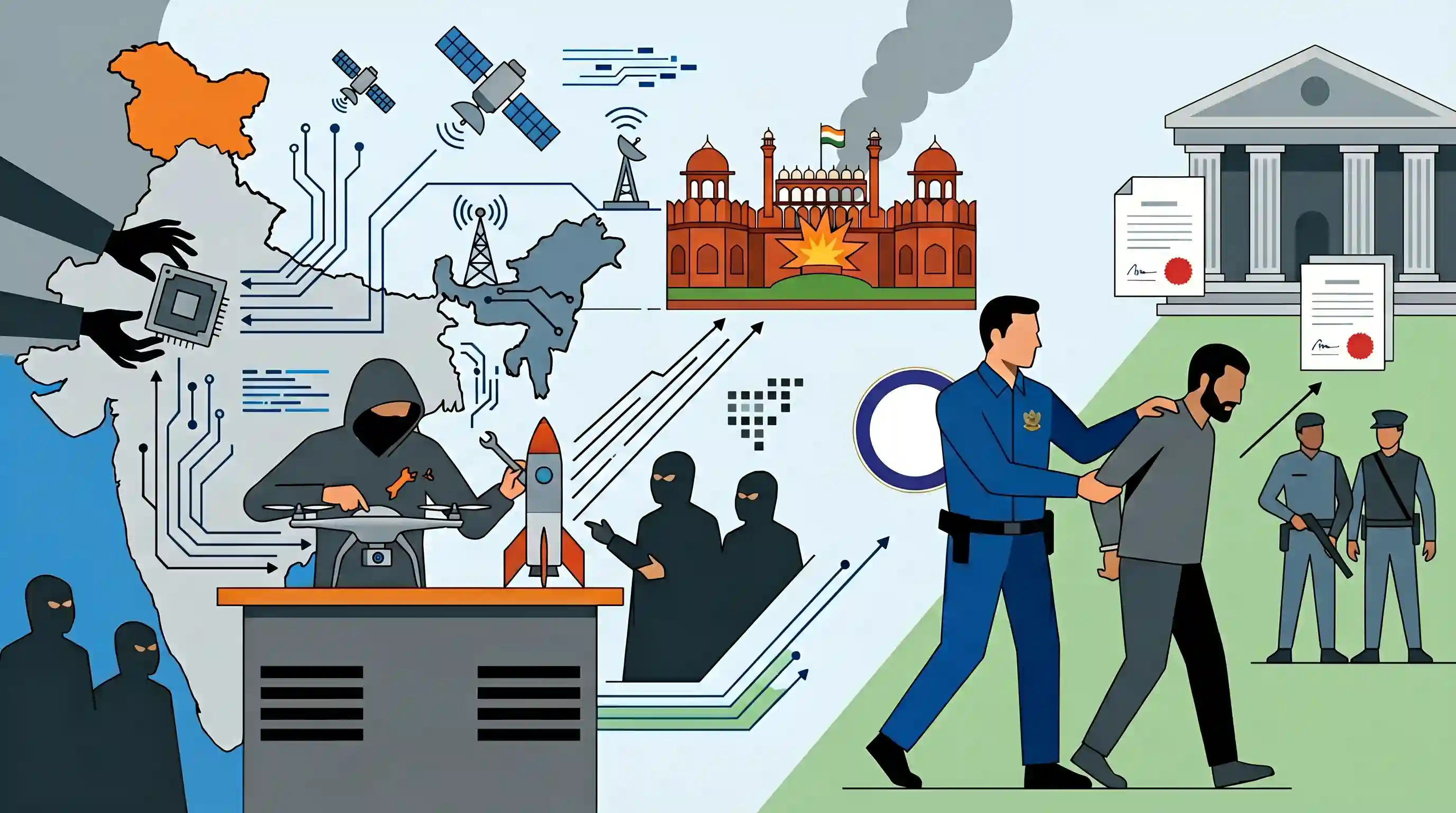
The National Investigation Agency (NIA) has secured a seven-day remand for Jasir Bilal Wani, a key accused in the Red Fort blast case. Wani, a resident of Anantnag, was arrested in Srinagar for allegedly modifying drones and attempting to manufacture rockets to facilitate the November 10 terror attack. This development highlights the evolving modus operandi of terrorist groups, particularly the increasing reliance on drone technology and specialized technical support for orchestrating asymmetric attacks, thereby compounding India's internal security challenges.
Key Points
- A Delhi court remanded Jasir Bilal Wani, a key accused in the Red Fort blast case, to seven-day custody of the National Investigation Agency (NIA).
- Wani was arrested in Srinagar for allegedly providing technical support for the terror attack.
- He is accused of modifying drones and attempting to manufacture rockets ahead of the November 10 blast at the Red Fort.
- The case underscores the growing use of off-the-shelf and modified drone technology by terror operatives, presenting a new dimension to internal security threats.
Important Terms
National Investigation Agency (NIA)

India's premier federal counter-terrorism agency, established under the NIA Act, 2008. It investigates and prosecutes offences affecting national sovereignty, security, and integrity across state boundaries without requiring prior state consent.
UPSC context
GS Paper III: Internal Security/Security Forces. Tests knowledge of the federal security architecture and the agency's mandate in counter-terrorism.
Patiala House Court
A primary venue in New Delhi for designated NIA Special Courts. These courts are established under the NIA Act to ensure the speedy trial of terror-related scheduled offences.
UPSC context
GS Paper II: Judiciary/Governance. Relevant for understanding the legal and judicial mechanisms for handling high-profile internal security cases.
Asymmetric Warfare
Conflict where parties' resources/capabilities differ significantly, leading the weaker party (often non-state actors) to use unconventional tactics, such as drone-based attacks or IEDs, to bypass conventional military strength.
UPSC context
GS Paper III: Internal Security. Tests the ability to analyze evolving terror tactics and the technological shift in modern security threats.
Unmanned Aerial Vehicles (UAVs)
Commonly known as drones, these are pilotless aircraft used by both state and non-state actors. In a security context, they are increasingly utilized for surveillance and as delivery platforms for explosives.
UPSC context
GS Paper III: Science & Tech and Internal Security. Focuses on the dual-use nature of technology and its implications for border and internal security.
Unlawful Activities (Prevention) Act (UAPA)
India's primary anti-terror legislation designed to provide effective prevention of unlawful activities. It empowers the government to designate individuals as terrorists and provides the legal basis for NIA investigations.
UPSC context
GS Paper II & III: Governance and Security. Vital for understanding the legal framework governing national security and civil liberties.
Scheduled Offences
A list of specific crimes under various laws (e.g., Atomic Energy Act, UAPA) found in the NIA Act's schedule. The NIA has exclusive jurisdiction to investigate these offences.
UPSC context
GS Paper III: Internal Security. Relates to the jurisdiction and statutory powers of central investigative agencies.
Prelims Trap
NIA requires prior permission from the respective State DGP to conduct searches and seize terror-linked properties.
The NIA is a central agency empowered by the NIA Act to investigate scheduled offences, conduct raids, and seize properties anywhere in India without prior state permission.
Static Concepts Connected
What offences were added to the NIA's jurisdiction in the 2019 Amendment?
- Cyber-terrorism: Investigations into offences under Section 66F of the Information Technology Act.
- Explosives: Jurisdiction to probe offences under the Explosive Substances Act, 1908 (crucial for IED and rocket cases).
- Trafficking & Smuggling: Human trafficking, manufacture/sale of prohibited arms, and offences related to counterfeit currency.
- Extra-territorial Jurisdiction: Subject to international treaties and domestic laws of other countries, the NIA can now investigate scheduled offences committed outside India.
How does India regulate and counter rogue drone threats?
- NPNT Framework: DGCA mandates software firewalls ensuring a drone cannot fly without valid digital permission.
- C-UAS Deployment: National Counter Rogue Drone Guidelines (2019) propose Full-scale, Mid-segment, and Basic models based on an asset's strategic vulnerability.
Cross-Topic Patterns
Drone weaponization + Border Smuggling
The weaponization of commercial drones by terror modules mirrors the ongoing cross-border challenge of drones dropping drugs and small arms in Punjab and J&K, linking hinterland terrorism to border management.
DIY Tech + Asymmetric Warfare
The modification of off-the-shelf tech highlights a shift toward low-cost, decentralized asymmetric attacks, challenging traditional signal intelligence and perimeter security.

Expect a Mains question linking DIY drone tech to asymmetric warfare, or a Prelims MCQ on the NIA's 2019 expanded scheduled offences.
Linked PYQs · 4
Linked PYQs · 4
- 2019MainsGS3
Indian Government has recently strengthened the anti-terrorism laws by amending the Unlawful Activities (Prevention) Act (UAPA), 1967 and the NIA Act. Analyze the changes in the context of prevailing security environment while discussing the scope and reasons for opposing the UAPA by human rights organizations.
- 2021MainsGS3
Analyse the complexity and intensity of terrorism, its causes, linkages and obnoxious nexus. Also suggest measures required to be taken to eradicate the menace of terrorism.
- 2023MainsGS3
The use of unmanned aerial vehicles (UAVs) by our adversaries across the borders to ferry arms/ammunitions, drugs, etc., is a serious threat to the internal security. Comment on the measures being taken to tackle this threat.
- 2023MainsGS3
What are the internal security challenges being faced by India? Give out the role of Central Intelligence and Investigative Agencies tasked to counter such threats.
