Richard Nixon Visit In 1953 And Cold War Roots Of India US Friction
Source:Indian Express ↗
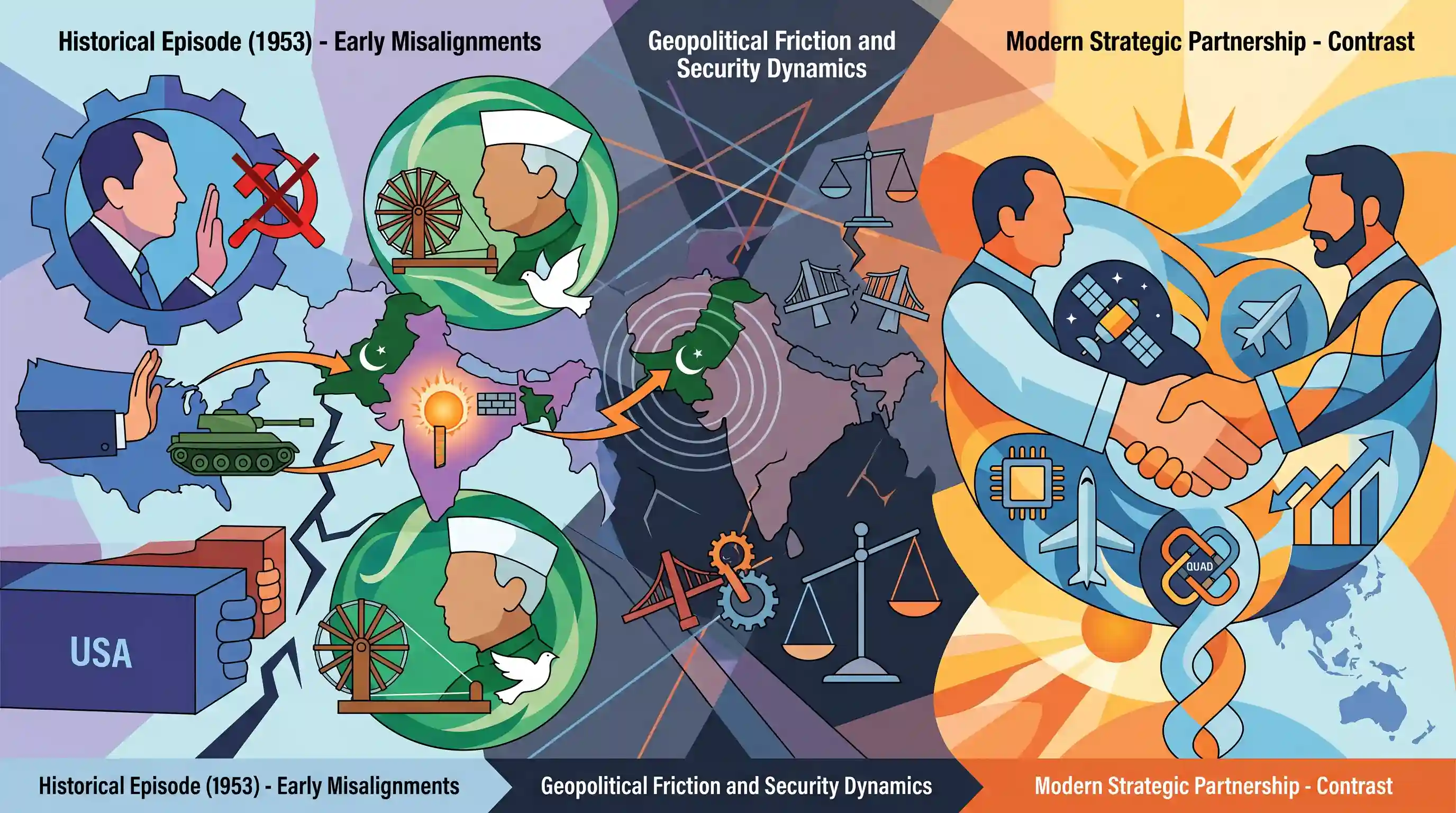
Why It Matters
Understanding the historical roots of India-US friction—particularly the US arming of Pakistan during the Cold War—provides essential context for analyzing the modern transformation of their bilateral ties into a comprehensive global strategic partnership.
Summary
The article reflects on the historic 1953 visit of US Vice-President Richard Nixon to India amidst the Cold War's 'Red Scare,' illustrating how differing worldviews between Washington and New Delhi shaped decades of geopolitics. Despite a grand reception, Nixon and Prime Minister Jawaharlal Nehru clashed over the threat of Communism; Nehru championed Non-Alignment, while Nixon demanded anti-communist solidarity. This ideological divide, coupled with Nixon's favorable impression of Pakistan's military leadership during the same trip, catalyzed the US decision to arm Pakistan. This historical episode serves as a reminder of how early misalignments in global strategy sowed long-standing friction in India-US relations, providing a stark contrast to the modern-day strategic partnership between the two nations.
Key Points
- In 1953, US Vice-President Richard Nixon visited India during a period dominated by Cold War anxieties and the domestic 'Red Scare' in America.
- Prime Minister Jawaharlal Nehru advocated for the Non-Aligned Movement (NAM) and a nuanced approach to global affairs, refusing to join the US-led anti-communist bloc.
- Nixon perceived India's neutral stance as morally ambiguous and was frustrated by Nehru's perceived dismissiveness towards the threat posed by the Communist bloc.
- During the same tour, Nixon visited Pakistan and was highly impressed by its military leadership, who enthusiastically aligned with US anti-communist objectives.
- Nixon's visit was a pivotal turning point that led to the US militarily backing Pakistan, fundamentally altering the South Asian security dynamic and causing decades of mistrust between India and the US.
- The historical context highlights the evolution of India-US ties, contrasting past friction over global strategy with today's deepening bilateral and strategic convergence.
Important Terms
Non-Aligned Movement (NAM)

An international forum of 120 developing nations not formally aligned with any major power bloc, established in 1961 to preserve sovereignty during the Cold War.
UPSC context
GS Paper II (International Relations); tests understanding of India's post-independence foreign policy, strategic autonomy, and leadership in the Global South.
Cold War
The period of geopolitical tension (1947–1991) between the US and USSR, which shaped global alliances and prompted India's policy of non-alignment.
UPSC context
GS Paper I (World History) and II (International Relations); evaluates how bipolarity influenced India's early diplomatic choices and security environment.
Red Scare
Periods of intense anti-communist paranoia in the US (notably the 1950s McCarthyism) that dictated aggressive "containment" policies and fueled diplomatic friction with non-aligned nations.
UPSC context
GS Paper II (International Relations); explains historical ideological barriers and the "estrangement" phase in India-US bilateral ties.
Strategic Partnership
The current framework of India-US relations characterized by deep cooperation in defense, critical technology (iCET), and maintaining a rules-based, free, and open Indo-Pacific.
UPSC context
GS Paper II (International Relations); vital for questions on bilateral groupings, technology transfers, and the shift from "estranged" to "comprehensive global" partners.
South Asian Security Dynamics
The complex interplay of military rivalries (India-Pakistan-China), nuclear deterrence, and non-traditional threats like terrorism that shape the regional stability of South Asia.
UPSC context
GS Paper II (International Relations); tests knowledge of regional geopolitics, neighborhood policy, and the impact of external superpower involvement in South Asia.
Prelims Trap
India's Non-Alignment meant strict neutrality and a refusal to engage with either Cold War superpower.
NAM was not passive neutrality or isolationism. It meant active engagement on global issues based on independent judgment, and India strategically engaged both blocs.
Static Concepts Connected
What were the US-led Cold War military alliances in Asia?
- SEATO (1954): Southeast Asia Treaty Organization aimed to block communist expansion. Pakistan joined primarily to secure US military hardware, deeply escalating South Asian tensions.
- CENTO (1955): Also known as the Baghdad Pact, focusing on the Middle East. Pakistan's membership cemented the US-Pakistan military nexus, estranging India.
How did Nehruvian Non-Alignment fundamentally differ from neutrality?
- Active Engagement: Unlike traditional neutrality (e.g., Switzerland), NAM involved proactive participation in global politics to de-escalate superpower tensions and promote peace.
- Strategic Autonomy: It ensured India retained sovereign decision-making on international issues based on merit, explicitly rejecting rigid, predefined bloc loyalties.
- Anti-colonial Focus: NAM carried a strong moral undertone, prioritizing global decolonization, racial equality, and anti-imperialism, which often frustrated Western powers.
Cross-Topic Patterns
From Cold War Estrangement to Quad
The historical US-Pakistan military nexus contrasts sharply with today's iCET and Quad, illustrating India's shift from Cold War ideological friction to pragmatic Indo-Pacific partnerships.
Nehruvian NAM to Modern Multi-alignment
Nehru’s 1950s refusal to join anti-communist blocs mirrors India’s modern multi-alignment (e.g., stance on Russia-Ukraine), proving 'strategic autonomy' remains the enduring DNA of Indian diplomacy.

Mains GS2 will likely test the evolution of India-US ties, contrasting Cold War estrangement (SEATO/CENTO) with modern Quad alignment.
Linked PYQs · 2
Linked PYQs · 2
- 2019MainsGS2
‘What introduces friction into the ties between India and the United States is that Washington is still unable to find for India a position in its global strategy, which would satisfy India's national self-esteem and ambitions.’ Explain with suitable examples.
- 2025MainsGS1
Trace India's consolidation process during early phase of independence in terms of polity, economy, education and international relations.
