Bureaucratic Bottlenecks in Scientific Research Funding
Source:The Hindu ↗
Why It Matters
Provides an excellent case study for Mains GS2 (Bureaucracy vs. Development) and GS3 (Challenges in the S&T Ecosystem). It highlights how backend governance reforms (like the Treasury Single Account system) can inadvertently disrupt scheme delivery and exacerbate gender inequities in STEM fields if not managed with proper contingencies.
Summary
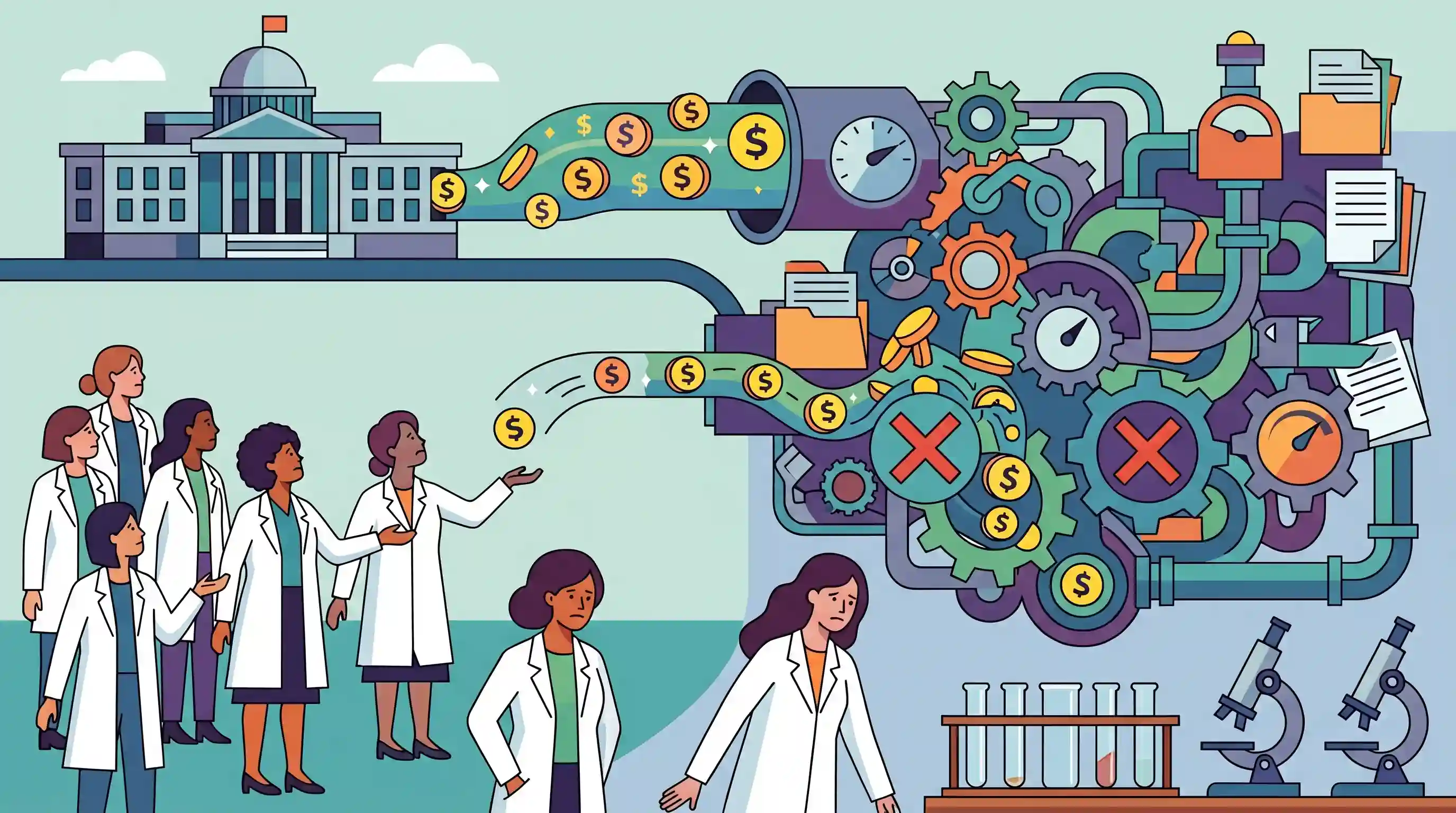
The article critiques the chronic administrative delays and bureaucratic bottlenecks plaguing India's scientific research ecosystem, using the recent plight of 75 women scientists under the Department of Biotechnology’s Biocare programme as a focal point. Delays in releasing salaries and grants—attributed to the government's transition to the Treasury Single Account system—expose deeper systemic flaws in public fund management for science. These administrative disruptions disproportionately affect women and early-career researchers, ultimately undermining India's R&D credibility and driving away scientific talent.
Key Points
- 75 women scientists selected under the DBT's Biocare programme are experiencing prolonged delays in receiving their sanction letters and salaries.
- The immediate cause of the delay is the government's transition to the Treasury Single Account system, illustrating a lack of contingency planning during backend administrative transitions.
- Cumbersome bureaucracy, labyrinthine grant applications, and erratic access to funds act as major structural roadblocks in India's R&D ecosystem.
- Funding disruptions disproportionately impact vulnerable cohorts like women and early-career researchers, harming India's scientific credibility and ability to retain talent.
Important Terms
BioCARe Programme

A DBT scheme supporting unemployed or early-career women scientists with research grants and salaries. It aims to re-orient and retain female talent in biotechnology research.
UPSC context
GS Paper 1 (Social Issues) and Paper 3 (S&T); tests gender equity and science policy.
Treasury Single Account (TSA)
A financial management reform that consolidates government bank accounts into a single structure. It ensures "just-in-time" fund releases and prevents the buildup of idle public money.
UPSC context
GS Paper 3 (Economy); relevant for public financial management and administrative transparency.
Department of Biotechnology (DBT)
A central agency under the Ministry of Science and Technology. It drives India's biotechnology sector through R&D funding, infrastructure, and international collaborations.
UPSC context
GS Paper 3 (S&T); tests knowledge of institutional frameworks driving scientific innovation.
Public Financial Management System (PFMS)
A digital platform managed by the Controller General of Accounts for tracking, accounting, and disbursing government funds. It provides the infrastructure for TSA and Direct Benefit Transfer.
UPSC context
GS Paper 2 (E-Governance); key to understanding leakage-free welfare delivery.
Gross Expenditure on Research and Development (GERD)
The total amount spent by both public and private sectors on research and development. India’s GERD is currently low, around 0.6% to 0.7% of GDP.
UPSC context
GS Paper 3 (Economy/S&T); evaluates India's global competitiveness in innovation.
Prelims Trap
"The BioCARe programme is implemented by the Ministry of Women and Child Development to empower rural women."
BioCARe is specifically for women scientists (often those with career breaks), and it is administered by the Department of Biotechnology, not MWCD.
Static Concepts Connected
What is the Treasury Single Account (TSA) system?
- Definition: A unified banking structure maintained at the RBI, offering a consolidated view of the government's cash balances at any given time.
- PFMS integration: Utilizes the Public Financial Management System (PFMS) to enable 'just-in-time' fund releases to autonomous bodies, preventing idle parking of funds.
- Core objective: Reduces unnecessary government borrowing costs and enhances fiscal transparency by tightly controlling actual cash outflows.
Why is India's R&D expenditure historically low and stagnant?
- Low private share: Unlike global leaders where private enterprise drives over 65% of R&D, India's private sector contribution remains stubbornly below 40%.
- Stagnant GDP share: Overall spending has stagnated at roughly 0.65% of GDP for two decades, far missing the long-standing national policy target of 2%.
- Bureaucratic bottlenecks: Complex grant application procedures, bureaucratic red tape, and delayed disbursements actively discourage sustained research and institutional capacity building.
Cross-Topic Patterns
Digital governance vs. vulnerable cohorts
The STEM 'leaky pipeline' (Society) is actively worsened by backend e-governance transitions (PFMS/TSA), illustrating how rigid public finance digitization can disproportionately harm vulnerable cohorts.
ANRF and the R&D funding crisis
The highlighted bureaucratic bottlenecks provide perfect context for the Anusandhan National Research Foundation (ANRF), which aims to bypass these hurdles by crowding in private R&D capital.

TSA mechanics via PFMS and the DBT's BioCARe scheme are ripe for a combined Prelims question linking public finance with women in STEM.
Linked PYQs · 3
Linked PYQs · 3
- 2016MainsGS2
Traditional bureaucratic structure and culture have hampered the process of socio-economic development in India." Comment.
- 2024MainsGS1
Distinguish between gender equality, gender equity and women's empowerment. Why is it important to take gender concerns into account in programme design and implementation?
- 2021MainsGS3
What are the research and developmental achievements in applied biotechnology? How will these achievements help to uplift the poorer sections of the society?
