Foreign Black Money Law Enforcement and Asset Recovery Challenges
Source:Indian Express ↗
Why It Matters
It exposes the stark reality behind the enforcement of India's stringent 2015 anti-black money legislation, providing crucial data for Mains answers on parallel economy, tax evasion, and institutional challenges in asset recovery.
Summary
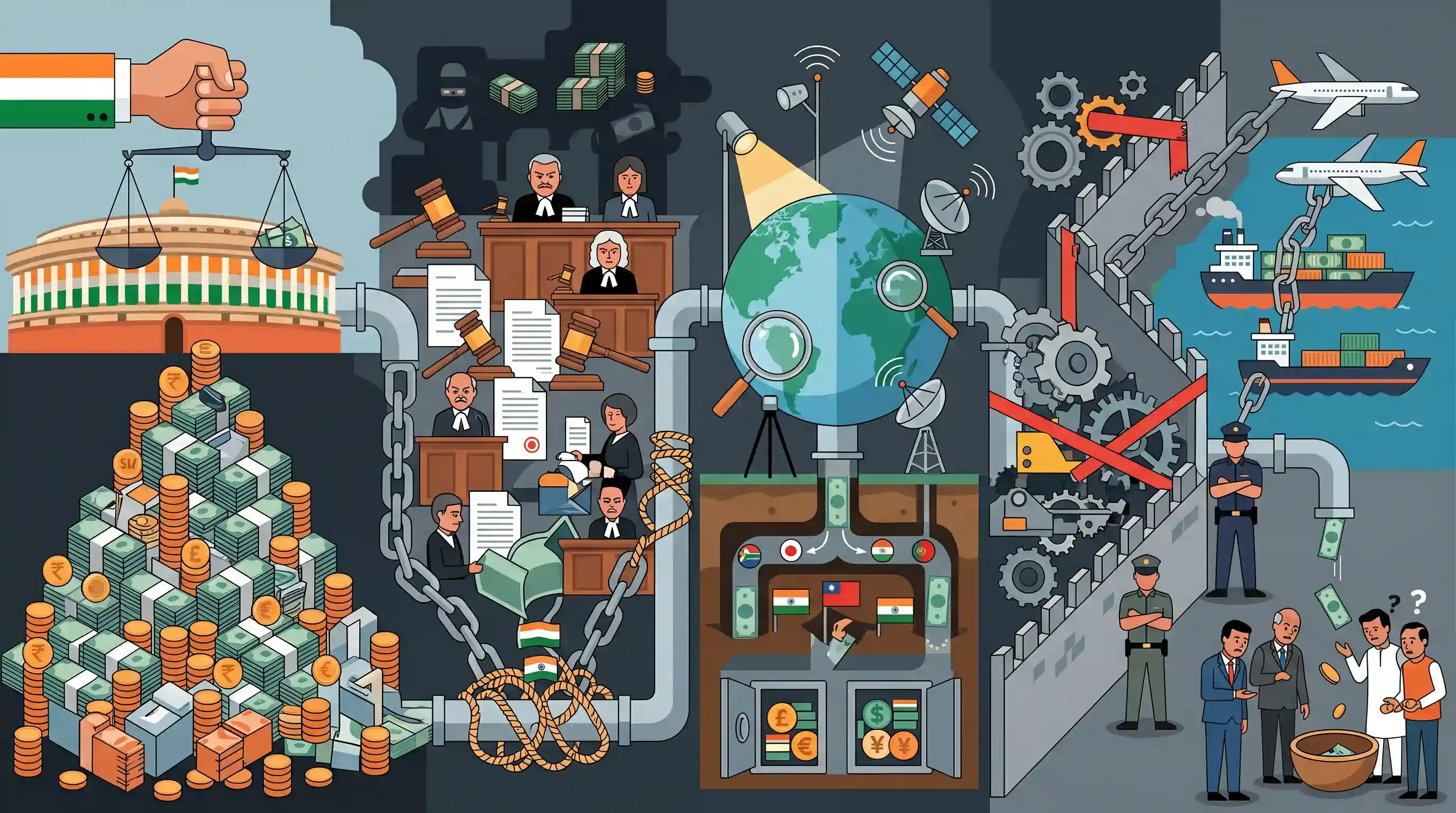
Over the past decade, the Indian government has raised tax demands totaling ₹35,104 crore under the Black Money (Undisclosed Foreign Income and Assets) and Imposition of Tax Act, 2015. However, actual recoveries have amounted to only ₹338 crore. This glaring discrepancy highlights systemic bottlenecks in penalizing offshore tax evasion, including lengthy legal disputes, difficulties in tracing overseas wealth, and the complexities of repatriating assets from foreign jurisdictions.
Key Points
- The Government of India raised a massive tax demand of ₹35,104 crore over the last 10 years under the foreign black money law.
- The actual recovery amount stands at merely ₹338 crore, indicating a recovery rate of less than 1%.
- The massive gap between tax demand and actual recovery highlights significant challenges in prosecuting offshore tax evasion, such as protracted legal battles and complex international asset tracing.
- The data calls for a review of the efficacy of the Black Money (Undisclosed Foreign Income and Assets) and Imposition of Tax Act, 2015 and the institutional capacity to repatriate overseas assets.
Important Terms
Black Money (Undisclosed Foreign Income and Assets) and Imposition of Tax Act, 2015

A 2015 law targeting Indian residents' hidden offshore wealth, imposing a 30% tax and 90% penalty to deter tax evasion and facilitate the repatriation of undisclosed foreign assets.
UPSC context
GS Paper III (Economy); tests knowledge of legal frameworks to combat illicit financial flows and improve tax compliance.
Parallel Economy
An unofficial sector where economic activities go unreported and unmeasured to evade taxes, creating a "shadow" system that weakens formal monetary and fiscal policies.
UPSC context
GS Paper III (Indian Economy); focuses on the challenges of black money, revenue leakage, and fiscal governance.
Tax Evasion
The illegal practice where individuals or entities deliberately underreport income, inflate expenses, or hide assets to avoid paying taxes legally due to the government.
UPSC context
GS Paper III (Economy); distinguishes illegal non-compliance from legal tax avoidance (using loopholes) and tests ethical understanding.
Money Laundering
The process of concealing the criminal origins of "dirty" money through placement, layering, and integration to make it appear as "clean" or legitimate wealth.
UPSC context
GS Paper III (Security); relevant for financial crimes, PMLA, and the nexus between illicit money and organized crime.
Automatic Exchange of Information (AEOI)
A global OECD-led standard where countries automatically share financial account details of non-residents with their home countries to detect and deter offshore tax evasion.
UPSC context
GS Paper II/III (IR/Economy); tests knowledge of global financial transparency standards and international cooperation against tax havens.
Prelims Trap
The Black Money Act 2015 penalises all undisclosed income and assets, both domestic and foreign, unearthed by the authorities.
The Act specifically targets only undisclosed FOREIGN income and assets. Domestic tax evasion is governed separately under the standard Income Tax Act, 1961.
Static Concepts Connected
What are the core provisions of the Black Money Act 2015?
- Applicability: Applies exclusively to ordinary residents of India possessing undisclosed overseas income or assets.
- Tax & Penalty: Imposes a flat 30% tax alongside a 90% penalty, amounting to a staggering 120% of the fair market value of the hidden asset.
- Prosecution: Wilful attempts to evade tax on foreign income can attract rigorous imprisonment ranging from 3 to 10 years.
How does India trace offshore black money legally?
- AEOI Framework: India uses the OECD's Common Reporting Standard to receive automated data on financial accounts held by Indians in partner countries.
- DTAAs: Bilateral Double Taxation Avoidance Agreements (DTAAs) are increasingly updated to include strict tax information exchange clauses.
- FATCA pact: India signed an Inter-Governmental Agreement with the US to implement FATCA, facilitating cross-border financial tracking.
Cross-Topic Patterns
Round-tripping and PMLA linkages
Unrecovered offshore wealth frequently re-enters India disguised as FDI via tax havens, connecting tax evasion failures directly to Prevention of Money Laundering Act (PMLA) enforcement.
AEOI versus Tax Havens
Despite India's adoption of the OECD's Automatic Exchange of Information (AEOI), opaque trusts in non-compliant shell jurisdictions continue to bypass domestic legislative actions.

GS3 Mains 2026 will likely test the enforcement failures of domestic laws (like the 2015 Act) despite global AEOI and OECD BEPS pacts.
Linked PYQs · 3
Linked PYQs · 3
- 2021PrelimsGS1
Which one of the following effects of creation of black money in India has been the main cause of worry to the Government of India?
- 2021MainsGS3
Discuss how emerging technologies and globalisation contribute to money laundering. Elaborate measures to tackle the problem of money laundering both at national and international levels.
- 2025PrelimsGS1
With reference to the Government of India, consider the following information: Organization Some of its functions It works under I. Directorate of Enforcement Enforcement of the Fugitive Economic Offenders Act, 2018 Internal Security Division-I, Ministry of Home Affairs II. Directorate of Revenue Intelligence Enforces the Provisions of the Customs Act, 1962 Department of Revenue, Ministry of Finance III. Directorate General of Systems and Data Management Carrying out big data analytics to assist tax officers for better policy and nabbing tax evaders Department of Revenue, Ministry of Finance In how many of the above rows is the information correctly matched?
