Velpur Model for Grassroots Eradication of Child Labour
Source:The Hindu ↗
Why It Matters
Child labour remains a critical hurdle to India's human capital development. Understanding successful grassroots models like Velpur is highly relevant for UPSC Mains GS2 (Social Justice & Governance), offering practical case studies for answers on the role of civil society, local bodies, and community mobilization in implementing the Right to Education and protecting child rights.
Summary
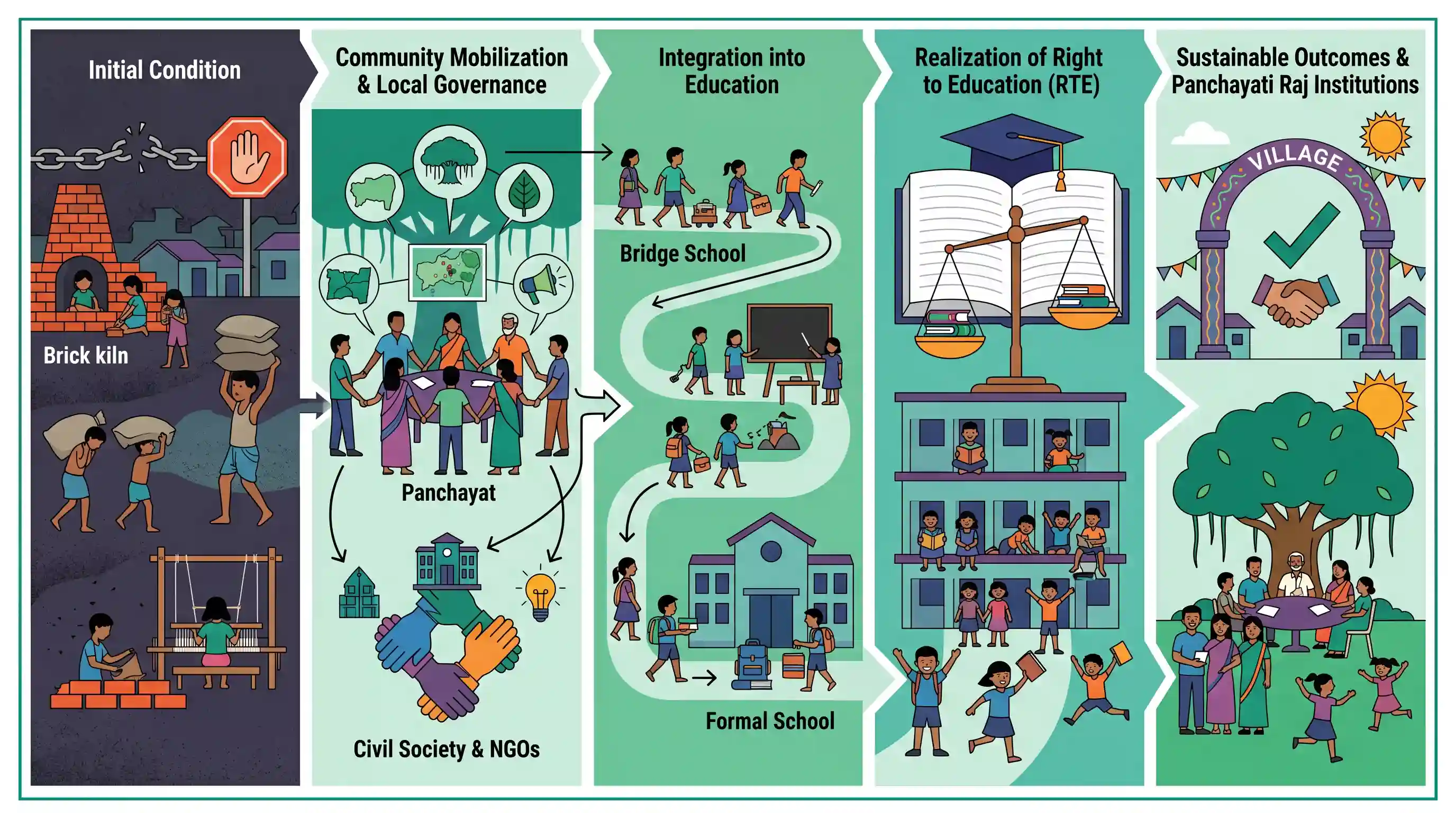
The article recounts the success story of Velpur in eradicating child labour, emphasizing the pivotal role of community mobilization, local governance, and civil society. By creating a collective societal consensus against child labour and ensuring that all out-of-school children are integrated into the formal education system, the Velpur model demonstrates a sustainable approach to child welfare. It highlights that the true realization of the Right to Education (RTE) and the elimination of child labour depend on grassroots democratic action and the active involvement of Panchayati Raj institutions rather than relying solely on legislative bans.
Key Points
- The Velpur model showcases how community-driven initiatives and grassroots mobilization can effectively eradicate child labour.
- Active participation of Gram Panchayats, parents, and local youth groups is crucial in establishing a zero-tolerance societal norm against child labour.
- The approach shifts the focus from purely punitive legal measures to ensuring every child is enrolled in formal, full-time schools, recognizing out-of-school children as potential child labourers.
- Demonstrates that successful implementation of child rights and the Right to Education (RTE) Act requires decentralized governance and strong civil society engagement.
Important Terms
Velpur Model

A pioneering 100-day community-led campaign (Telangana, 2001) that eradicated child labour through total consensus among local governance, administration, and civil society, ensuring universal school enrollment.
UPSC context
GS Paper 2 (Governance/Social Justice). Replicable case study for grassroots-led social reform and administrative-civil society convergence in welfare.
Right to Education (RTE) Act
A 2009 legislation that makes free and compulsory education a fundamental right for children aged 6–14 years under Article 21A, holding the state accountable for enrollment.
UPSC context
GS Paper 2 (Social Justice/Education). Core legal framework for human development and the primary institutional tool against child exploitation.
Child Labour (Prohibition and Regulation) Amendment Act, 2016
Amended in 2016, this law prohibits the employment of children below 14 in all occupations (except family enterprises) and bars adolescents (14–18) from hazardous work.
UPSC context
GS Paper 2 (Vulnerable Sections). Essential for understanding labor reforms, children's rights, and legal loopholes in child protection.
Gram Panchayats
The village-level tier of local self-government empowered by the 73rd Amendment to manage social development and monitor primary education and welfare at the grassroots.
UPSC context
GS Paper 2 (Polity/Devolution of Powers). Key to implementation of social audits and community-based monitoring of rights.
Civil Society Organizations (CSOs)
Non-state, not-for-profit entities (NGOs, community groups) that advocate for policy reforms and act as intermediaries between the state and public for social justice.
UPSC context
GS Paper 2 (Role of NGOs/Civil Society). Vital for analyzing participatory governance and community mobilization in social issues.
Article 24
A Fundamental Right in the Indian Constitution that prohibits the employment of children below 14 years in factories, mines, or other hazardous industries.
UPSC context
GS Paper 2 (Polity/Fundamental Rights). Constitutional cornerstone for child safety and labor law adjudication.
Prelims Trap
The Child Labour Act completely bans the employment of children under 14 in all occupations without any exceptions.
The Act provides explicit exceptions: children under 14 can help in family enterprises (non-hazardous) after school hours/vacations, and work as child artists.
Static Concepts Connected
What are the Constitutional safeguards against child labour in India?
- Article 24: Prohibits the employment of children below 14 years in factories, mines, or other hazardous occupations.
- Article 39 (e)&(f): Directs the State to ensure children are protected against exploitation, and against moral and material abandonment.
- Article 21A: Mandates free and compulsory education for all children aged 6 to 14 years, structurally preventing labour.
Which 11th Schedule items empower PRIs in child welfare and education?
- Item 17: Devolves powers related to education, including primary and secondary schools, to Panchayati Raj Institutions.
- Item 25: Empowers PRIs to take action and implement schemes regarding women and child development locally.
Cross-Topic Patterns
Convergence of RTE and Labour Laws
Treating every out-of-school child as a potential child labourer bridges the administrative gap between the Education Ministry's RTE mandate and the Labour Ministry's enforcement.
Attitudinal change in GS4 Case Studies
The Velpur model is a perfect GS4 example demonstrating how social persuasion and community consensus succeed where purely punitive legal measures fail.

Expect a Mains GS2/GS4 question evaluating how PRI-led community mobilization succeeds where punitive child labour legislation fails.
Linked PYQs · 3
Linked PYQs · 3
- 2016MainsGS2
Examine the main provisions of the National Child Policy and throw light on the status of its implementation.
- 2022MainsGS2
The Right of Children to Free and Compulsory Education Act, 2009 remains inadequate in promoting incentive-based system for children's education without generating awareness about the importance of schooling. Analyse.
- 2018PrelimsGS1
International Labour Organization's Conventions 138 and 182 are related to
