Decentralisation and Community Centric Public Healthcare
Source:The Hindu ↗
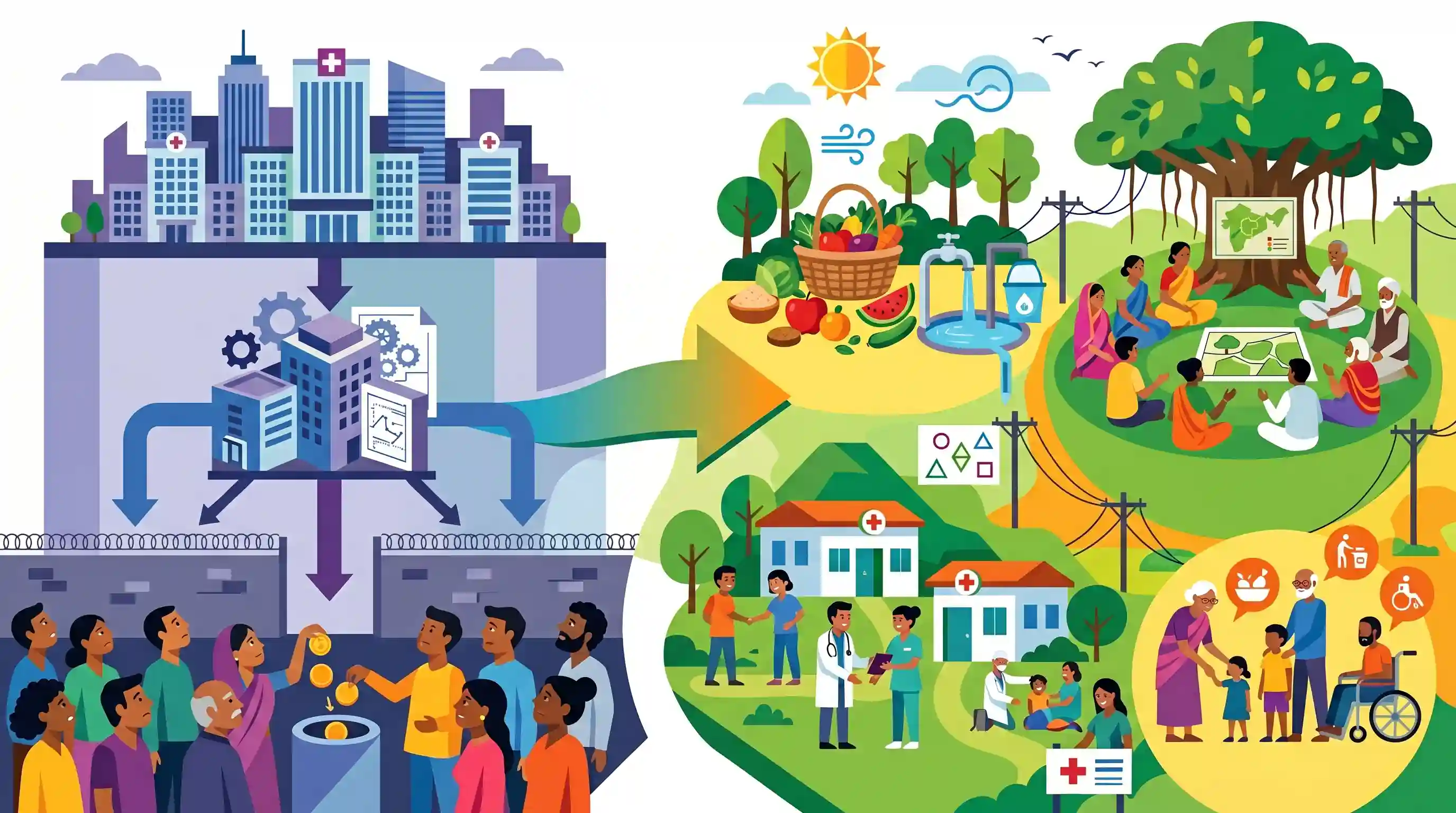
Why It Matters
Provides a critical analysis of India's healthcare trajectory, warning against excessive marketisation and advocating for community-led primary care. Crucial for GS2 answers on health governance, decentralization, and the limitations of insurance-based models.
Summary
The article argues that India's public healthcare system must pivot from top-down, tertiary-care-focused, and insurance-based models to a community-centric approach. It highlights the persistent issue of high out-of-pocket expenditure (OOPE) driven by inadequate public health infrastructure and underfunding. To truly serve the population, health policies must address the social determinants of health—such as nutrition, sanitation, and environment—and aggressively strengthen primary healthcare at the grassroots level. The author advocates for greater decentralization, urging the empowerment of local communities and Panchayati Raj Institutions to participate in health planning and delivery, thereby reconnecting public health systems with the genuine, everyday needs of the people.
Key Points
- India's public health policy needs to shift away from heavily medicalized, top-down, and insurance-based models (like PM-JAY) towards community-centered primary healthcare.
- Underfunded public health infrastructure continues to drive high Out-of-Pocket Expenditure (OOPE), which disproportionately affects vulnerable populations and pushes them into poverty.
- A holistic health approach must prioritize the Social Determinants of Health (SDOH)—such as nutrition, clean water, and sanitation—rather than focusing exclusively on curative services.
- Decentralization of health planning is essential. Empowering Panchayati Raj Institutions (PRIs) and local communities ensures that health services align with actual grassroots needs and improve accountability.
Important Terms
National Health Mission (NHM)

A flagship public health initiative (launched 2013) subsuming rural and urban missions to provide equitable, affordable, and quality healthcare through system strengthening and community-based interventions like ASHA workers.
UPSC context
GS Paper II: Social Sector/Health; tests understanding of primary healthcare frameworks and grassroots delivery mechanisms.
Ayushman Bharat
India's flagship health scheme (2018) comprising two pillars: Health and Wellness Centres (HWCs) for comprehensive primary care and PM-JAY for secondary and tertiary care insurance.
UPSC context
GS Paper II: Welfare Schemes; evaluates knowledge of universal health coverage (UHC) and financial protection for vulnerable sections.
Pradhan Mantri Jan Arogya Yojana (PM-JAY)
The insurance component of Ayushman Bharat providing ₹5 lakh annual hospitalization cover to the bottom 40% of India's population for secondary and tertiary care.
UPSC context
GS Paper II: Social Justice; tests analysis of insurance-based healthcare models vs. public service delivery.
National Health Policy 2017
Strategic framework aiming to increase public health spending to 2.5% of GDP and achieve universal health access through preventive and promotive care.
UPSC context
GS Paper II: Health Policy; key for tracking national health targets and long-term sector reforms.
Out-of-pocket expenditure (OOPE)
Direct payments made by households for healthcare services at the point of care, often leading to medical impoverishment; a key metric of health financing efficiency.
UPSC context
GS Paper III: Indian Economy/Health; critical for discussing healthcare affordability and the need for public financing.
Panchayati Raj Institutions (PRIs)
Three-tier local self-government bodies (Gram, Block, District) empowered by the 73rd Amendment to manage local services, including primary healthcare and sanitation.
UPSC context
GS Paper II: Local Governance; tests knowledge of decentralization and community-led health planning.
Prelims Trap
Ayushman Bharat PM-JAY provides universal coverage for primary healthcare and outpatient consultations to reduce OOPE.
PM-JAY provides insurance cover strictly for secondary and tertiary care hospitalization. Outpatient care (OPD), which drives the vast majority of OOPE in India, is not covered under the insurance component.
Static Concepts Connected
How does the Constitution facilitate decentralized healthcare delivery?
- State Subject: Public health and sanitation is Entry 6 of the State List (Seventh Schedule), giving primary legislative power to states.
- 11th Schedule: Article 243G delegates powers to Panchayats over 29 items, explicitly including 'Health and sanitation, hospitals, PHCs, and dispensaries'.
- 12th Schedule: Article 243W delegates similar public health and sanitation responsibilities to Urban Local Bodies.
What are the key targets of the National Health Policy 2017?
- GDP Target: Increase Government Health Expenditure to 2.5% of GDP by 2025.
- Life Expectancy: Increase life expectancy at birth from 67.5 to 70 by 2025.
- Disease Burden: Reduce premature mortality from cardiovascular diseases, cancer, diabetes, or chronic respiratory diseases by 25% by 2025.
Cross-Topic Patterns
Devolution vs. CSS Health Funding
Heavy reliance on Centrally Sponsored Schemes (like NHM) centralizes health planning, often contradicting the constitutional mandate for state and PRI-led grassroots healthcare delivery.
OOPE as a poverty trap
High OOPE (47.1%) negates poverty alleviation efforts; sudden medical emergencies remain a primary driver of vulnerable households slipping back below the poverty line (transient poverty).
Climate impacts on SDOH
Extreme weather directly impacts Social Determinants of Health (disrupting clean water, shifting vector ecology), demanding climate-resilient primary healthcare models at the Panchayat level.

Mains 2026: Expect a critical evaluation of PM-JAY vs Primary Care, testing why tertiary insurance fails to reduce OOP expenses.
Linked PYQs · 3
Linked PYQs · 3
- 2024MainsGS2
In a crucial domain like the public healthcare system the Indian State should play a vital role to contain the adverse impact of marketisation of the system. Suggest some measures through which the State can enhance the reach of public healthcare at the grassroots level.
- 2021MainsGS2
“Besides being a moral imperative of a Welfare State, primary health structure is a necessary precondition for sustainable development.” Analyze.
- 2022PrelimsGS1
With reference to Ayushman Bharat Digital Mission, consider the following statements: 1. Private and public hospitals must adopt it. 2. As it aims to achieve universal health coverage, every citizen of India should be part of it ultimately. 3. It has seamless portability across the country. Which of the statements given above is/are correct?
