Israeli Strike on Qatar and West Asian Geopolitical Escalation
Source:The Hindu ↗
Why It Matters
The escalating conflict in West Asia acts as a direct threat to India's strategic imperatives. Understanding the geopolitical dynamics—such as mediation roles, sovereignty issues, and normalization processes—is crucial for analyzing India's foreign policy challenges concerning energy security and diaspora protection.
Summary
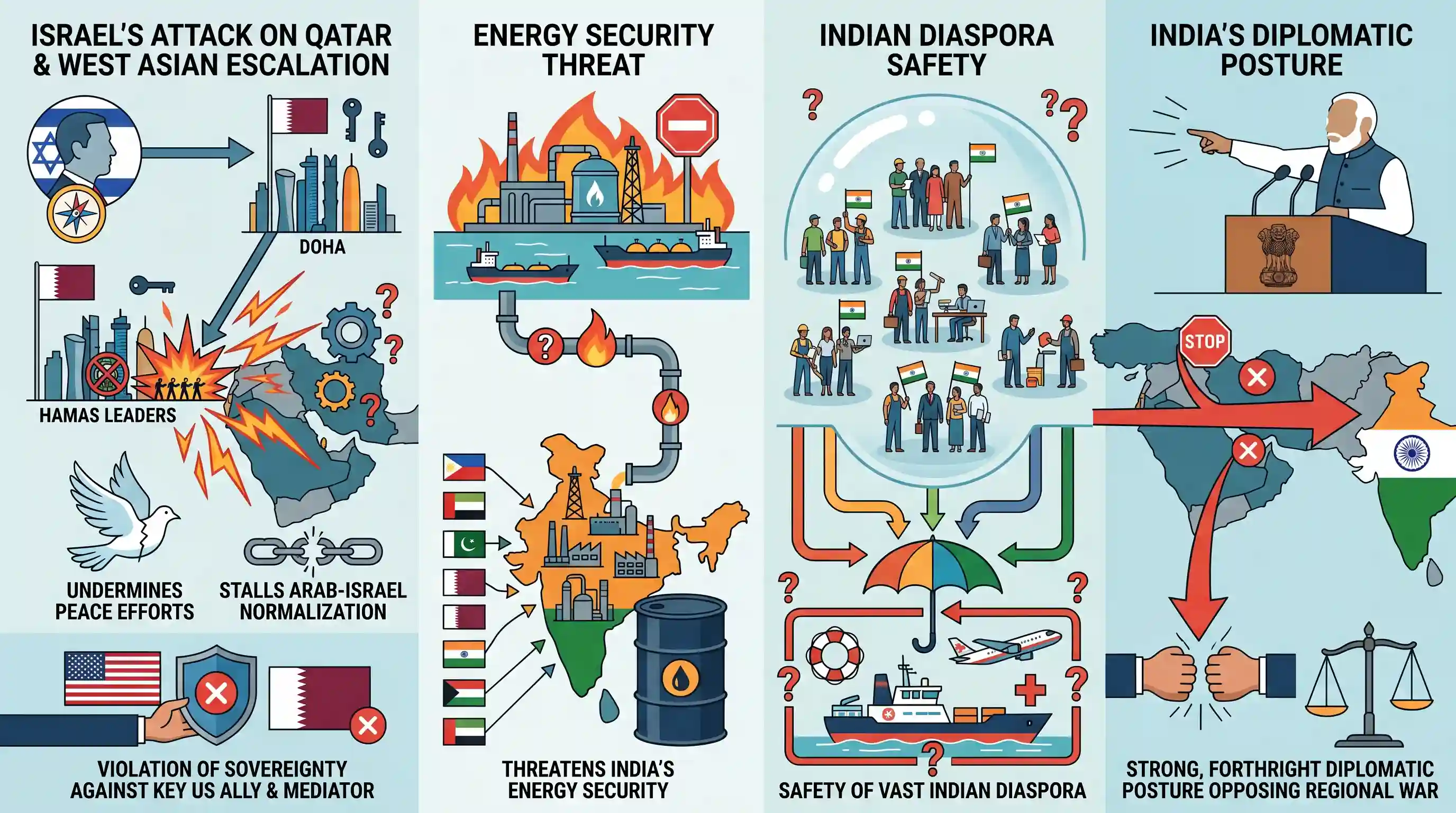
Israel's September 9, 2025 attack on Qatar targeting Hamas leaders marks a severe escalation in West Asian geopolitics. The editorial criticizes this violation of sovereignty against a key US ally and ceasefire mediator, warning that it undermines peace efforts in Gaza and stalls the Arab-Israel normalization process. The expansion of hostilities to the Gulf deeply impacts India, threatening its energy security and the safety of its vast diaspora. The piece calls on New Delhi to adopt a stronger, more forthright diplomatic posture opposing the regional war.
Key Points
- Israel launched a controversial strike targeting Hamas leaders in Qatar on September 9, 2025, significantly escalating the regional conflict.
- Qatar is a critical US ally, hosts a major American military base, and acts as a central mediator for a ceasefire in Gaza, making the strike a profound diplomatic breach.
- The attack threatens to derail ongoing ceasefire negotiations and deals a severe blow to the fragile Arab-Israel normalization efforts, particularly with Saudi Arabia.
- For India, the expansion of the conflict into the Gulf region is alarming as it directly threatens national energy security and the safety of millions of Indian diaspora living there.
- While PM Narendra Modi condemned the violation of Qatar's sovereignty, the editorial urges India to take a more forthright stance against Israel's regional aggression to restore stability in West Asia.
Important Terms
Arab-Israel Normalisation Process

The diplomatic process of establishing official, formal ties between Israel and Arab nations, aiming to shift from decades of hostility to cooperation in trade, security, and technology.
UPSC context
GS Paper 2 (International Relations); tests regional stability, India’s ‘Link West’ policy, and the impact of Abraham Accords.
Hamas
A Palestinian Sunni-Islamic militant and political organization that governs the Gaza Strip. Founded in 1987, it advocates for an Islamic state in historic Palestine and rejects Israel's existence.
UPSC context
GS Paper 2 (International Relations); tests knowledge of non-state actors, regional conflicts, and their impact on global security.
Indian Diaspora
The community of over 9 million Indian nationals and people of Indian origin in West Asia, serving as India's largest remittance source and a key soft power asset.
UPSC context
GS Paper 2 (International Relations/Diaspora); tests protection of nationals, remittance-based economic stability, and diplomatic leverage.
Energy Security
The reliable and affordable availability of energy resources. India depends on West Asia for over 60% of its crude oil and 40% of its natural gas (LNG).
UPSC context
GS Paper 3 (Economy/Energy); tests strategic autonomy, resource dependencies, and vulnerability to global supply chain disruptions.
West Asian Geopolitics
The strategic interaction of states in the Middle East, characterized by power rivalries, religious-sectarian tensions, and control over energy-rich territories and maritime chokepoints.
UPSC context
GS Paper 2 (International Relations); tests understanding of India's ‘extended neighborhood’ and balancing ties with rival regional powers.
Abraham Accords
A set of U.S.-brokered 2020 agreements normalizing diplomatic relations between Israel and several Arab states, including the UAE, Bahrain, Sudan, and Morocco.
UPSC context
GS Paper 2 (IR); tests knowledge of shifting alliances in West Asia and their implications for India’s regional engagement.
Prelims Trap
Qatar is a key signatory to the US-brokered Abraham Accords.
Qatar is NOT a signatory to the Abraham Accords. It acts as a mediator and maintains a distinct foreign policy from UAE and Bahrain.
Static Concepts Connected
What are the key pillars of India's relations with the Gulf region?
- Energy Security: The Gulf region supplies roughly 60% of India's crude oil, and Qatar alone supplies around 45% of India's Liquefied Natural Gas (LNG).
- Diaspora & Remittances: The region hosts nearly 9 million Indian expatriates who contribute a major share of India's annual inward remittances, stabilizing foreign exchange reserves.
- Strategic Partnerships: Ties have evolved from buyer-seller dynamics to comprehensive strategic partnerships, including joint military exercises, counter-terrorism cooperation, and minilaterals like I2U2.
Which key maritime chokepoints govern trade from the West Asian region?
- Strait of Hormuz: Connects the Persian Gulf to the Gulf of Oman and Arabian Sea. It is the world's most critical transit chokepoint for crude oil and LNG.
- Bab el-Mandeb: Connects the Red Sea to the Gulf of Aden. Essential for maritime trade navigating toward the Suez Canal and Europe.
Cross-Topic Patterns
Gulf Instability & Macroeconomic stability
Geopolitical shocks in West Asia spike global crude and LNG prices, directly widening India's Current Account Deficit (CAD) and fueling imported inflation.
Diaspora Evacuation & Soft Power
Threats to the 8.9 million Gulf diaspora invoke India's historical evacuation mandates (e.g., Operation Raahat, Kaveri), testing its naval logistics and crisis-response diplomacy.

Expect a 2026 Prelims mapping question linking West Asian conflict zones (Gaza, Yemen, Qatar) to key chokepoints like the Strait of Hormuz.
Linked PYQs · 5
Linked PYQs · 5
- 2025MainsGS2
"Energy security constitutes the dominant kingpin of India's foreign policy, and is linked with India's overarching influence in Middle Eastern countries.” How would you integrate energy security with India's foreign policy trajectories in the coming years?
- 2023MainsGS2
Indian diaspora has scaled new heights in the West. Describe its economic and political benefits for India.
- 2017MainsGS2
The question of India's Energy Security constitutes the most important part of India's economic progress. Analyze India's energy policy cooperation with West Asian countries.
- 2018PrelimsGS1
The term "two-state solution" is sometimes mentioned in the news in the context of the affairs of
- 2015PrelimsGS1
The area known as 'Golan Heights' sometimes appears in the news in the context of the events related to
