United States Environmental Protection Agency endangerment rollback
Source:Indian Express ↗
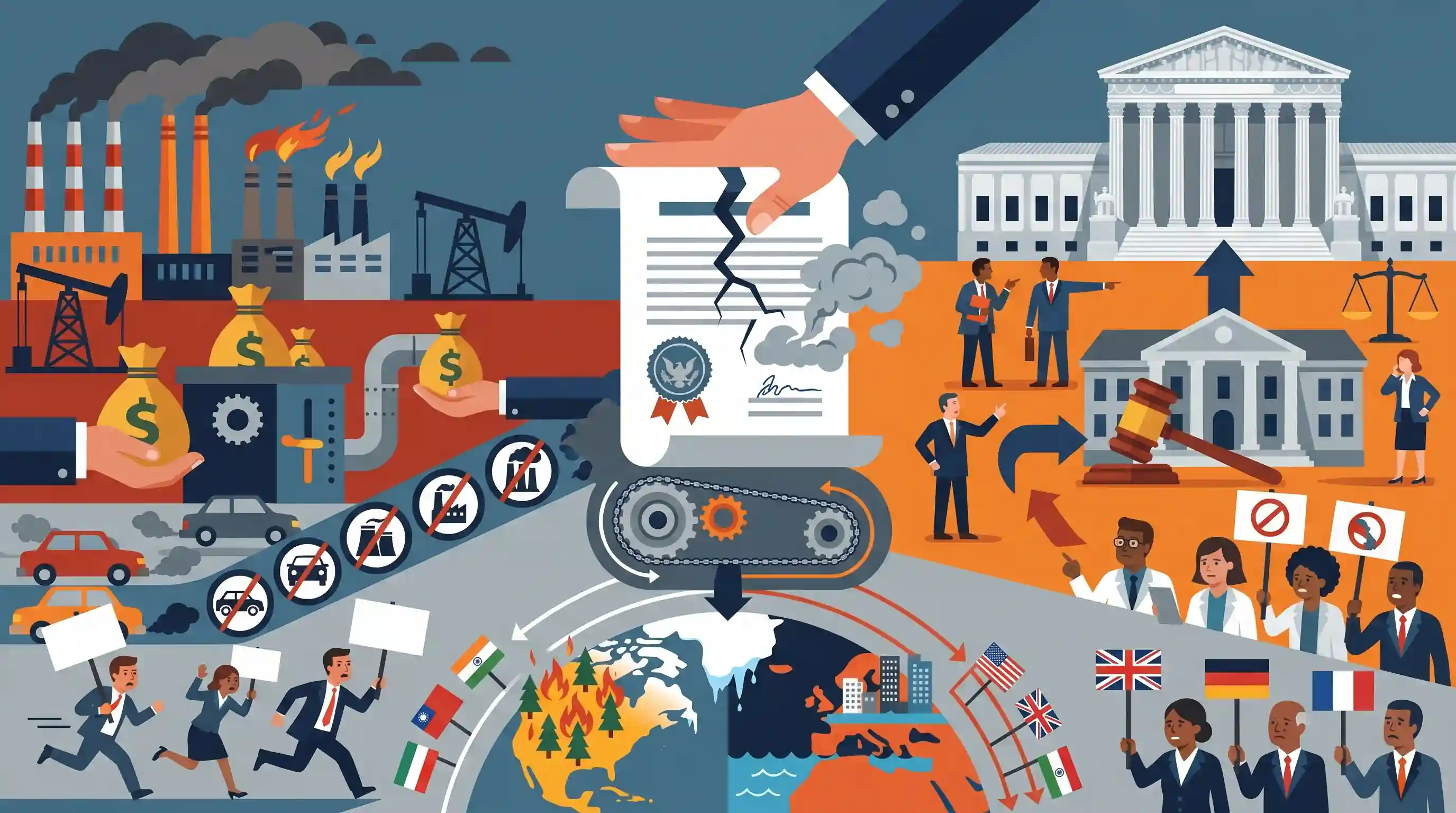
Why It Matters
The rollback of the EPA's endangerment finding highlights the tension between economic deregulation and environmental protection. For UPSC aspirants, it is a crucial case study in how shifts in the domestic policies of major powers (like the US) can stall global climate initiatives, impact international climate negotiations (GS2), and challenge environmental governance frameworks (GS3).
Summary
The Trump administration is moving to reverse the landmark 2009 Environmental Protection Agency (EPA) 'endangerment finding', which declared greenhouse gases a threat to public health and welfare. This foundational ruling has underpinned major US climate regulations for over a decade. The proposed rollback, aimed at broader industrial deregulation and estimated to be a $1 trillion move, has drawn sharp criticism from experts and lawmakers who view it as a reckless retreat from climate action. The decision is poised to face significant legal challenges and is widely expected to reach the US Supreme Court. This shift not only threatens domestic environmental protections but also has profound implications for global climate change mitigation efforts.
Key Points
- The Trump administration is attempting to scrap the 2009 EPA 'endangerment finding', a landmark ruling that classified greenhouse gases as a threat to public health and welfare.
- This 2009 ruling serves as the legal foundation for major federal climate regulations and emissions standards in the United States.
- Reversing the finding aims to dismantle federal climate policies and deregulate industries, a move estimated to have a $1 trillion economic impact.
- Experts, lawmakers, and environmental groups have strongly condemned the rollback, warning of its severe consequences for climate action.
- The contentious decision is expected to trigger intense legal battles, likely culminating in a Supreme Court showdown.
- This deregulation move marks a significant retreat in US climate policy, undermining global efforts and commitments to mitigate climate change.
Important Terms
2009 EPA Endangerment Finding

A formal 2009 US determination declaring greenhouse gases a threat to public health. It serves as the legal trigger for regulating climate pollution under the Clean Air Act.
UPSC context
GS3: Environmental Degradation. Illustrates the legal basis for climate regulation and how domestic policy changes impact global governance.
Environmental Protection Agency (EPA)
The US federal agency responsible for environmental regulation. It implements key laws like the Clean Air Act to protect human health and the environment from pollution.
UPSC context
GS3: International institutions. Essential for understanding US-led environmental standards and their influence on global climate mitigation trends.
Paris Agreement
A 2015 international treaty aiming to limit global warming to well below 2°C. It relies on Nationally Determined Contributions (NDCs) from participating member nations.
UPSC context
GS3: Global Environmental Governance. A core topic for international commitments, India’s climate targets, and multilateral climate diplomacy.
Greenhouse Gases (GHGs)
Atmospheric gases (e.g., CO2, methane) that trap heat, causing the greenhouse effect. Their reduction is the primary goal of modern environmental laws and treaties.
UPSC context
GS3: Basics of Environment. Fundamental science for understanding global warming, pollution control, and international emission reduction frameworks.
Climate Change Mitigation
Efforts to reduce or prevent the emission of greenhouse gases. Strategies include transitioning to renewable energy, improving efficiency, and protecting forests as carbon sinks.
UPSC context
GS3: Conservation. Tests knowledge of policy actions, technological innovation, and cooperation required to achieve global climate stability.
Clean Air Act (US)
The foundational US environmental law authorizing the federal government to regulate air emissions to safeguard public health and the environment.
UPSC context
GS2: Comparative Constitutions. Shows how statutory mandates and judicial review shape national policy with significant global environmental ripples.
Prelims Trap
"The EPA Endangerment Finding on greenhouse gases is a compliance mechanism under the Paris Agreement."
The EPA finding is purely US domestic law under the Clean Air Act, triggered by a US Supreme Court ruling (Massachusetts v. EPA), not an international UNFCCC mandate.
Static Concepts Connected
Which are the main Greenhouse Gases targeted by global climate frameworks?
- Kyoto Protocol Gases: The Kyoto Protocol initially targeted six GHGs: Carbon dioxide, Methane, Nitrous oxide, HFCs, PFCs, and Sulphur hexafluoride. Nitrogen trifluoride (NF3) was added later.
- Kigali Amendment: It specifically targets the phase-down of Hydrofluorocarbons (HFCs), which are extremely potent greenhouse gases despite not being ozone-depleting substances.
What is the Principle of Common But Differentiated Responsibilities (CBDR)?
- Core Definition: A UNFCCC principle acknowledging all states share obligations to address environmental destruction but hold unequal responsibility, primarily due to the historical emissions of industrialized nations.
- Paris Agreement Shift: Shifted from strict Kyoto bifurcations to Nationally Determined Contributions (NDCs), where all countries set voluntary targets, though developed nations are expected to lead absolute reductions.
Cross-Topic Patterns
Judicial activism in climate governance
The US Supreme Court's 2007 role in mandating GHG regulation mirrors the Indian Supreme Court's recent expansion of Article 21 to explicitly include the "right against the adverse effects of climate change."
Developed nation policy & Global South burden
US deregulation directly jeopardizes international climate finance commitments, widening the NCQG funding gap and forcing developing nations like India to bear higher mitigation costs independently.

Expect a GS-3 Mains question directly linking US domestic climate rollbacks to the widening global climate finance gap and CBDR dilution.
Linked PYQs · 4
Linked PYQs · 4
- 2022MainsGS3
Discuss global warming and mention its effects on the global climate. Explain the control measures to bring down the level of greenhouse gases which cause global warming, in the light of the Kyoto Protocol, 1997.
- 2022MainsGS2
‘Clean energy is the order of the day.’ Describe briefly India's changing policy towards climate change in various international fora in the context of geopolitics.
- 2016PrelimsGS1
What is 'Greenhouse Gas Protocol?
- 2022PrelimsGS1
"Climate Action Tracker" which monitors the emission reduction pledges of different countries is a :
