Post Flood Sanitation and Disease Control in Gujarat
Source:toi ↗
Why It Matters
Highlights the practical application of disaster management frameworks involving central and state agencies (NDRF/SDRF) and emphasizes the critical importance of post-disaster sanitation and water purification to prevent secondary casualties from disease outbreaks.
Summary
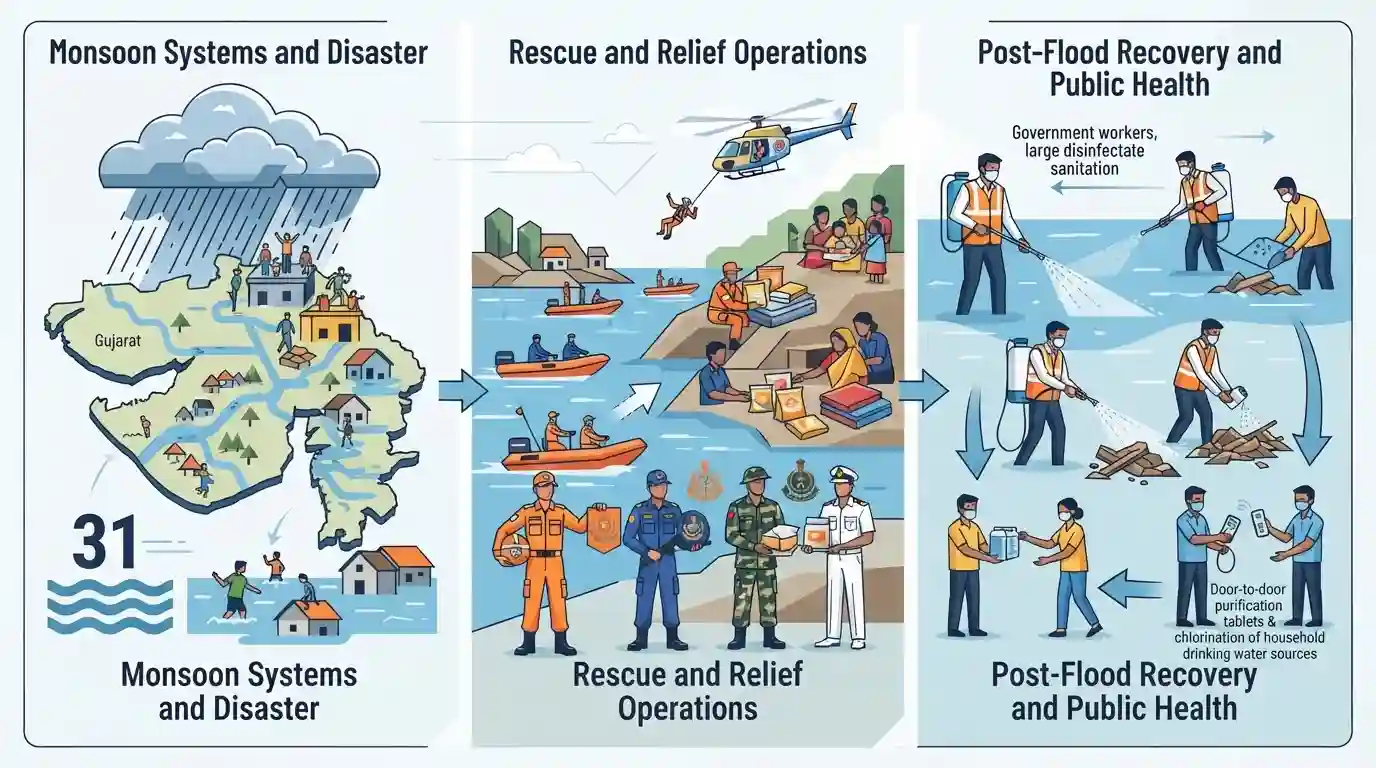
Torrential rains have devastated parts of Gujarat, claiming 31 lives and causing extensive flooding. Massive rescue and relief operations were mobilized involving the NDRF, SDRF, Army, and Coast Guard. As floodwaters recede, the Gujarat government, led by CM Bhupendra Patel, is prioritizing disease prevention through large-scale sanitation measures and door-to-door chlorination of drinking water, particularly in heavily affected districts like Kheda, Navsari, and Valsad.
Key Points
- Unprecedented torrential rains triggered severe floods across Gujarat, resulting in at least 31 casualties.
- Ahmedabad recorded its fourth-highest rainfall event in 100 years.
- Rescue operations were conducted jointly by the Indian Army, Coast Guard, NDRF, and SDRF, including airlifting stranded people.
- With waters receding, the state is prioritizing public health by conducting massive sanitation drives and door-to-door water chlorination to prevent waterborne diseases.
Important Terms
National Disaster Response Force (NDRF)

A specialized force established under the Disaster Management Act, 2005, for rapid response to natural and man-made disasters. It operates under the National Disaster Management Authority and draws personnel from Central Armed Police Forces.
UPSC context
Vital for GS Paper 3 (Disaster Management); tests knowledge of India's statutory institutional framework for emergency rescue and relief operations.
State Disaster Response Force (SDRF)
State-level specialized forces mandated by the Disaster Management Act, 2005, to act as the first line of organized defense during disasters. They are typically raised from state armed police forces and work alongside the NDRF.
UPSC context
Highly relevant for GS Paper 3 (Disaster Management); illustrates the decentralized nature of India's disaster management architecture.
India Meteorological Department (IMD)
India's principal agency under the Ministry of Earth Sciences responsible for weather forecasting, seismology, and issuing early warnings for extreme weather events like cyclones and heavy rainfall.
UPSC context
Important for GS Paper 1 (Geography) and GS 3 (Disaster Management); focuses on climate systems, early warning capabilities, and monsoon tracking.
Prelims Trap
"The National Disaster Response Fund (NDRF) is maintained within the Consolidated Fund of India."
The NDRF is actually held in the Public Account of India under 'reserve funds not bearing interest', as established by Section 46 of the Disaster Management Act, 2005.
Static Concepts Connected
Why does NDMA classify Urban Flooding as a separate disaster from riverine floods?
- Catchment Alteration: Urbanization creates impermeable concrete surfaces, preventing groundwater recharge and increasing surface flood volumes by up to 6 times.
- Peak Flow Dynamics: Flood peaks can be 1.8 to 8 times higher in urban areas with exceptionally fast flow times, reducing response windows.
- Artificial Drainage: Unlike natural floodplains, urban mitigation relies entirely on engineered stormwater drain capacity and solid waste management to prevent blockages.
What are the primary public health threats in post-flood environments?
- Waterborne Infections: Sewer overflow contaminating drinking water lines frequently leads to outbreaks of Cholera, Typhoid, and Hepatitis A and E.
- Zoonotic Risks: Exposure to floodwaters contaminated with animal urine significantly elevates the risk of Leptospirosis, particularly among rescue personnel and displaced citizens.
- Vector-borne Diseases: Receding, stagnant pools create ideal breeding grounds for Aedes and Anopheles mosquitoes, precipitating secondary Dengue and Malaria epidemics.
Cross-Topic Patterns
Urban Flooding + Climate Resilient Cities
Flooding in highly developed hubs like Ahmedabad highlights the friction between extreme weather events (monsoon anomalies) and concrete-heavy urban planning, a recurring theme in GS3 Mains.
Disaster Funds + Federal Finance
The transition of relief burden from SDRF (state-level) to NDRF (national-level) during severe calamities links Disaster Management directly to center-state financial relations and Finance Commission guidelines.

Expect a 2026 Prelims question pairing NDMA's distinct urban flooding criteria with the specific placement of the NDRF in the Public Account.
Linked PYQs · 2
Linked PYQs · 2
- 2021GPSC_PRELIMSGS1
Statement: A large number of people in the city die every year due to polluted drinking water. Courses of action: 1. The government should make necessary arrangements to provide safe drinking water to the people of the city. 2. The government should educate people about the dangers of drinking contaminated water.
- 2025GPSC_PRELIMSGS1
Consider the following statements about the Tapi River: 1. The Tapi river flows south of the Satpura mountain range. 2. The Tapi river is the only river in the Indian peninsula that flows from east to west. 3. The Ajanta and Satmala mountains are situated to the north of the Tapi river. Which of the above statement(s) is/are correct?
