Andhra Pradesh Swarna Constituency Vision Action Plans Implementation
Source:new-indian-express ↗
Why It Matters
The article outlines AP's pioneering 'Swarna Niyojakavargam' localized action plans, the P4 developmental model, and state-specific welfare schemes. These initiatives represent major structural transformations in regional governance, social welfare, and public administration, making them highly relevant for APPSC Group 1 Prelims (polity, administration, and state economy sections).
Summary
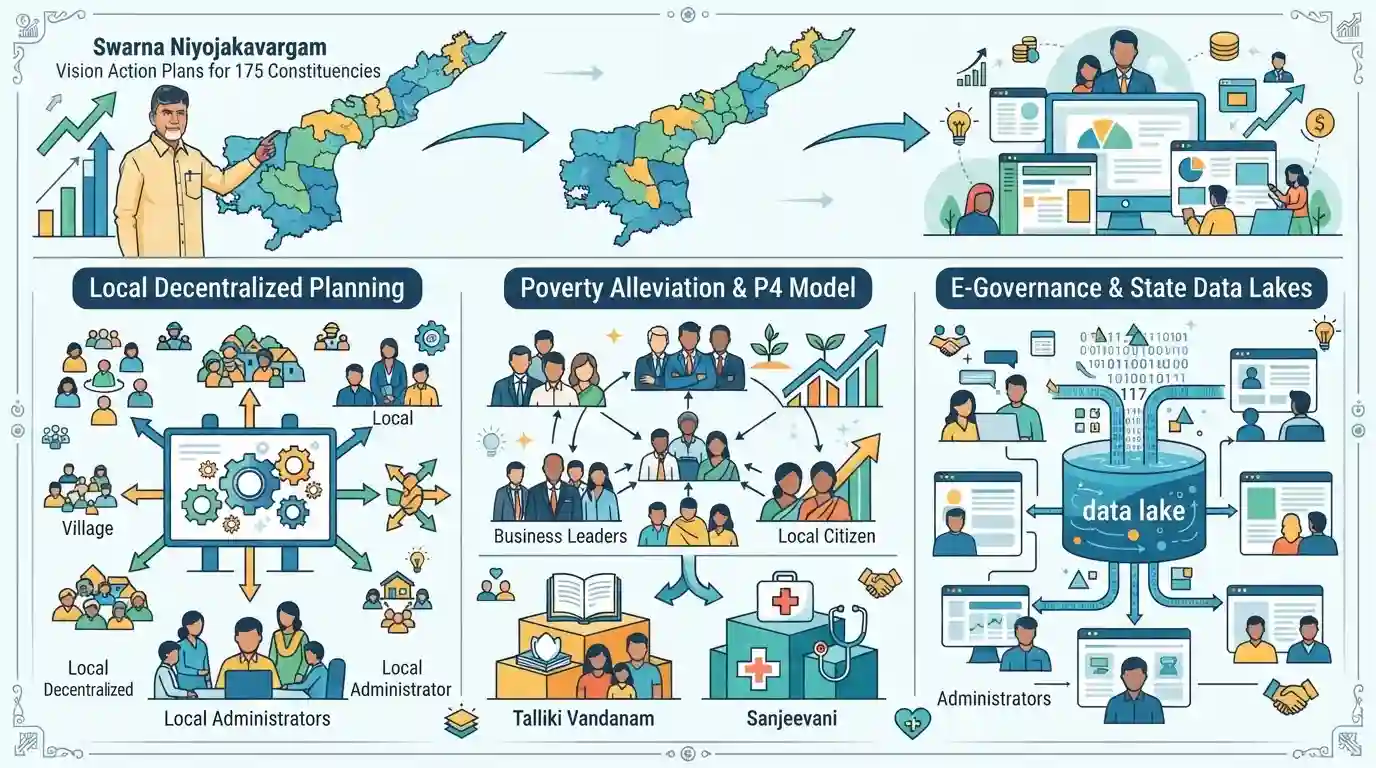
Andhra Pradesh Chief Minister N Chandrababu Naidu has directed administrators to aggressively implement the Swarna Niyojakavargam Vision Action Plans across all 175 constituencies. Utilizing the P4 (Public-Private-People Partnership) model, a newly-established Data Lake, and various state welfare initiatives like Talliki Vandanam and Sanjeevani, the state aims to drive localized growth, scale up human capital, and boost per capita income.
Key Points
- Swarna Niyojakavargam Vision Action Plans: AP is the first state in India to design and implement localized, constituency-specific action plans across all 175 Assembly constituencies, serving as a benchmark for local administration.
- P4 Model (Public-Private-People Partnership): Emphasizes active collaboration among local administrations, entrepreneurs, and corporate partners to uplift poor households and systematically enhance per capita income in each constituency.
- Data Lake and Tech Integration: The state has established a 'Data Lake' to map and analyze regional human and natural resources, using advanced data-driven tools to optimize service delivery.
- Administrative Capacity Building: To support these policy actions, AP state employees have successfully completed 1.50 crore online skill-upgradation courses.
- Welfare & Infrastructure Initiatives: Features key social interventions including the Sanjeevani healthcare initiative, Talliki Vandanam educational relief scheme, Mega DSC recruitment, and the public-participatory Wings to Dreams campaign for Bhogapuram International Airport.
Important Terms
Swarna Niyojakavargam Vision Action Plans

Localized, constituency-specific action plans across all 175 Assembly segments of Andhra Pradesh to map resources and drive decentralized socio-economic growth.
UPSC context
GS Paper II/III (Governance/Economy); tests decentralized local planning and constituency-level state development policies.
P4 Model (Public-Private-People Partnership)
A collaborative welfare model in Andhra Pradesh pairing wealthy mentors with underprivileged families to provide customized, non-cash livelihood support for poverty eradication.
UPSC context
GS Paper III (Economy); tests poverty alleviation models, community partnerships, and rural development strategies in Andhra Pradesh.
Sanjeevani healthcare initiative
A state-wide digital healthcare programme utilizing AI, universal digital health records, and drones to deliver predictive and curative medical care to remote and tribal areas.
UPSC context
GS Paper III (Health/Social Justice); tests technology integration in healthcare, rural medicine, and tribal welfare.
Talliki Vandanam scheme
An Andhra Pradesh welfare scheme providing ₹15,000 annually directly to mothers of school-going children (Classes 1–12) to reduce education's financial burden.
UPSC context
GS Paper III (Welfare Schemes); tests educational empowerment, women-centric welfare policies, and DBT initiatives.
Mega DSC teacher recruitment
A large-scale, merit-based public recruitment drive to fill over 16,000 vacant government teacher posts with high administrative transparency.
UPSC context
GS Paper II (Governance/HRD); tests state employment policies, educational reforms, and transparency in public recruitment.
Wings to Dreams of North Andhra campaign
A public participation campaign to secure voluntary community collaboration and support for the development of the Bhogapuram International Airport.
UPSC context
GS Paper III (Infrastructure); tests public partnership in infrastructure planning and regional development of North Andhra.
Prelims Trap
The Talliki Vandanam scheme restricts the ₹15,000 annual financial assistance to a maximum of two school-going children per household.
Unlike conventional state welfare caps, Talliki Vandanam explicitly imposes no ceiling on the number of school-going children per household, though it deducts ₹2,000 at source.
Static Concepts Connected
What is the constitutional mandate for District Planning Committees (DPCs) under Article 243ZD?
- Constitutional Mandate: Article 243ZD requires states to constitute DPCs to consolidate plans prepared by Panchayats and Municipalities into a draft district development plan.
- Key Considerations: DPCs must integrate common spatial planning, infrastructure sharing, and environmental conservation when drafting regional development plans.
- AP Localized Innovation: While DPCs focus on administrative districts, AP's Swarna Niyojakavargam introduces a unique assembly-constituency-level micro-planning model.
Cross-Topic Patterns
Localized planning meets SDG targets
Constituency-level Swarna Niyojakavargam plans directly align local resource mapping with UN Sustainable Development Goals, creating a model for sub-state SDG monitoring.
Welfare economics vs. Fiscal headroom
Balancing direct benefit transfers like Talliki Vandanam with capital projects like Bhogapuram Airport tests AP's medium-term fiscal health and debt sustainability.

APPSC is highly likely to test the unique operational metrics of P4 (MBK 10-20) and the child-ceiling exemptions under Talliki Vandanam.
Linked PYQs · 2
Linked PYQs · 2
- 2024APPSC_PRELIMSGS1
Which of the following statements are valid regarding the interventions of the Government of Andhra Pradesh in the context of Healthcare ? I. Telemedicine facility is available in all Ayushman Bharat Health and Wellness Centres (AB-HWCs) to avail specialist services through district hub. II. The Family Doctor Programme has been planned to be implemented as a standalone project without the need to be integrated with Primary Health Centres (PHCs). III. Dr. YSR Aarogyasri Scheme has been revamped, by increasing the income limit from ₹ 2.5 lakh to ₹ 5 lakh per annum per family. IV. 'Aarogya Aasara' Scheme is intended to provide post-operative sustenance allowance with certain eligible conditions complied with. Select the correct answer using the codes given below :
- 2023APPSC_PRELIMSGS1
One of the following welfare programmes implemented by Government of Andhra Pradesh is not part of Navaratnalu.
