US India Trade Talks and Protection of Domestic Agricultural Sector
Source:The Hindu ↗
Why It Matters
The article highlights the tension between international trade negotiations (like the US-India FTA) and the protection of domestic agricultural sectors. This is crucial for understanding India's stance in global trade, the impact of tariffs, and the balancing act required to ensure domestic food security and the livelihoods of millions of farmers while engaging with international markets.
Summary
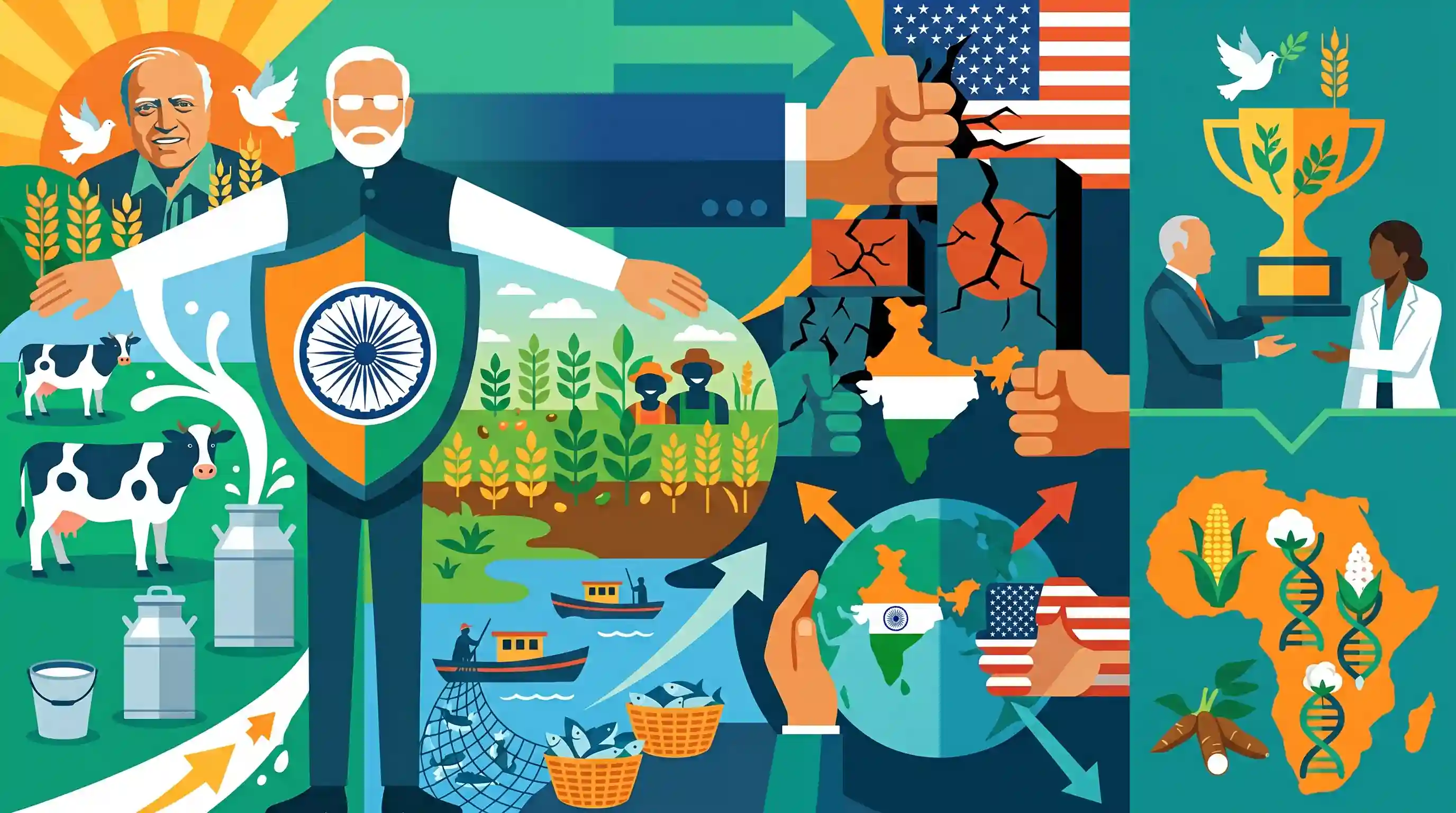
Prime Minister Narendra Modi asserted his commitment to protecting the interests of Indian farmers, dairy producers, and fishermen amidst ongoing Free Trade Agreement (FTA) negotiations with the United States. Speaking at the M.S. Swaminathan Centenary International Conference, Modi's remarks come in response to US pressure to open India's agricultural markets and recent 50% tariffs imposed on Indian imports. He underscored India's leading global position in the production of milk, pulses, jute, and several other commodities. During the event, the inaugural M.S. Swaminathan Annual Award for Food and Peace was presented to Nigerian scientist Ademola A. Adenle for his contributions to genetically modified agriculture policies in Africa.
Key Points
- Prime Minister Modi emphasized that India will prioritize protecting its farmers, dairy producers, and fishermen from any adverse impacts of a Free Trade Agreement (FTA) with the US.
- The statement follows US President Donald Trump's move to raise tariffs on all Indian imports to 50%, alongside US demands for greater access to India's dairy and agricultural markets.
- Modi highlighted India's agricultural prowess, noting it ranks first globally in producing milk, pulses, and jute, and second in rice, wheat, cotton, fruits, vegetables, and fish.
- Nigerian scientist Ademola A. Adenle received the first M.S. Swaminathan Annual Award for Food and Peace, recognized for his work on evidence-based policymaking regarding genetically modified (GM) agriculture in Africa.
Important Terms
Free Trade Agreement (FTA)

A formal pact between two or more countries to reduce or eliminate tariffs and non-tariff barriers on goods and services while establishing trade and investment rules.
UPSC context
GS Paper 2 (International Relations) and GS Paper 3 (Economy); tests trade diplomacy and protection of domestic sectors.
M.S. Swaminathan Annual Award for Food and Peace
A global honor established by The World Academy of Sciences (TWAS) recognizing individuals from developing nations for transformative contributions to food security, sustainable agriculture, and peacebuilding.
UPSC context
GS Paper 3 (Agriculture/Science); tests awareness of international awards and global leadership in food security.
M.S. Swaminathan Research Foundation (MSSRF)
A Chennai-based non-profit NGO founded in 1988 that leverages science and technology for sustainable rural development, environmental stability, and the 'Evergreen Revolution'.
UPSC context
GS Paper 3 (Agriculture/Environment); tests role of research institutions in promoting sustainable farming and biodiversity.
Genetically Modified (GM) Agriculture
The use of biotechnology to alter a plant's DNA, introducing traits like pest resistance, herbicide tolerance, or improved nutritional content to enhance food security.
UPSC context
GS Paper 3 (Science and Tech/Agriculture); tests understanding of biosafety, biotechnology, and agricultural ethics.
Evergreen Revolution
A concept pioneered by Dr. M.S. Swaminathan focusing on increasing agricultural productivity in perpetuity without causing ecological or social harm.
UPSC context
GS Paper 3 (Agriculture/Environment); tests knowledge of sustainable farming models as alternatives to chemical-intensive methods.
World Trade Organization (WTO)
The only global international organization dealing with the rules of trade between nations, ensuring trade flows as smoothly, predictably, and freely as possible.
UPSC context
GS Paper 2 (International Institutions); tests trade governance, dispute resolution, and agricultural subsidy boxes.
Prelims Trap
India ranks first globally in the production of rice, wheat, and milk.
India is first in milk, pulses, and jute, but second (behind China) in rice and wheat. UPSC frequently swaps 1st and 2nd rankings to trap aspirants.
Static Concepts Connected
Why does India resist including agriculture and dairy in Free Trade Agreements (FTAs)?
- Subsidy disparity: Developed nations heavily subsidize their farmers, making their agricultural and dairy exports artificially cheaper than India’s smallholder produce.
- Rural livelihood protection: India's dairy sector is dominated by landless and marginal farmers. Opening the market to highly subsidized foreign dairy could collapse rural incomes and cooperative structures.
- Non-tariff barriers: Developed nations often use stringent Sanitary and Phytosanitary (SPS) measures to block Indian agricultural exports while simultaneously demanding lower Indian tariffs.
How are Genetically Modified (GM) crops regulated in India?
- Apex regulator: The Genetic Engineering Appraisal Committee (GEAC), under the Ministry of Environment, Forest and Climate Change (MoEFCC), is the statutory body for GM approvals.
- Legal framework: GM crops are regulated under the 1989 Rules for the manufacture, use, import, and export of hazardous microorganisms/GE organisms, formulated under the Environment (Protection) Act, 1986.
- Current status: Bt Cotton is the only GM crop commercially cultivated in India. Other crops like Bt Brinjal and GM Mustard (DMH-11) face ongoing litigation and field trial hurdles.
Cross-Topic Patterns
FTAs + Dairy Cooperatives
India's refusal to open dairy in FTAs (RCEP, US) protects the socio-economic structure of Operation Flood, where milk acts as critical income insurance for landless and marginal farmers.
GM Crops + Evergreen Revolution
M.S. Swaminathan advocated for an "Evergreen Revolution" balancing tech with ecology. The new award focusing on evidence-based GM policy highlights the ongoing debate between biosafety and agricultural yield.

Expect a 2026 multi-statement question combining India's global agricultural production rankings with WTO/FTA dairy market access hurdles.
Linked PYQs · 4
Linked PYQs · 4
- 2023MainsGS3
What are the direct and indirect subsidies provided to farm sector in India? Discuss the issues raised by the World Trade Organization (WTO) in relation to agricultural subsidies.
- 2020PrelimsGS1
With reference to pulse production in India, consider the following statements: 1. Black gram can be cultivated as both kharif and rabi crop. 2. Green-gram alone accounts for nearly half of pulse production. 3. In the last three decades, while the production of kharif pulses has increased, the production of rabi pulses has decreased. Which of the statements given above is/are correct?
- 2021PrelimsGS1
Bollgard I and Bollgard II technologies are mentioned in the context of
- 2018PrelimsGS1
With reference to the Genetically Modified mustard (GM mustard) developed in India, consider the following statements: 1. GM mustard has the genes of a soil bacterium that give the plant the property of pest-resistance to a wide variety of pests. 2. GM mustard has the genes that allow the plant cross-pollination and hybridization. 3. GM mustard has been developed jointly by the IARI and Punjab Agricultural University. Which of the statements given above is/are correct?
