US and Iran Nuclear Program Talks in Rome
Source:Indian Express ↗
Why It Matters
The US-Iran nuclear standoff directly impacts global energy markets and regional stability in the Middle East. For India, a resolution is vital for energy security, stable oil prices, and the advancement of strategic connectivity projects like the Chabahar Port, which have been historically hindered by US sanctions on Iran.
Summary
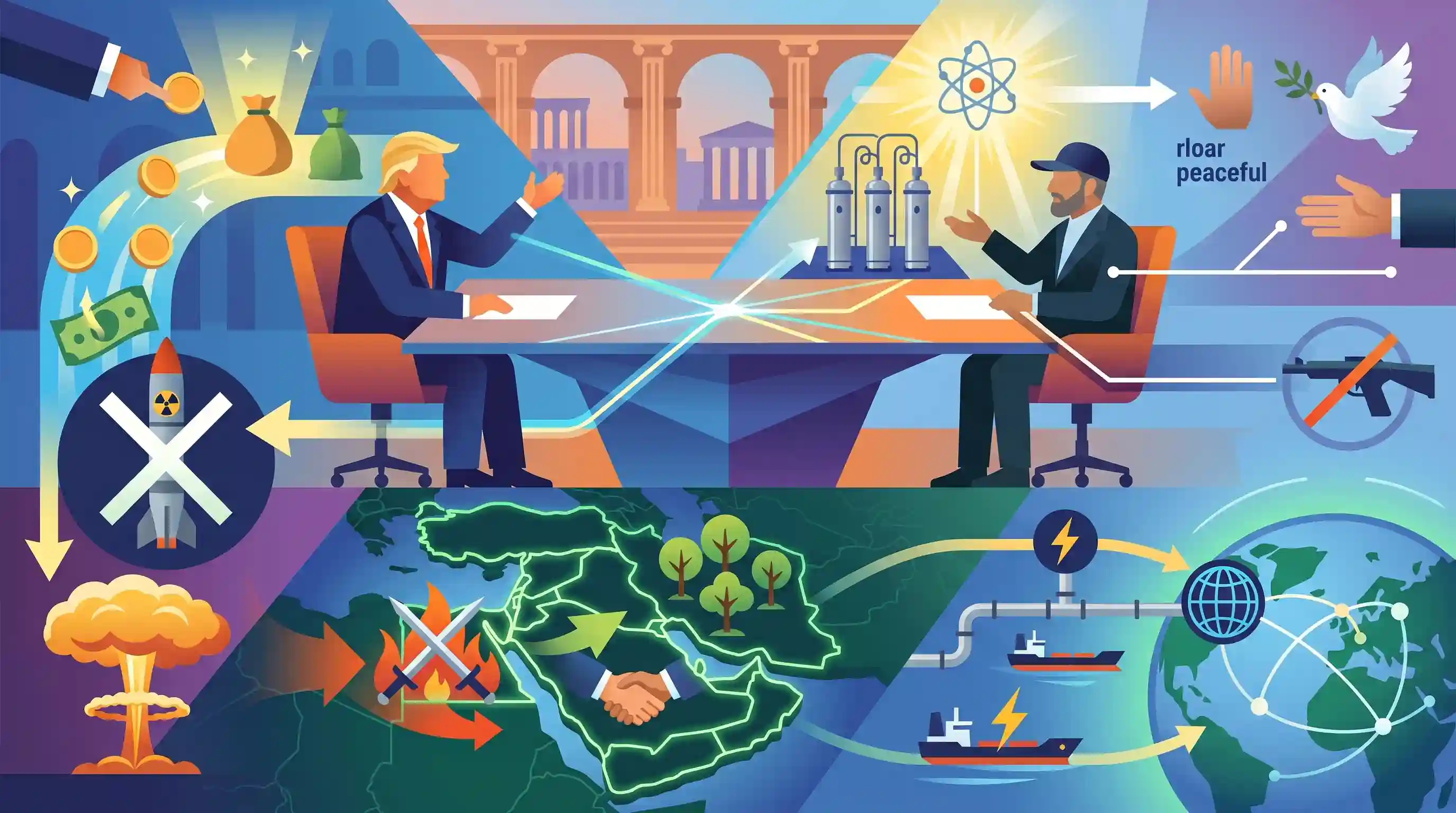
Iran and the United States are engaged in indirect negotiations in Rome concerning Iran's nuclear program. While Iran has expressed a willingness to compromise and offer assurances that its nuclear activities will not lead to weaponization, it maintains that its right to uranium enrichment for peaceful purposes is non-negotiable. US President Donald Trump has signaled optimism about reaching an agreement, emphasizing the prevention of a nuclear-armed Iran in exchange for economic relief from sanctions. These talks are crucial for de-escalating tensions in the Middle East and could have significant implications for global energy security and geopolitics.
Key Points
- Iran and the US are holding their fifth round of indirect talks in Rome, Italy, to address Iran's nuclear program.
- Iranian Foreign Minister Abbas Araghchi emphasized that Iran is willing to compromise to provide assurances against nuclear weaponization.
- Araghchi stated that uranium enrichment for peaceful nuclear energy is a red line and strictly non-negotiable.
- US President Donald Trump has expressed optimism regarding the talks, maintaining that Iran cannot possess nuclear weapons but offering economic revival.
- Iran seeks the lifting of crippling US sanctions in exchange for providing confidence-building measures regarding its nuclear activities.
Important Terms
Joint Comprehensive Plan of Action (JCPOA)

A 2015 landmark agreement between Iran and the P5+1 (UN Security Council permanent members and Germany) to limit Iran's nuclear program in exchange for lifting economic sanctions.
UPSC context
Critical for GS Paper II (International Relations). Tests knowledge of West Asian geopolitics and the impact of major power policies on India.
Uranium Enrichment
The technical process of increasing the concentration of the fissile isotope Uranium-235. Low-enriched uranium (3-5%) powers reactors; high-enriched uranium (90%+) is required for nuclear weapons.
UPSC context
Relevant for GS Paper III (Science & Technology) and GS Paper II (International Relations) regarding nuclear proliferation and energy security.
International Atomic Energy Agency (IAEA)
An autonomous international organization within the UN system that promotes peaceful nuclear energy use and verifies that nuclear materials are not diverted for military purposes.
UPSC context
Significant for GS Paper II (International Institutions). Tests understanding of global nuclear governance and verification mechanisms.
Non-Proliferation Treaty (NPT)
A 1968 international treaty aimed at preventing the spread of nuclear weapons, promoting peaceful energy, and achieving disarmament. India remains a non-signatory, citing the treaty's discriminatory nature.
UPSC context
Essential for GS Paper II (Multilateral Agreements). Evaluates India’s nuclear doctrine and its stance on global disarmament frameworks.
Economic Sanctions
Financial and trade penalties imposed by nations or international bodies to coerce a state into changing its behavior, often used as a non-military foreign policy tool.
UPSC context
Crucial for GS Paper II (Foreign Policy). Examines the 'Maximum Pressure' strategy and its repercussions on global trade and India’s interests.
Energy Security
A nation's ability to ensure a stable and affordable supply of energy. For India, Iran is a strategic partner for oil imports and regional connectivity projects.
UPSC context
Key for GS Paper II and III. Focuses on India's strategic autonomy and projects like the Chabahar Port and INSTC.
Prelims Trap
"Iran is not a signatory to the Non-Proliferation Treaty (NPT)."
Aspirants often confuse Iran's nuclear controversies with non-signatories like India, Israel, and Pakistan. Iran IS an NPT signatory; the dispute is over compliance and enrichment limits.
Static Concepts Connected
What distinguishes Low-Enriched Uranium (LEU) from Highly Enriched Uranium (HEU)?
- Low-Enriched Uranium (LEU): Enriched to 3-20% U-235, it is used primarily for commercial light-water power reactors and peaceful scientific research.
- Highly Enriched Uranium (HEU): Enriched above 20%. Weapons-grade HEU requires an enrichment level of 90% or higher to be viable for nuclear warheads.
- Dual-Use Technology: Both processes use identical centrifuge technology, making strict IAEA monitoring necessary to ensure LEU isn't further enriched into HEU.
How do IAEA Comprehensive Safeguards differ from the Additional Protocol?
- Comprehensive Safeguards: Mandatory for non-nuclear NPT states, allowing the IAEA to verify only declared nuclear material and declared facilities.
- Additional Protocol: A voluntary agreement granting the IAEA broader access rights to inspect undeclared sites and verify the absence of covert activities.
Cross-Topic Patterns
US Sanctions + Chabahar Exemption
US-Iran relations dictate the viability of India's Chabahar Port and INSTC ambitions, which historically relied on fragile US waivers from secondary sanctions to proceed.
Maritime Chokepoints + Energy Security
Diplomatic de-escalation secures the Strait of Hormuz from military blockades, stabilizing global oil and LNG prices while safeguarding India's highly vulnerable Middle East energy imports.

Expect a 2026 Prelims question mapping Middle East chokepoints (Hormuz) or distinguishing IAEA Comprehensive vs Additional protocols.
Linked PYQs · 2
Linked PYQs · 2
- 2018MainsGS2
In what ways would the ongoing US-Iran Nuclear Pact Controversy affect the national interest of India? How should India respond to this situation?
- 2025MainsGS2
"Energy security constitutes the dominant kingpin of India's foreign policy, and is linked with India's overarching influence in Middle Eastern countries.” How would you integrate energy security with India's foreign policy trajectories in the coming years?
