Karnataka Socio-Economic Survey and Caste Re-Enumeration
Source:Indian Express ↗
Why It Matters
The issue illustrates the intense intersection of caste demographics, affirmative action policy, and internal party politics in India. It is highly relevant for understanding the demands for a nationwide caste census, the political anxieties of dominant vs. backward classes, and the top-down functioning of political parties in shaping state-level socio-economic policies.
Summary
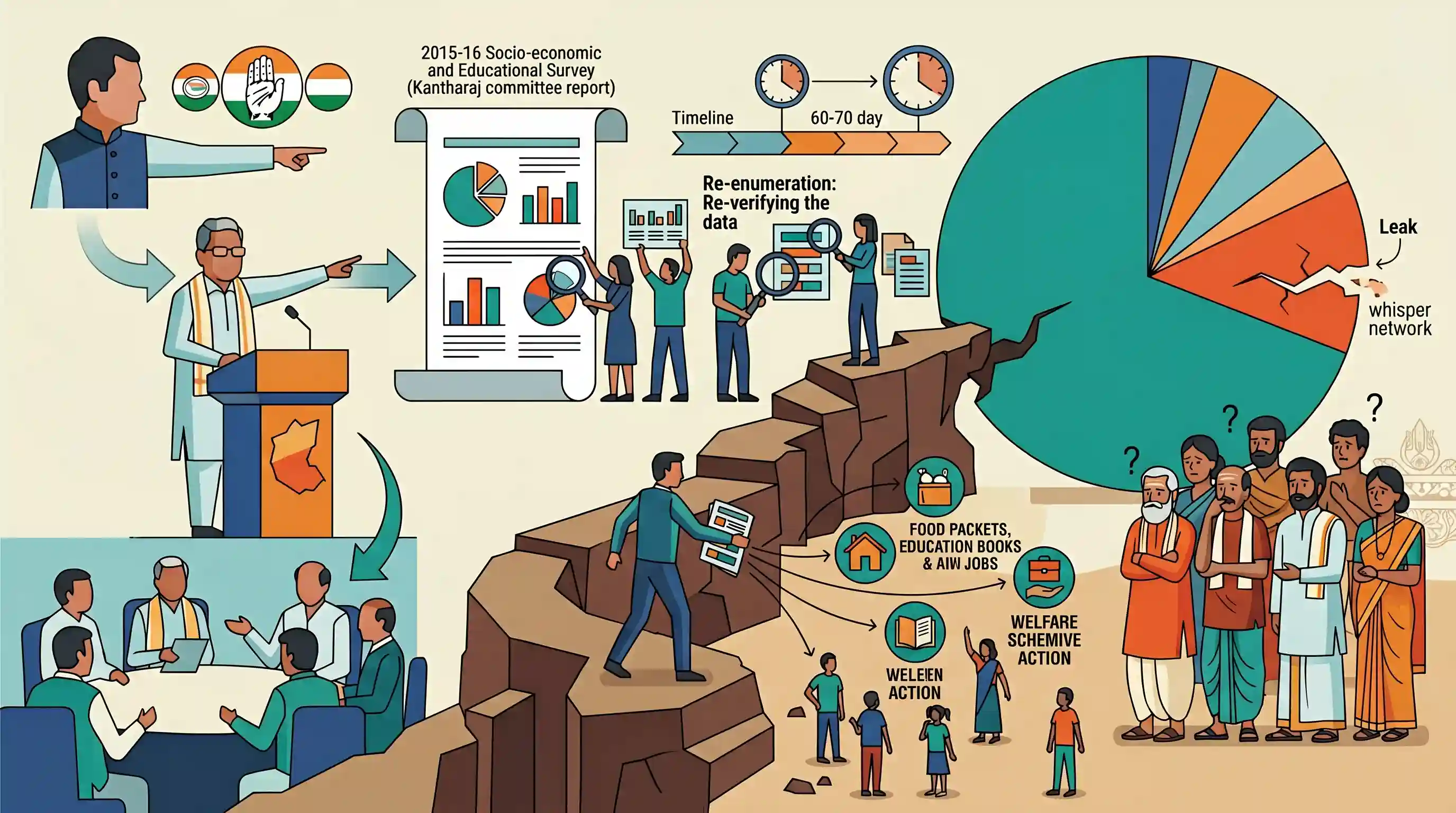
Karnataka Chief Minister Siddaramaiah announced a re-enumeration of the caste population data for the state's Socio-economic and Educational Survey, a move he attributed to directives from the Congress high command rather than an independent state government decision. The fresh data collection, slated to finish within 60-70 days, seeks to update the original 2015-16 Kantharaj committee report, the recommendations of which have been "principally accepted" by the state Cabinet. The update navigates sensitive political terrain, addressing anxieties among dominant communities like Lingayats and Vokkaligas over leaked data suggesting OBCs constitute nearly 70% of the state's population.
Key Points
- The Karnataka government announced a re-enumeration of caste population data to update the state's 2015-16 Socio-economic and Educational Survey.
- CM Siddaramaiah noted that the directive for re-enumeration came directly from the Congress high command, reflecting top-down political dynamics.
- The Cabinet has "principally accepted" the recommendations of the Kantharaj committee report while commissioning the fresh data collection to be completed in 60-70 days.
- The initial report caused political friction by allegedly revealing that Other Backward Classes (OBCs) make up 70% of the state's population, sparking anxieties among dominant communities like Lingayats and Vokkaligas.
- The census is crucial for formulating data-driven affirmative action and welfare schemes, yet it remains deeply embedded in electoral politics.
Important Terms
Socio-economic and Educational Survey (SEES)

A comprehensive state-level exercise mapping demographic, social, and economic data of all castes to refine welfare targeting and reservation policies. Usually conducted by state Backward Classes Commissions.
UPSC context
GS Paper 2: Social Justice; GS Paper 1: Indian Society. Tests understanding of data-driven governance and inclusion.
Karnataka State Commission for Backward Classes
A statutory body established under the Karnataka State Commission for Backward Classes Act, 1995, mandated to investigate and recommend the inclusion/exclusion of communities in the state's OBC list.
UPSC context
GS Paper 2: Statutory and quasi-judicial bodies. Relevant for questions on institutional frameworks for social justice.
Kantharaj Committee Report
The 2015-16 survey report headed by H. Kantharaj that first enumerated Karnataka's caste population; its recent 'in-principle' acceptance and planned update are central to current state politics.
UPSC context
GS Paper 2: Government policies and interventions. Crucial for understanding regional implementations of affirmative action.
Caste Census
The enumeration of population based on caste identity. Unlike the decennial Census (which counts only SCs/STs), it seeks granular data for all groups to assess representation.
UPSC context
GS Paper 1: Social Issues; GS Paper 2: Polity. Tests debates on identity politics vs. evidence-based policymaking.
Indra Sawhney Judgment (1992)
The landmark Supreme Court ruling that capped reservations at 50% and introduced the 'creamy layer' concept. State caste surveys often seek to challenge this ceiling with new data.
UPSC context
GS Paper 2: Indian Constitution and Judiciary. Essential for questions on the legal limits of reservation.
Affirmative Action
Policies designed to compensate for historical discrimination against specific groups, such as reservation in education and employment, based on socio-economic and educational backwardness.
UPSC context
GS Paper 2: Welfare schemes for vulnerable sections. Core concept for social justice and equality of opportunity.
Prelims Trap
States possess concurrent constitutional powers to conduct a formal Caste Census.
A formal 'Census' is exclusively a Union subject under Entry 69, List I. States legally bypass this by conducting socio-economic 'surveys' for data collection.
Static Concepts Connected
Why do States conduct 'Socio-Economic Surveys' instead of a Caste Census?
- Union Monopoly: A 'Census' falls under Entry 69 of the Union List, giving Parliament exclusive domain under the Census Act, 1948.
- State Workaround: States utilize executive orders and statutory bodies to conduct 'surveys', legally bypassing the Union List to gather localized demographic data.
- Constitutional Mandate: Judgments like Indra Sawhney mandate that modifications to reservation quotas under Articles 15(4) and 16(4) must be backed by empirical, quantifiable data on backwardness.
What is 'High Command Culture' in Indian politics?
- Centralized Authority: It refers to the heavy concentration of decision-making power within the national leadership of a political party, overriding local state units.
- Impact on Federalism: It dilutes state autonomy, as policies and leadership choices are often dictated by national electoral strategies rather than localized socio-economic needs.
Cross-Topic Patterns
Caste Surveys & Sub-classification
The Supreme Court's 2024 ruling allowing SC/ST sub-classification makes empirical state-level data collection constitutionally vital to defend newly targeted quotas.
Welfare vs. Dominant Agrarian Castes
Data revealing massive OBC populations frequently triggers backlash from historically dominant agrarian castes (like Lingayats, Vokkaligas, or Marathas) fearing a loss of their political and electoral hegemony.

Entry 69 (Census) vs state survey powers and the SC's empirical data mandate will likely form a multi-statement polity question in 2026.
Linked PYQs · 3
Linked PYQs · 3
- 2018MainsGS1
Caste system is assuming new identities and associational forms. Hence, caste system cannot be eradicated in India." Comment.
- 2020MainsGS1
Has caste lost its relevance in understanding the multi-cultural Indian Society? Elaborate your answer with illustrations.
- 2014MainsGS2
Do government's schemes for up-lifting vulnerable and backward communities by protecting required social resources for them, lead to their exclusion in establishing businesses in urban economies ?
