Reserve Bank of India Tightens Regulations on Revolving Credit
Source:The Hindu ↗
কেন এটি গুরুত্বপূর্ণ
Revolving credit products play a major role in expanding financial inclusion but can precipitate systemic risks if unregulated. Understanding the RBI's macroprudential tools, such as adjusting risk weights, is essential for UPSC aspirants analyzing India's financial stability, shadow banking, and consumer protection frameworks.
সারসংক্ষেপ
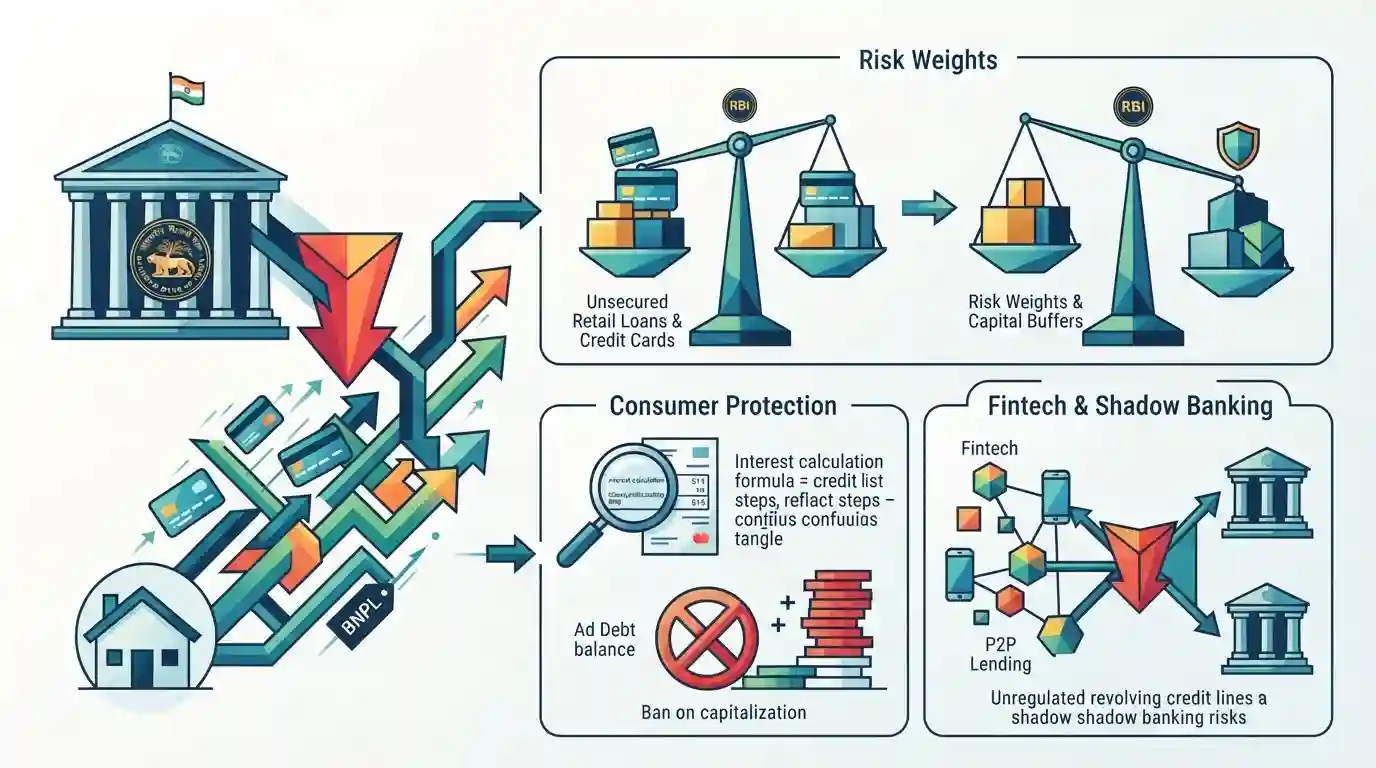
The Reserve Bank of India (RBI) has proactively tightened regulations around 'revolving credit'—a flexible financing mechanism where borrowers can repeatedly access and repay funds up to a set limit, such as through credit cards, overdrafts, and Buy Now Pay Later (BNPL) schemes. Driven by concerns over the rapid growth of unsecured retail loans and rising household debt, the RBI has deployed macroprudential tools to curb overheating in this sector. Key measures include increasing the risk weights on consumer credit and credit card receivables, which mandates commercial banks and NBFCs to hold larger capital buffers, effectively making unsecured lending costlier. Additionally, the RBI has prioritized consumer protection by banning the capitalization of penal charges and enhancing transparency in interest calculations to prevent debt traps. Recent regulations have also targeted fintechs and Peer-to-Peer (P2P) lending platforms, restricting them from offering unregulated revolving credit lines to mitigate shadow banking risks and ensure broader systemic stability.
মূল বিষয়
- Revolving credit is a financial facility that allows borrowers to continuously draw down, repay, and redraw funds up to a pre-approved limit, commonly seen in credit cards and overdrafts.
- The RBI has raised concerns over the disproportionate surge in unsecured retail lending, identifying it as a potential source of systemic risk and unsustainable household debt.
- To mitigate these risks, the RBI has utilized macroprudential measures, notably increasing risk weights on consumer credit and credit card loans, forcing banks and NBFCs to maintain higher capital reserves.
- The central bank has introduced strict consumer protection norms, ensuring transparency in Minimum Amount Due (MAD) calculations and prohibiting the capitalization of penal interest to protect borrowers from debt traps.
- Regulatory perimeters have been expanded to restrict fintechs and P2P lending platforms from offering shadow banking-like revolving credit, ensuring balanced financial inclusion without systemic instability.
গুরুত্বপূর্ণ শব্দ
Non-Banking Financial Companies (NBFCs)

Financial institutions registered under the Companies Act that provide banking-like services but cannot accept demand deposits, issue cheques, or access deposit insurance.
UPSC context
GS Paper III (Indian Economy). Tests shadow banking, financial inclusion, and regulatory differences with commercial banks.
Peer-to-Peer (P2P) Lending Guidelines
RBI regulations classifying online loan aggregators as NBFC-P2Ps, restricting credit guarantees, capping loan exposures, and limiting domestic borrowing tenures.
UPSC context
GS Paper III (Indian Economy/Fintech). Tests regulatory frameworks governing fintech innovations and shadow banking risks.
Buy Now Pay Later (BNPL)
A short-term consumer credit option allowing point-of-sale purchase financing, regulated by RBI to ensure credit bureau reporting and licensed lender partnerships.
UPSC context
GS Paper III (Indian Economy). Tests digital payment ecosystems, retail lending regulations, and systemic consumer debt.
Risk Weights
The percentage multiplier applied to loan exposures, dictating how much regulatory capital banks or NBFCs must maintain to absorb potential credit defaults.
UPSC context
GS Paper III (Banking Sector). Tests capital adequacy ratio (CAR), Basel III standards, and lending cooling mechanisms.
Macroprudential Tools
Policy mechanisms used by central banks to manage systemic, system-wide financial risks and preserve overall stability rather than targeting individual institutions.
UPSC context
GS Paper III (Monetary Policy). Tests financial system stability and macroprudential vs microprudential policy tools.
প্রিলিমস ফাঁদ
The RBI allows banks to capitalize penal interest by compounding it with the principal to deter default.
Under the RBI's Fair Lending Practice framework, penalties for loan defaults must be levied strictly as 'penal charges' and cannot be capitalized (compounded) or added to the interest rate as 'penal interest'.
সংযুক্ত স্থির ধারণা
What is Capital Adequacy Ratio (CAR) and how do risk weights influence bank lending?
- Definition: CAR measures a bank's capital relative to its risk-weighted assets (RWA) to ensure it can absorb a reasonable amount of loss.
- Calculation: CAR is calculated as (Tier 1 Capital + Tier 2 Capital) divided by Risk-Weighted Assets. RBI mandates a 9% minimum CAR for scheduled commercial banks.
- Risk Weight Mechanism: Assets are weighted by risk (e.g., 0% for government bonds, 125% for unsecured credit). Higher risk weights increase the denominator (RWA).
- Regulatory Impact: To maintain the mandated CAR when risk weights rise, banks must either raise fresh capital or restrict lending to that specific sector.
How do macroprudential tools differ from monetary policy instruments?
- Primary Objective: Monetary policy focuses on price stability and economic growth, while macroprudential policy targets systemic risk and financial stability.
- Specificity: Monetary tools (e.g., Repo, CRR) are blunt instruments affecting the entire economy, whereas macroprudential tools are highly targeted.
- Key Instruments: Macroprudential tools include sector-specific risk weights, Loan-to-Value (LTV) limits, and countercyclical capital buffers.
আন্তঃবিষয় প্যাটার্ন
Financial Inclusion vs Financial Overheating
Rapid credit expansion via BNPL and fintech drives consumption but risks household debt traps, testing the balance between credit penetration and systemic banking stability.
Shadow Banking and NBFC Systemic Risk
Tightening regulations on fintechs and P2P lenders blocks regulatory arbitrage, ensuring non-bank entities cannot bypass standard commercial banking risk safeguards.

Concepts like risk weights, CAR, and RBI's macroprudential tools are highly likely to appear in a conceptual multi-statement MCQ.
সংযুক্ত PYQ · 3
সংযুক্ত PYQ · 3
- 2024PrelimsGS1
Consider the following statements : Statement-I : Syndicated lending spreads the risk of borrower default across multiple lenders. Statement-II : The syndicated loan can be a fixed amount/lump sum of funds, but cannot be a credit line. Which one of the following is correct in respect of the above statements?
- 2024MainsGS3
What are the causes of persistent high food inflation in India? Comment on the effectiveness of the monetary policy of the RBI to control this type of inflation.
- 2022MainsGS3
Is inclusive growth possible under market economy ? State the significance of financial inclusion in achieving economic growth in India.
