Reserve Bank of India Expected Credit Loss Provisioning Framework
Source:The Hindu ↗
Why It Matters
Understanding the RBI's ECL framework is critical for aspirants as it represents a fundamental shift in how Indian banks manage credit risk, provisioning, and capital adequacy. Questions on Basel norms, NPAs, and RBI guidelines frequently appear in GS3 Economy and Prelims.
Summary
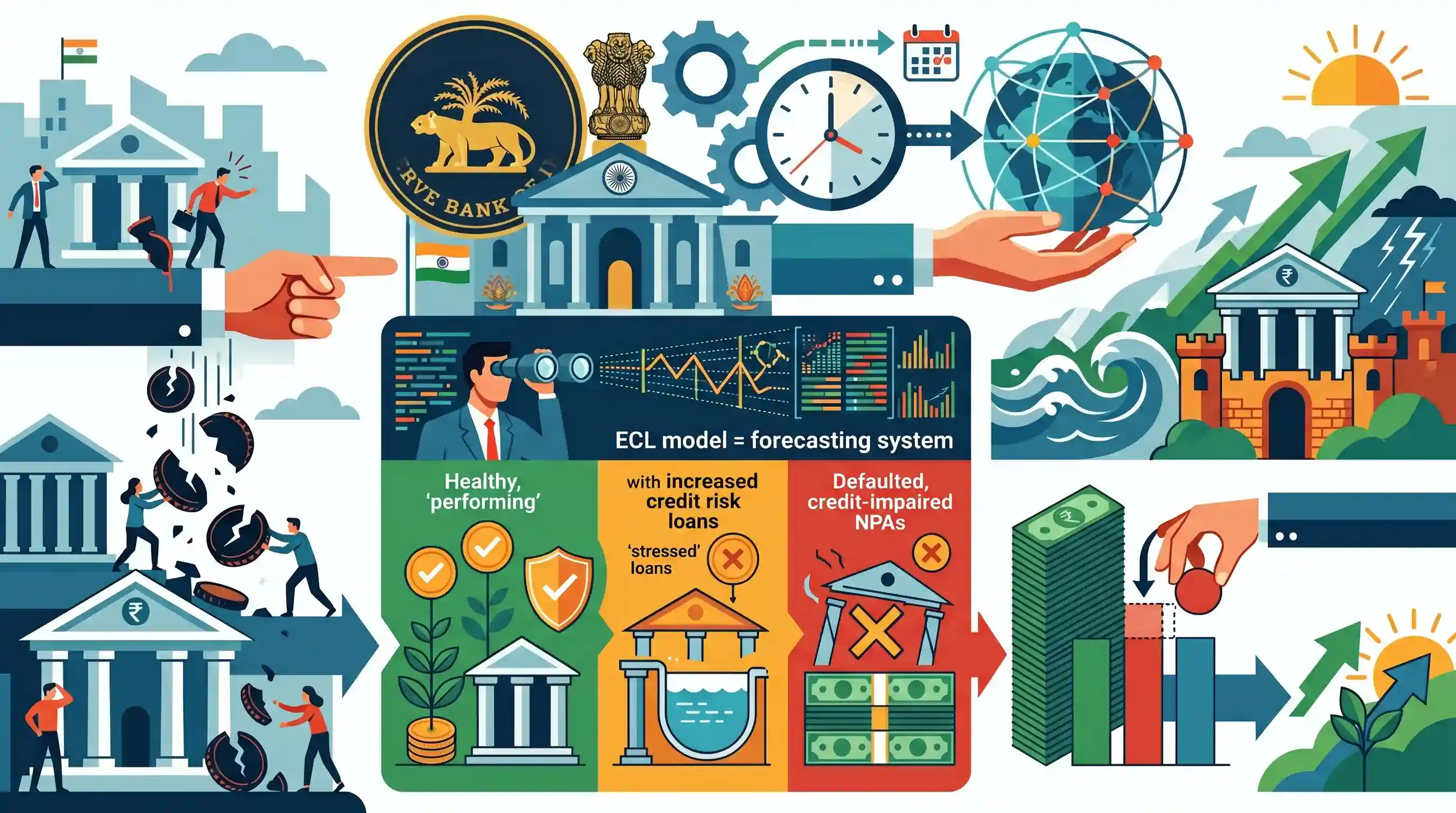
The Reserve Bank of India (RBI) is proposing new bad loan norms based on the Expected Credit Loss (ECL) method, transitioning Indian banks from an incurred loss approach to a forward-looking provision system. This change aligns with the global IFRS-9 framework. Taking effect from April 2027, the new norms will classify non-performing assets (NPAs) into three stages based on credit risk. The transition will likely impose a short-term cost impact on banks' profitability and capital adequacy, estimated to decrease their common equity tier-1 (CET-1) capital by 120 basis points, while ultimately strengthening the financial system.
Key Points
- The RBI will implement an expected credit loss (ECL) framework for bank provisioning starting April 1, 2027, shifting away from the incurred loss model.
- This transition aligns the Indian banking sector with the global IFRS-9 accounting standards initially introduced in 2008.
- Under the new norms, loans will be classified into three stages based on credit risk, requiring either 12-month ECL or lifetime ECL provisions.
- NPA classification will shift from an account level to a borrower level, meaning one defaulted loan will classify all of a borrower's loans as non-performing.
- The new provisioning requirements are expected to have a one-time cost impact, reducing banks' common equity tier-1 (CET-1) capital by a net 120 basis points.
Important Terms
Expected Credit Loss (ECL) Framework

A forward-looking accounting method where banks estimate and set aside funds for potential future loan defaults from the moment credit is extended, rather than waiting for an actual default.
UPSC context
GS Paper III (Economy); tests understanding of banking reforms, financial stability, and RBI’s shift toward global accounting standards.
Incurred Loss Model
The traditional accounting method where banks recognize credit losses and create financial provisions only after a default event or objective evidence of impairment has already occurred.
UPSC context
GS Paper III (Economy); tests knowledge of traditional vs. modern risk management frameworks and the evolution of Indian banking regulations.
Common Equity Tier-1 (CET-1) Capital
The highest quality core capital of a bank, primarily comprising common shares and retained earnings, used to absorb losses on a going-concern basis to ensure solvency.
UPSC context
GS Paper III (Economy); tests comprehension of Basel III norms, capital adequacy requirements, and bank resilience against systemic shocks.
IFRS-9 (International Financial Reporting Standard 9)
An international financial reporting standard for financial instruments that mandates a proactive "expected credit loss" approach to prevent delayed recognition of bad loans.
UPSC context
GS Paper III (Economy); tests awareness of global financial standards and India’s efforts to align domestic banking with international best practices.
Provisioning
The act of setting aside a portion of a bank’s profits to cover potential future losses from bad loans, ensuring the institution remains financially healthy.
UPSC context
GS Paper III (Economy); tests understanding of NPA management, bank profitability, and the impact of regulatory changes on credit availability.
Non-Performing Assets (NPAs)
Loans or advances for which the principal or interest payment remains overdue for 90 days or more; new norms suggest classification at the borrower level.
UPSC context
GS Paper III (Economy); tests knowledge of asset classification, credit discipline, and recent RBI mandates on borrower-level identification.
Prelims Trap
"The Expected Credit Loss (ECL) model requires banks to provision for bad loans only after an actual default occurs."
This defines the outgoing 'incurred loss' model. The new ECL framework forces banks to provision for potential future losses before actual defaults materialize.
Static Concepts Connected
What is Common Equity Tier 1 (CET-1) capital under Basel III?
- Core Equity: The highest quality of regulatory capital held by banks, primarily consisting of common shares and disclosed reserves (retained earnings).
- Primary Buffer: It absorbs immediate financial losses, ensuring the bank remains solvent during economic downturns without requiring taxpayer bailouts.
- Regulatory Floor: Basel III mandates strict minimum percentages of a bank's risk-weighted assets to be held as CET-1 to ensure systemic stability.
How are Non-Performing Assets (NPAs) traditionally classified in India?
- Substandard Assets: Loans that have remained non-performing (interest/principal overdue for more than 90 days) for a period less than or equal to 12 months.
- Doubtful Assets: Assets that have remained in the substandard category for a period of 12 months, requiring higher provisioning.
- Loss Assets: Assets identified as uncollectible losses by the bank, internal auditors, or RBI, but not yet fully written off the books.
Cross-Topic Patterns
ECL and Twin Balance Sheet syndrome
Forward-looking provisioning (ECL) complements the Insolvency and Bankruptcy Code (IBC) by forcing early recognition of corporate stress, preventing the 'extend and pretend' loan crises of the 2010s.
IFRS-9 and global standardisation
Moving to IFRS-9 and linking NPA status to the 'borrower-level' rather than 'account-level' tightens systemic risk controls, reflecting India's deeper integration with post-2008 global financial surveillance frameworks.

Expect a 2026 Prelims question contrasting 'incurred loss' vs 'expected credit loss', alongside CET-1 capital definitions under Basel III.
Linked PYQs · 4
Linked PYQs · 4
- 2018PrelimsGS1
Consider the following statements: 1. Capital Adequacy Ratio (CAR) is the amount that banks have to maintain in the form of their own funds to offset any loss that banks incur if the account-holders fail to repay dues. 2. CAR is decided by each individual bank. Which of the statements given above is/are correct?
- 2019PrelimsGS1
Which of the following is not included in the assets of a commercial bank in India?
- 2024PrelimsGS1
Consider the following statements : 1. In India, Non-Banking Financial Companies can access the Liquidity Adjustment Facility window of the Reserve Bank of India. 2. In India, Foreign Institutional Investors can hold the Government Securities (G-Secs). 3. In India, Stock Exchanges can offer separate trading platforms for debts. Which of the statements given above is/are correct?
- 2020PrelimsGS1
In the context of the Indian economy, non-financial debt includes which of the following? 1. Housing loans owed by households 2. Amounts outstanding on credit cards 3. Treasury bills Select the correct answer using the code given below:
