RBI Monetary Policy Committee Minutes Signal Interest Rate Pressures
Source:The Hindu ↗
কেন এটি গুরুত্বপূর্ণ
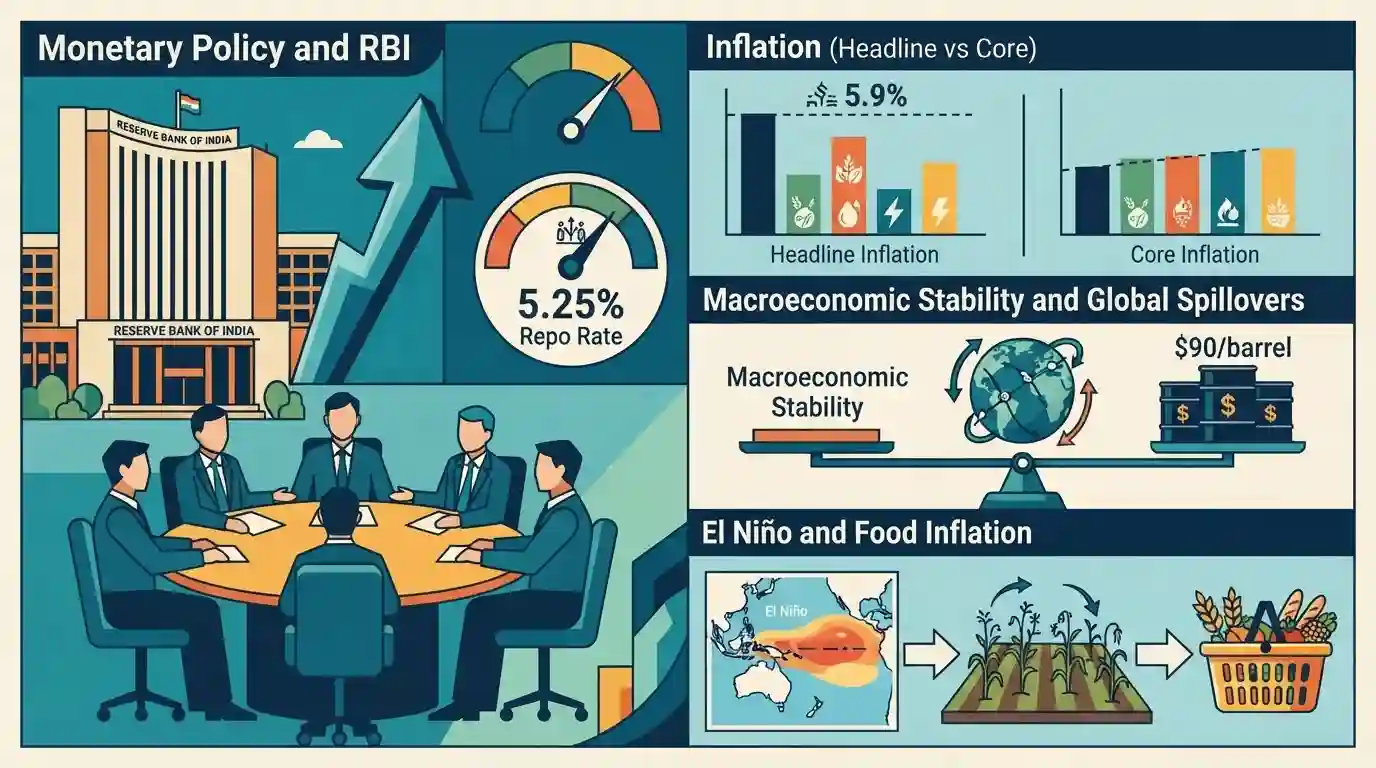
This article provides crucial contemporary insights into India's monetary policy formulation, showing how the RBI balances growth objectives against complex inflationary pressures (such as core/headline inflation divergences, supply-side El Niño shocks, and global oil prices). It directly addresses core concepts of the UPSC Economics syllabus, including the function of the MPC, inflation targeting, and external economic shocks.
সারসংক্ষেপ
The minutes of the August 2026 RBI Monetary Policy Committee (MPC) meeting suggest a potential 'hardening' or increase of the policy repo rate (currently at 5.25%) later in the year. Although the MPC opted to maintain a wait-and-watch approach to assess weather-related (El Niño) and geopolitical uncertainties, members expressed concern over headline inflation potentially peaking at 5.9% in Q3 2026-27, core inflation rising, and global oil prices averaging $90 per barrel. The committee ruled out any further monetary easing, focusing instead on anchoring household inflation expectations and preventing supply-side shocks from triggering secondary broad-based inflation.
মূল বিষয়
- The minutes of the August 2026 Monetary Policy Committee (MPC) meeting indicate a strong signal towards the hardening of interest rates (potential policy rate hikes) in the near future due to upward inflationary pressures.
- The benchmark Policy Repo Rate has been maintained at 5.25% since February 2026, but further monetary policy easing is ruled out.
- RBI Governor Sanjay Malhotra highlighted that while average inflation last year was 2% (when the repo rate was set to 5.25%), headline inflation has averaged 3.93% in 2026, and core inflation is projected to average 4.3% in 2026-27. This suggests a need for policy recalibration, though he prefers waiting for more data certainty.
- Deputy Governor Poonam Gupta stated that headline inflation is projected to peak at 5.9% in Q3 of 2026-27, which may build a strong case for rate hikes. Growth projections assume global crude oil prices averaging around $90 per barrel, aligning with the IMF's July 2026 World Economic Outlook (WEO) update.
- MPC members emphasized risks from secondary effects of inflation (such as pass-throughs of high fuel and input costs to consumer prices), unanchoring of household inflation expectations, geopolitical conflict spillovers, and weather-related disruptions (like El Niño's impact on food prices).
গুরুত্বপূর্ণ শব্দ
Monetary Policy Committee (MPC)

A six-member committee led by the RBI Governor. It determines the benchmark policy interest rate (repo rate) required to achieve the flexible inflation target set by the government.
UPSC context
GS Paper 3 (Economy). Tests knowledge of RBI's institutional framework, statutory mandates (RBI Act), and inflation targeting mechanisms.
Policy Repo Rate
The benchmark interest rate at which the Reserve Bank of India lends short-term funds to commercial banks. It is the RBI's primary tool to control inflation and manage money supply.
UPSC context
GS Paper 3 (Economy). Crucial for Prelims MCQs and understanding monetary policy transmission, liquidity management, and growth-inflation dynamics.
Headline Inflation
The total inflation rate in an economy, measured by the overall change in the Consumer Price Index (CPI). It includes all goods and services, including highly volatile food and fuel prices.
UPSC context
GS Paper 3 (Economy). Important for Prelims and analyzing how supply shocks like El Niño impact consumer cost-of-living.
Core Inflation
A measure of underlying inflation that excludes highly volatile items like food and fuel. It provides a clearer view of long-term, demand-driven price pressures, guiding central banks in monetary policy.
UPSC context
GS Paper 3 (Economy). Vital for distinguishing structural price pressures from transitory shocks when assessing RBI's policy decisions.
Hardening of Interest Rates
A monetary scenario where the central bank increases benchmark policy rates or reduces market liquidity to control inflation. This drives up the cost of borrowing for both businesses and the government.
UPSC context
GS Paper 3 (Economy). Relevant for understanding macroeconomic impacts on private credit growth, government borrowing costs, and liquidity.
প্রিলিমস ফাঁদ
The inflation target under the flexible framework is determined and revised periodically by the Monetary Policy Committee (MPC).
The inflation target is determined by the Central Government in consultation with the RBI (Section 45ZA), not by the MPC itself.
সংযুক্ত স্থির ধারণা
What is the structural difference between Headline and Core Inflation?
- Volatility Component: Headline inflation measures price changes in the entire CPI basket, while Core inflation excludes volatile food and fuel components.
- Policy Sensitivity: Core inflation reflects long-term economic demand pressures, making it more responsive to RBI rate changes than supply-driven headline inflation.
What is the statutory mandate and composition of the Monetary Policy Committee (MPC)?
- Statutory Basis: Constituted under Section 45ZB of the amended RBI Act, 1934, to determine the policy repo rate required to achieve the inflation target.
- Composition: Consists of six members: three from the RBI (including the Governor) and three appointed by the Central Government.
- Decision Rule: Decisions are taken by a majority vote, with the RBI Governor holding a casting vote in case of a tie.
আন্তঃবিষয় প্যাটার্ন
Climate anomalies + monetary policy limits
Frequent El Niño events cause supply-side food inflation (45.86% CPI weight), rendering demand-side interest rate hikes less effective and highlighting the need for agricultural storage reforms.
Global crude shocks + fiscal arithmetic
Crude at $90/bbl forces a hawkish RBI monetary policy to prevent imported inflation, while simultaneously straining India's Current Account Deficit and fiscal subsidy allocations.

Expect a multi-statement question linking CPI/WPI structural composition with the statutory process of setting inflation targets under the RBI Act.
সংযুক্ত PYQ · 4
সংযুক্ত PYQ · 4
- 2017PrelimsGS1
Which of the following statements is/are correct regarding the Monetary Policy Committee (MPC)? 1. It decides the RBI's benchmark interest rates. 2. It is a 12-member body including the Governor of RBI and is reconstituted every year. 3. It functions under the chairmanship of the Union Finance Minister. Select the correct answer using the code given below:
- 2020PrelimsGS1
Consider the following statements: 1. The weightage of food in Consumer Price Index (CPI) is higher than that in Wholesale Price Index (WPI). 2. The WPI does not capture changes in the prices of services, which CPI does. 3. Reserve Bank of India has now adopted WPI as its key measure of inflation and to decide on changing the key policy rates. Which of the statements given above is/are correct?
- 2022PrelimsGS1
With reference to the Indian economy, consider the following statements: 1. If the inflation is too high, Reserve Bank of India (RBI) is likely to buy government securities. 2. If the rupee is rapidly depreciating, RBI is likely to sell dollars in the market. 3. If interest rates in the USA or European Union were to fall, that is likely to induce RBI to buy dollars. Which of the statements given above are correct?
- 2018MainsGS3
How would the recent phenomena of protectionism and currency manipulations in world trade affect macroeconomic stability of India?
