RBI Monetary Policy Committee Deliberates on Interest Rate Cuts
Source:The Hindu ↗
Why It Matters
Understanding the functions of the RBI and the Monetary Policy Committee (MPC) is central to the UPSC syllabus. Analyzing how macroeconomic indicators like CPI inflation and GDP growth influence policy rates helps answer questions on monetary policy, inflation management, and their broader impacts on credit flow and the economy.
Summary
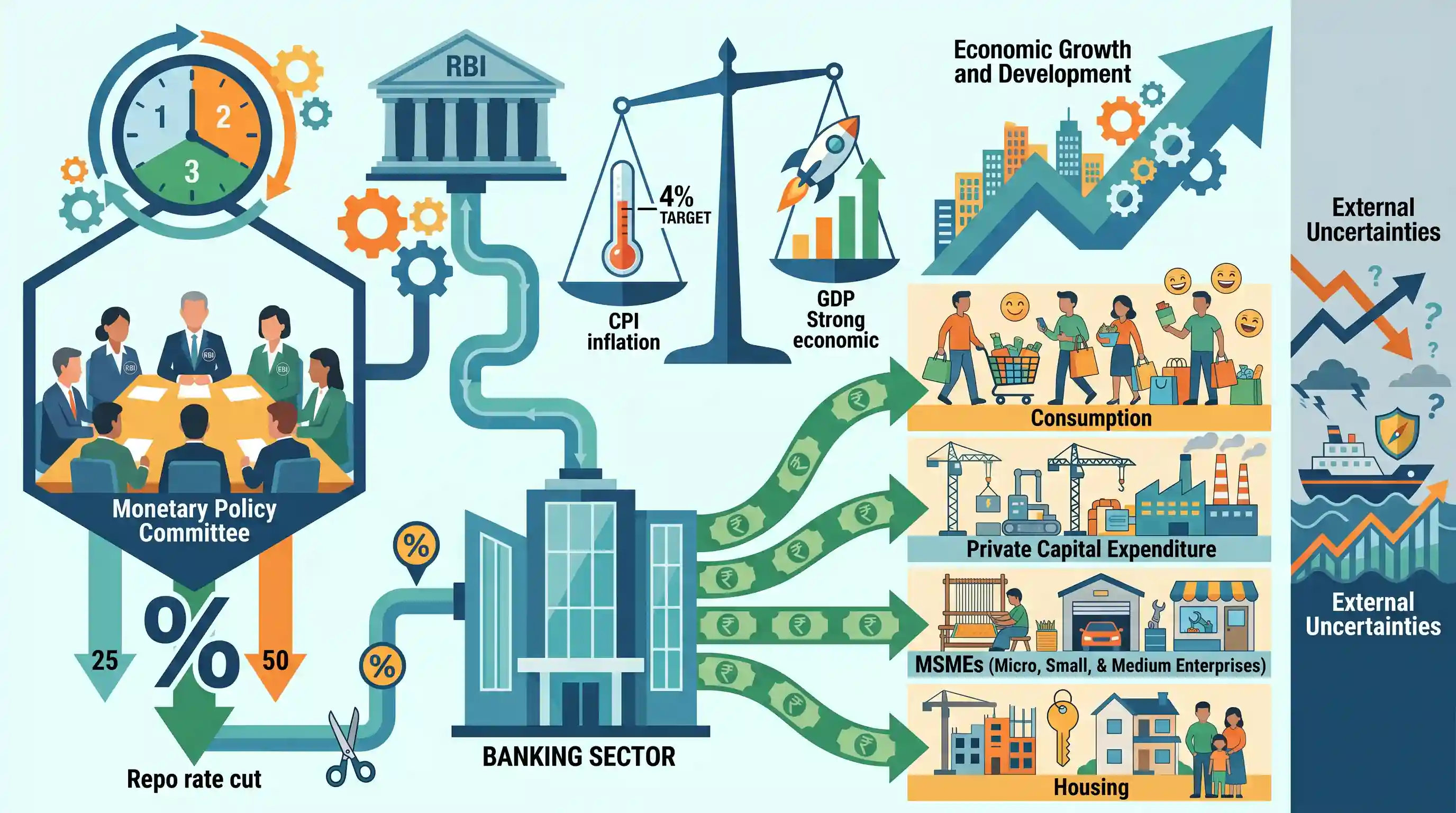
The Reserve Bank of India's Monetary Policy Committee (MPC) has commenced its three-day review meeting to determine the benchmark interest rates. With CPI inflation remaining below the 4% target and GDP growth standing strong, economists anticipate the RBI will announce a repo rate cut of 25 to 50 basis points. Further easing of the monetary policy aims to stimulate consumption, support private capital expenditure, and enhance credit flow to key sectors like MSMEs and housing, while navigating external uncertainties.
Key Points
- The RBI Monetary Policy Committee (MPC), headed by Governor Sanjay Malhotra, is deliberating on key interest rates with an expected decision on June 6.
- Experts anticipate a 25 to 50 basis points cut in the repo rate to fuel economic growth, given that CPI inflation is comfortably below the 4% target.
- Previous repo rate cuts in February and April prompted banks to reduce their External Benchmark-based Lending Rates (EBLRs) and Marginal Cost of funds-based Lending Rate (MCLR).
- A reduction in interest rates is expected to boost consumer spending, investment, and credit flow, particularly benefiting MSMEs and NBFCs in rural and semi-urban regions.
Important Terms
Monetary Policy Committee (MPC)

A six-member statutory body under the RBI Act 1934, chaired by the Governor, that determines the benchmark repo rate to maintain price stability while supporting growth.
UPSC context
GS Paper III (Economy). Key institutional mechanism for inflation targeting; frequently tested in Prelims and Mains.
Repo Rate
The interest rate at which the RBI lends short-term funds to commercial banks against government securities to manage liquidity and control inflation.
UPSC context
GS Paper III (Monetary Policy). Primary tool for liquidity management and a key indicator of economic stance.
CPI Inflation
The retail inflation measure used by the RBI as its nominal anchor. It is currently targeted at 4% within a 2-6% tolerance band.
UPSC context
GS Paper III (Inflation). Crucial for understanding macroeconomic stability and the official target for the MPC.
Basis Points (bps)
A financial unit equal to 1/100th of one percent (0.01%). It is used to express small changes in interest rates or bond yields precisely.
UPSC context
GS Paper III (Economy). Fundamental technical term for interpreting monetary policy shifts and financial news.
Reserve Bank of India (RBI)
India's central bank and regulatory body, established in 1935, responsible for regulating the banking system, managing foreign exchange, and implementing monetary policy.
UPSC context
GS Paper III. Core institution for financial stability, banking regulation, and developmental agenda.
Prelims Trap
"The Monetary Policy Committee (MPC) is responsible for determining the Repo Rate, CRR, and SLR to achieve the inflation target."
The MPC's statutory mandate is limited ONLY to determining the policy repo rate. Other tools like CRR, SLR, and Open Market Operations (OMOs) are managed independently by the RBI.
Static Concepts Connected
How does EBLR differ from MCLR in monetary transmission?
- MCLR (Internal): Based on a bank's internal cost of funds. Historically, this caused delayed or incomplete transmission of RBI repo rate cuts to consumers.
- EBLR (External): Linked directly to external benchmarks like the Repo Rate or Treasury Bills. Mandated by RBI in 2019 for retail and MSME loans.
- Reset frequency: EBLR guidelines require banks to reset interest rates at least once every three months, ensuring much faster pass-through of RBI policy changes.
What is the statutory structure and voting mechanism of the MPC?
- Composition: It has 6 members: 3 from the RBI (including the Governor) and 3 external experts appointed by the Central Government.
- Majority vote: Decisions are made by a majority vote of the members present and voting. The decisions are legally binding on the RBI.
- No Veto Power: The RBI Governor does not have a veto power but holds a casting vote in the event of a tie.
Cross-Topic Patterns
Rate cuts and exchange rate dynamics
A lower repo rate narrows bond yield differentials with advanced economies, potentially triggering FPI outflows and putting depreciation pressure on the Rupee, even as it boosts domestic GDP growth.
Headline vs. Core Inflation targeting
While the MPC legally targets Headline CPI, frequent policy debates hinge on core inflation. UPSC often tests the conceptual difference and weightages of food/fuel in these indices.

Expect a 2026 Prelims question linking MPC's statutory mandate (repo rate only) with transmission mechanisms of EBLR vs MCLR.
Linked PYQs · 5
Linked PYQs · 5
- 2022PrelimsGS1
In India, which one of the following is responsible for maintaining price stability by controlling inflation?
- 2025PrelimsGS1
Which of the following are the sources of income for the Reserve Bank of India? I. Buying and selling Government bonds II. Buying and selling foreign currency III. Pension fund management IV. Lending to private companies V. Printing and distributing currency notes Select the correct answer using the code given below.
- 2022PrelimsGS1
With reference to the Indian economy, consider the following statements: 1. If the inflation is too high, Reserve Bank of India (RBI) is likely to buy government securities. 2. If the rupee is rapidly depreciating, RBI is likely to sell dollars in the market. 3. If interest rates in the USA or European Union were to fall, that is likely to induce RBI to buy dollars. Which of the statements given above are correct?
- 2017PrelimsGS1
Which of the following statements is/are correct regarding the Monetary Policy Committee (MPC)? 1. It decides the RBI's benchmark interest rates. 2. It is a 12-member body including the Governor of RBI and is reconstituted every year. 3. It functions under the chairmanship of the Union Finance Minister. Select the correct answer using the code given below:
- 2016PrelimsGS1
What is/are the purpose/purposes of the 'Marginal Cost of Funds based Lending Rate (MCLR)' announced by RBI? 1. These guidelines help improve the transparency in the methodology followed by banks for determining the interest rates on advances. 2. These guidelines help ensure availability of bank credit at interest rates which are fair to the borrowers as well as the banks. Select the correct answer using the code given below.
