Reserve Bank Expected to Cut Repo Rate on Cooling Inflation
Source:Indian Express ↗
Why It Matters
Monetary policy decisions by the RBI are the cornerstone of macroeconomic management in India. Understanding the rationale behind repo rate changes, the functioning of the MPC, and how these decisions balance inflation control with economic growth is crucial for analyzing the effectiveness of India's monetary policy framework in UPSC Mains and Prelims.
Summary
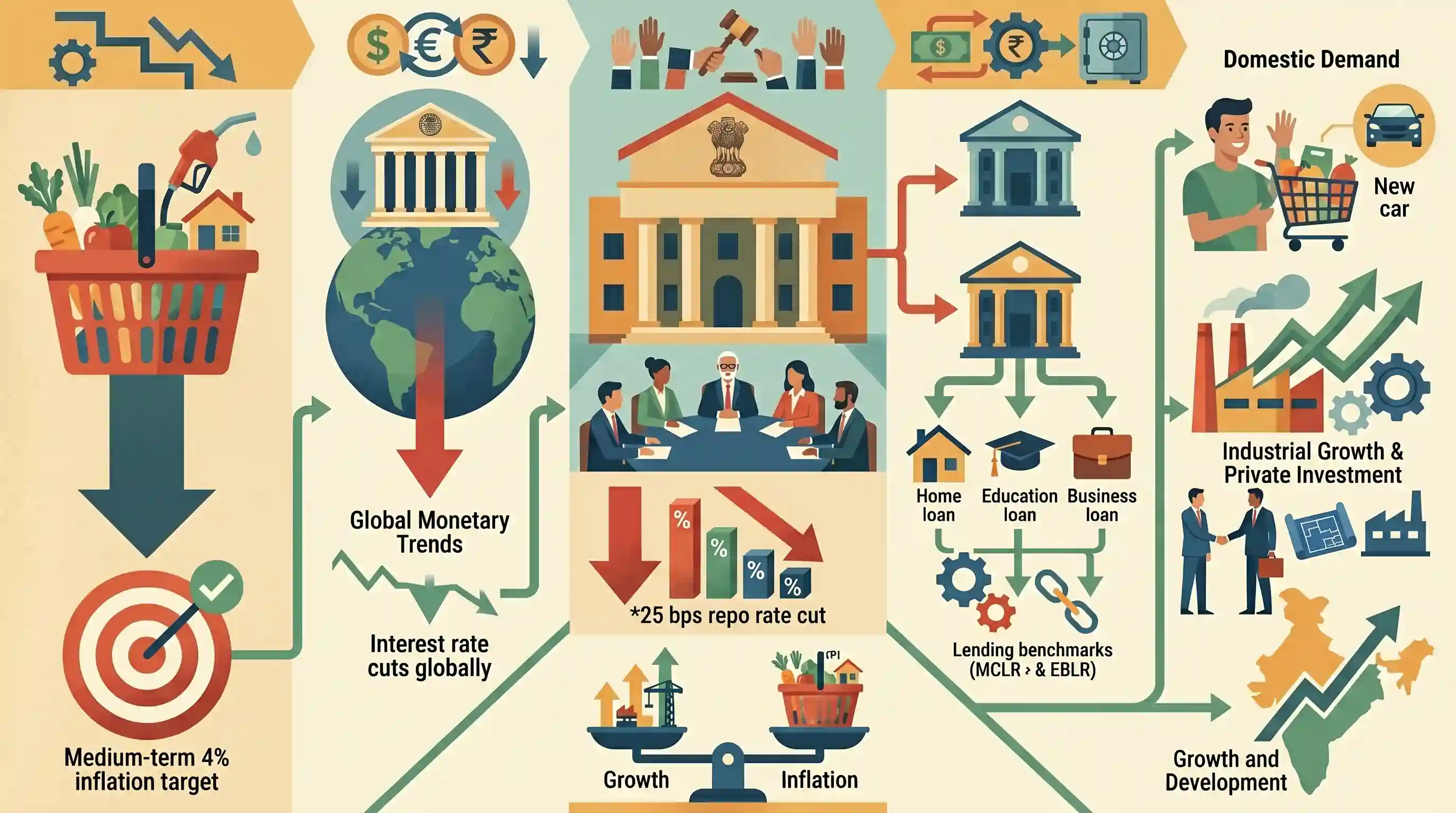
The Reserve Bank of India’s (RBI) Monetary Policy Committee (MPC) is widely anticipated to announce a repo rate cut of 25 basis points (bps) to 6% in its upcoming policy review. This expected pivot towards monetary easing is driven by a steady cooling of retail inflation (CPI) toward the RBI's medium-term target of 4%, alongside global monetary trends such as rate cuts by the US Federal Reserve. By lowering the benchmark repo rate, the central bank aims to reduce borrowing costs across the economy—positively impacting lending benchmarks like the MCLR and EBLR—thereby stimulating domestic demand, industrial growth, and private investment while carefully managing the inflation-growth trade-off.
Key Points
- The RBI's Monetary Policy Committee (MPC) is expected to cut the benchmark repo rate by 25 basis points to 6%.
- The primary driver for the expected rate cut is the continued moderation in headline retail inflation (CPI), bringing it closer to the RBI's 4% target.
- Global cues, such as the US Federal Reserve easing its own interest rates, provide the RBI with headroom to lower domestic rates without triggering capital flight or currency depreciation.
- A repo rate cut will decrease the cost of borrowing for consumers and corporations by lowering benchmarks like the External Benchmark Lending Rate (EBLR) and MCLR, subsequently boosting consumption and economic growth.
- The move signals a likely shift in the RBI's monetary policy stance, balancing the growth-inflation trade-off by pivoting away from 'withdrawal of accommodation'.
Important Terms
Flexible Inflation Targeting Framework

A statutory framework under the RBI Act (Section 45ZA) where the central bank targets 4% retail inflation (with a +/- 2% band) while supporting economic growth.
UPSC context
GS-III (Economy); tests understanding of price stability, the RBI's dual mandate, and Urjit Patel Committee recommendations.
Monetary Policy Committee (MPC)
A six-member statutory body, chaired by the RBI Governor, responsible for determining the policy repo rate required to achieve the inflation target.
UPSC context
GS-III (Economy); covers institutional frameworks, decision-making transparency, and statutory bodies under the RBI Act.
Repo Rate
The interest rate at which the RBI lends money to commercial banks against government securities to manage liquidity and control inflation.
UPSC context
GS-III (Economy); a fundamental pillar of macroeconomics and a key instrument for controlling money supply.
External Benchmark Lending Rate (EBLR)
A lending rate linked to external markers like the repo rate, ensuring that RBI's interest rate changes are passed on to borrowers more quickly.
UPSC context
GS-III (Banking); relevant for studying monetary policy transmission and retail loan pricing transparency.
US Federal Reserve
The central banking system of the United States; its interest rate decisions influence global liquidity, foreign portfolio investment (FPI), and the Indian Rupee.
UPSC context
GS-III (External Sector); tests knowledge of global linkages, capital account volatility, and currency depreciation.
Marginal Cost of Funds based Lending Rate (MCLR)
An internal benchmark for banks to set lending rates based on their incremental cost of funds, operating expenses, and reserve requirements.
UPSC context
GS-III (Banking); focuses on the evolution of lending regimes and the efficiency of bank-led transmission.
Prelims Trap
The RBI independently sets the 4% inflation target under the Flexible Inflation Targeting framework.
The Government of India, not the RBI, determines the inflation target every five years in consultation with the central bank under the RBI Act, 1934.
Static Concepts Connected
How does the EBLR differ from the previous MCLR regime?
- External linking: EBLR links floating retail and MSME loans directly to external metrics (like the repo rate), unlike MCLR which relied on a bank's internal cost of funds.
- Faster transmission: It removes bank discretion in rate setting, ensuring immediate transmission of RBI's policy rate cuts directly to consumer EMIs and borrowing costs.
What are the primary stances used in RBI monetary policy?
- Accommodative: Indicates the central bank is willing to lower interest rates to stimulate economic growth and expand money supply.
- Neutral: The RBI is flexible and can either cut or increase rates depending on macroeconomic data trends.
- Withdrawal of accommodation: The RBI is gradually draining excess systemic liquidity to rein in inflation while still supporting growth.
Cross-Topic Patterns
Global monetary cycles and INR stability
Fed rate cuts reduce the interest rate differential, preventing foreign portfolio (FPI) capital flight from India and easing depreciation pressure on the Rupee.
Fiscal consolidation easing monetary pressure
The Centre's strict adherence to fiscal glide paths has helped cool demand-side inflation, granting the RBI the macroeconomic headroom to pivot toward rate cuts.

Expect a multi-statement Prelims question testing EBLR transmission mechanics coupled with US Fed rate spillover effects on capital flows.
Linked PYQs · 4
Linked PYQs · 4
- 2017PrelimsGS1
Which of the following statements is/are correct regarding the Monetary Policy Committee (MPC)? 1. It decides the RBI's benchmark interest rates. 2. It is a 12-member body including the Governor of RBI and is reconstituted every year. 3. It functions under the chairmanship of the Union Finance Minister. Select the correct answer using the code given below:
- 2022PrelimsGS1
In India, which one of the following is responsible for maintaining price stability by controlling inflation?
- 2016PrelimsGS1
What is/are the purpose/purposes of the 'Marginal Cost of Funds based Lending Rate (MCLR)' announced by RBI? 1. These guidelines help improve the transparency in the methodology followed by banks for determining the interest rates on advances. 2. These guidelines help ensure availability of bank credit at interest rates which are fair to the borrowers as well as the banks. Select the correct answer using the code given below.
- 2024MainsGS3
What are the causes of persistent high food inflation in India? Comment on the effectiveness of the monetary policy of the RBI to control this type of inflation.
