RBI Polymer Currency Notes Trial and Global Tender Details
Source:Indian Express ↗
આ શા માટે મહત્વનું છે
Understanding the shift to polymer notes is relevant for GS3 (Economy) in terms of RBI's currency management and seigniorage, and for GS3 (Internal Security) regarding efforts to combat counterfeiting (FICN) and associated terror funding risks.
સારાંશ
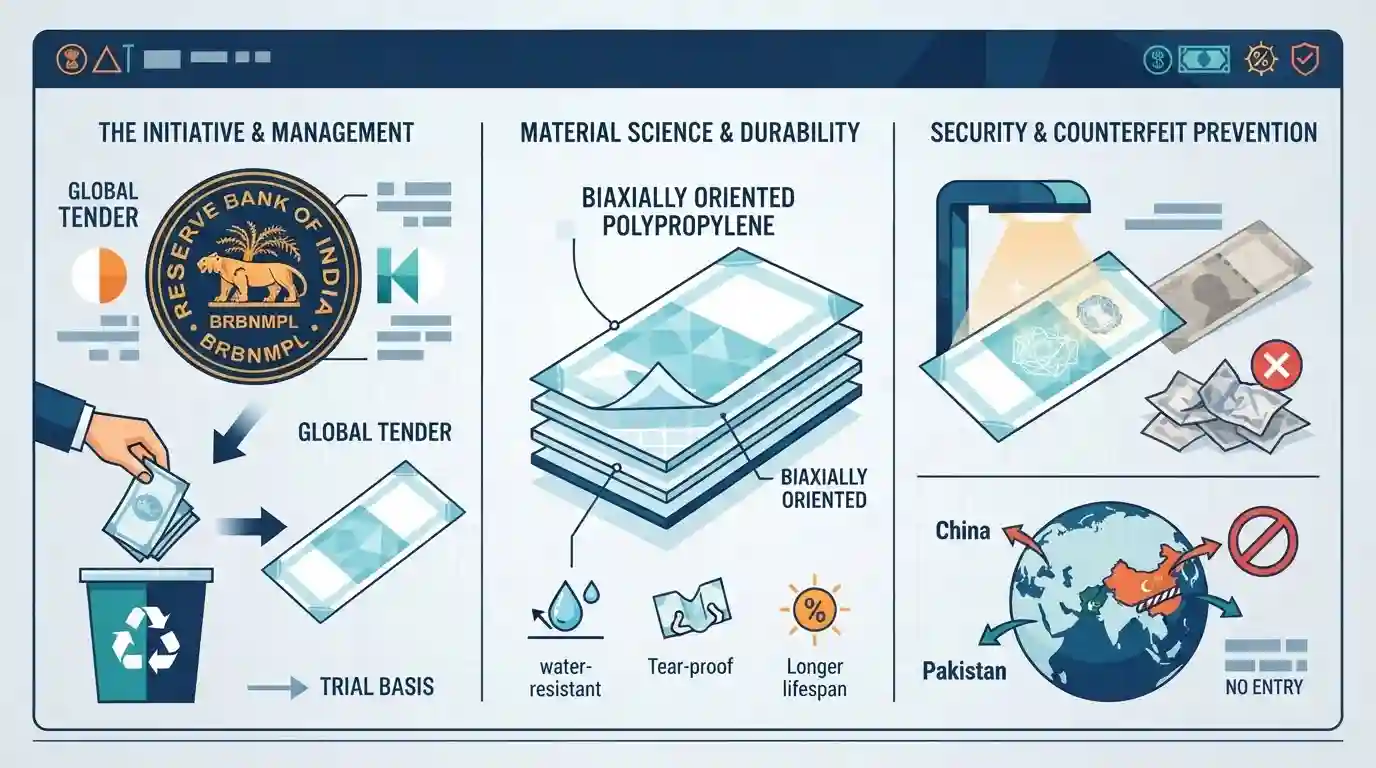
The Reserve Bank of India (RBI), through its subsidiary BRBNMPL, has floated a global tender to introduce polymer currency notes on a trial basis. The transition to Biaxially Oriented Polypropylene-based Opacified Polymer Substrate aims to enhance durability, reduce environmental impact, and curb the growing menace of counterfeit notes. Strict security guidelines restrict participation by entities or individuals linked to China and Pakistan to safeguard the printing process. This move is significant for currency management, addressing both the high economic costs of printing traditional cotton-paper notes and the internal security threat posed by Fake Indian Currency Notes (FICN).
મુખ્ય મુદ્દા
- The Reserve Bank of India (RBI) is preparing to trial polymer currency notes using Biaxially Oriented Polypropylene-based Opacified Polymer Substrate.
- BRBNMPL, an RBI subsidiary, has floated a global tender for supplying the polymer sheets, while printing will be done domestically by SPMCIL and BRBNMPL.
- The new notes aim to be more durable, environmentally friendly (longer life cycle), and difficult to counterfeit compared to traditional cotton-paper notes.
- Security clauses in the tender prohibit bidders from having operations, sourcing raw materials, or employing individuals with a work history in China or Pakistan.
- The initiative also addresses the rising detection of Fake Indian Currency Notes (FICN) and the high cost of printing currency (Rs 4,875 crore in 2025-26).
મહત્વપૂર્ણ શબ્દો
Reserve Bank of India (RBI)

India's central bank and apex monetary authority established under the RBI Act, 1934. It regulates the banking system, manages foreign exchange, issues currency, and formulates monetary policy to maintain price stability.
UPSC context
GS Paper III (Indian Economy); crucial for understanding monetary policy tools, inflation targeting, banking regulation, and currency management.
Bharatiya Reserve Bank Note Mudran Private Limited (BRBNMPL)
A wholly-owned subsidiary of the Reserve Bank of India established in 1995. It operates state-of-the-art currency printing presses in Mysuru and Salboni, printing the majority of India's banknotes.
UPSC context
GS Paper III (Indian Economy/Internal Security); relevant for currency management, securing printing processes against fake currency (FICN), and financial infrastructure.
Security Printing and Minting Corporation of India (SPMCIL)
A wholly government-owned Miniratna Category-I CPSE under the Ministry of Finance. Incorporated in 2006, it manufactures currency notes, security paper, mints coins, and prints travel documents like passports.
UPSC context
GS Paper III (Indian Economy/Internal Security); vital for learning about currency manufacturing infrastructure, anti-counterfeiting measures, and public sector undertakings.
પ્રિલિમ્સ ટ્રેપ
The Reserve Bank of India holds sole authority to independently determine and alter the material and design of Indian banknotes.
Under Section 25 of the RBI Act 1934, the Central Government, not the RBI, has the final authority to determine banknote design and materials, acting on the RBI Central Board's recommendations.
સંલગ્ન સ્થિર ખ્યાલો
What statutory rules govern currency design and printing infrastructure in India?
- Section 25 role: The Central Government determines banknote design, form, and material based on recommendations from the RBI's Central Board.
- Section 22 monopoly: Vests the sole right of banknote issuance across India exclusively in the Reserve Bank of India.
- Dual-entity printing: Banknotes are printed by SPMCIL (wholly owned by the Central Government) and BRBNMPL (wholly owned subsidiary of the RBI).
What makes Biaxially Oriented Polypropylene (BOPP) structurally distinct?
- Biaxial stretching: Stretching polypropylene along two axes realigns polymer chains, dramatically increasing tensile strength and preventing tearing.
- Non-porous barrier: The mechanical realignment creates a highly impermeable surface resistant to water, dirt, grease, and oil.
- Substrate composition: Unlike standard wood-pulp paper, traditional Indian banknotes are made of 100% cotton-rag paper; BOPP is a petroleum-based polymer.
આંતર-વિષય પેટર્ન
FICN and asymmetric internal security threats
High-quality fake currency undermines economic sovereignty. Transitioning to complex polymer substrates acts as a technological shield against state-sponsored economic destabilization.
Supply chain security as national defense
Restricting Chinese and Pakistani vendors under security clearances highlights how India integrates economic policy with national security, treating banknote printing as critical infrastructure.

2026 Prelims may test Section 25 of the RBI Act (design authority) paired with the material science properties of BOPP polymer substrates.
સંલગ્ન PYQ · 2
સંલગ્ન PYQ · 2
- 2023MainsGS3
Give out the major sources of terror funding in India and the efforts being made to curtail these sources. In the light of this, also discuss the aim and objective of the 'No Money for Terror (NMFT)' Conference recently held at New Delhi in November 2022.
- 2025PrelimsGS1
Which of the following are the sources of income for the Reserve Bank of India? I. Buying and selling Government bonds II. Buying and selling foreign currency III. Pension fund management IV. Lending to private companies V. Printing and distributing currency notes Select the correct answer using the code given below.
