RBI Tightens Bad Loan Norms for Banking Stability
Source:The Hindu ↗
Why It Matters
Reforming NPA classification and provisioning is crucial for the health of the Indian banking sector. Adopting the Expected Credit Loss (ECL) framework aligns Indian banking with international standards (like IFRS 9), ensuring banks proactively provision for potential losses and enhancing overall macroeconomic stability.
Summary
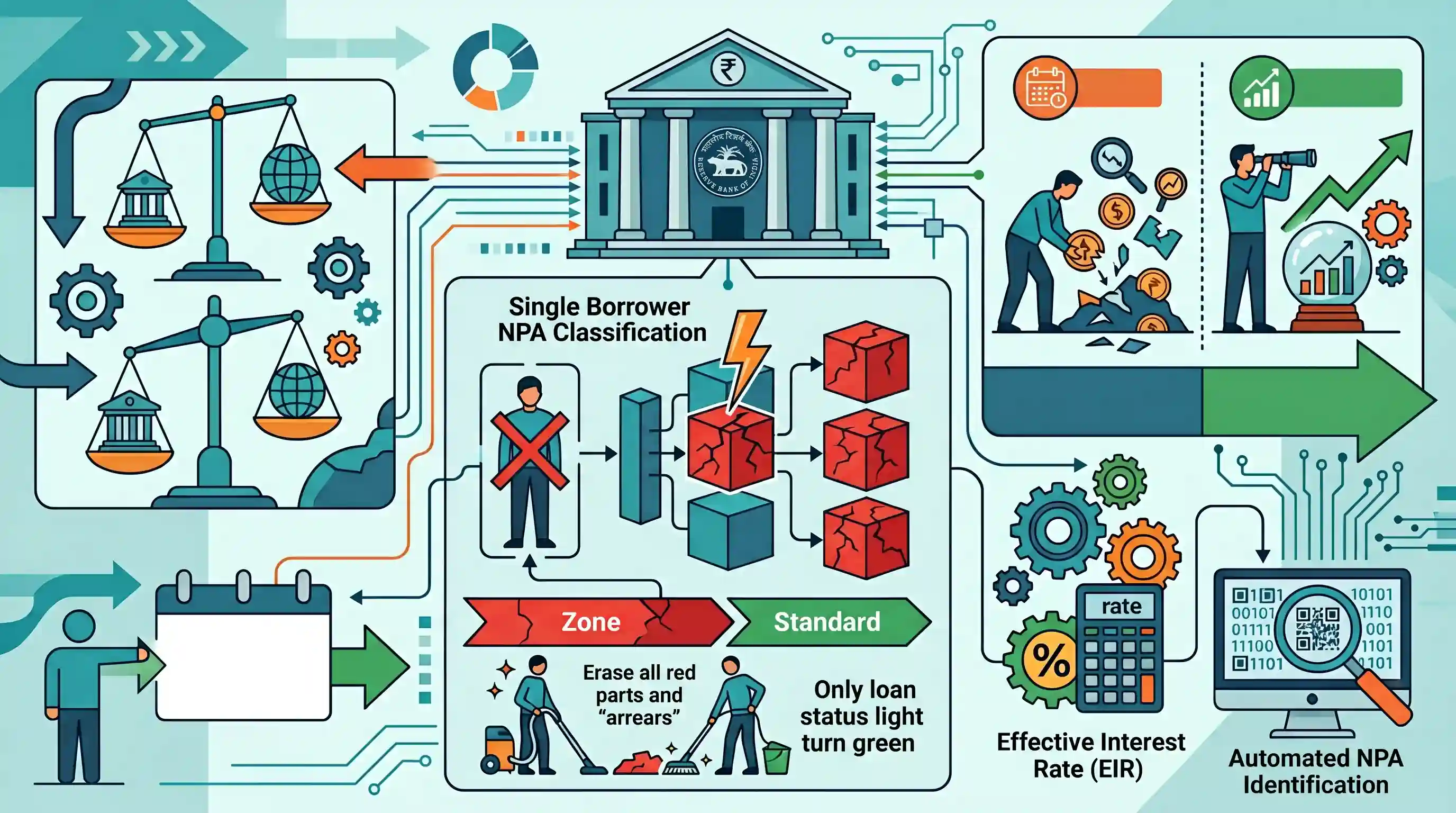
The Reserve Bank of India (RBI) has issued new draft guidelines to tighten rules for Non-Performing Assets (NPAs) to align with global standards. Effective April 1, 2027, the rules mandate that if a single loan to a borrower becomes an NPA, all other loans to that borrower will also be classified as NPAs. A loan can only revert to "standard" status if all arrears are cleared. Additionally, banks must adopt the forward-looking 'Expected Credit Loss' (ECL) framework for provisions instead of the 'Incurred Loss' method. The new norms also mandate automated NPA identification and the use of the Effective Interest Rate (EIR) for ECL calculations.
Key Points
- The RBI is tightening bad loan rules, effective April 1, 2027, stipulating that if a borrower defaults on one loan, all their loans will be classified as Non-Performing Assets (NPAs).
- The threshold of 90 days overdue remains the basis for classifying a loan as an NPA, but a loan can only be upgraded to a standard asset if the entire arrears (principal and interest) are repaid.
- Banks will shift from the older 'Incurred Loss' method to the forward-looking 'Expected Credit Loss' (ECL) framework for calculating bad loan provisions.
- The ECL framework categorizes assets into three stages based on credit risk and utilizes the Effective Interest Rate (EIR) instead of the contractual interest rate.
- The new guidelines mandate banks to implement fully automated IT systems for identifying NPAs, removing manual discretion to ensure accuracy and transparency.
Important Terms
Expected Credit Loss (ECL) framework

A forward-looking provisioning model where banks estimate potential credit losses based on historical data and economic forecasts before a default occurs.
UPSC context
GS Paper 3 (Economy); tests knowledge of banking reforms and alignment with global risk management standards like IFRS 9.
Incurred Loss Model
A reactive accounting model where banks only recognize credit losses and make provisions after a specific default event or trigger has already occurred.
UPSC context
GS Paper 3 (Economy); relevant for comparative analysis of legacy vs. modern banking regulatory shifts.
Non-Performing Asset (NPA)
A loan or advance for which the principal or interest payment remained overdue for a period of 90 days or more.
UPSC context
GS Paper 3 (Economy); critical for understanding bank asset quality and the Twin Balance Sheet problem.
Effective Interest Rate (EIR)
The real rate of interest on a loan, calculated by discounting estimated future cash flows to the asset's current value.
UPSC context
GS Paper 3 (Economy); technical term relevant to financial accounting standards and accurate loan valuation.
Prudential Norms
Regulatory guidelines issued by the RBI to ensure banks maintain adequate capital and classify assets correctly for systemic stability.
UPSC context
GS Paper 3 (Economy); fundamental for understanding the RBI’s oversight role and banking sector health.
Reserve Bank of India (RBI)
India’s central bank and regulatory body responsible for monetary policy and the supervision of the nation's financial system.
UPSC context
GS Paper 3 (Economy); tests understanding of the central bank's regulatory powers and macro-financial stability roles.
Prelims Trap
NPA classification under the new RBI rules is done strictly at the individual loan level.
The new guidelines explicitly mandate borrower-level NPA tagging. If a borrower defaults on even a single loan facility, all their active loans automatically become NPAs.
Static Concepts Connected
How are Non-Performing Assets (NPAs) classified based on aging in India?
- Sub-standard Assets: An asset that has remained an NPA for a period less than or equal to 12 months.
- Doubtful Assets: An asset that has remained in the sub-standard category for a period of 12 months.
- Loss Assets: Identified as uncollectible by the bank, auditor, or RBI, but not yet wholly written off.
What is the difference between Incurred Loss and Expected Credit Loss (ECL)?
- Incurred Loss Method: Banks provide for a bad loan only after a default event has actually occurred.
- Expected Credit Loss: Banks proactively estimate potential future credit losses and provision for them before a default happens.
Cross-Topic Patterns
ECL and Twin Balance Sheet syndrome
The shift to forward-looking ECL provisions acts as an early warning system, preventing the systemic buildup of hidden bad loans that cause Twin Balance Sheet crises.
Borrower-level tagging and IBC
Classifying all loans of a defaulter as NPA mirrors the Insolvency and Bankruptcy Code (IBC) framework, which resolves the corporate entity as a whole rather than isolated debts.

Expect a multi-statement Prelims question in 2026 comparing the 'Expected Credit Loss' framework vs 'Incurred Loss' methodology.
Linked PYQs · 2
Linked PYQs · 2
- 2019PrelimsGS1
What was the purpose of Inter-Creditor Agreement signed by Indian banks and financial institutions recently?
- 2016PrelimsGS1
What is/are the purpose/purposes of the 'Marginal Cost of Funds based Lending Rate (MCLR)' announced by RBI? 1. These guidelines help improve the transparency in the methodology followed by banks for determining the interest rates on advances. 2. These guidelines help ensure availability of bank credit at interest rates which are fair to the borrowers as well as the banks. Select the correct answer using the code given below.
