RBI cuts US Treasuries and accumulates gold to de-risk forex reserves
Source:Indian Express ↗
Why It Matters
The composition of a country's foreign exchange reserves is critical for its macroeconomic stability. The RBI's pivot from US Treasuries to Gold indicates a significant shift in India's geoeconomic strategy, reflecting efforts to insulate the economy from global financial weaponization and currency volatility. This is highly relevant for GS-3 Economy and Prelims questions on Forex components.
Summary
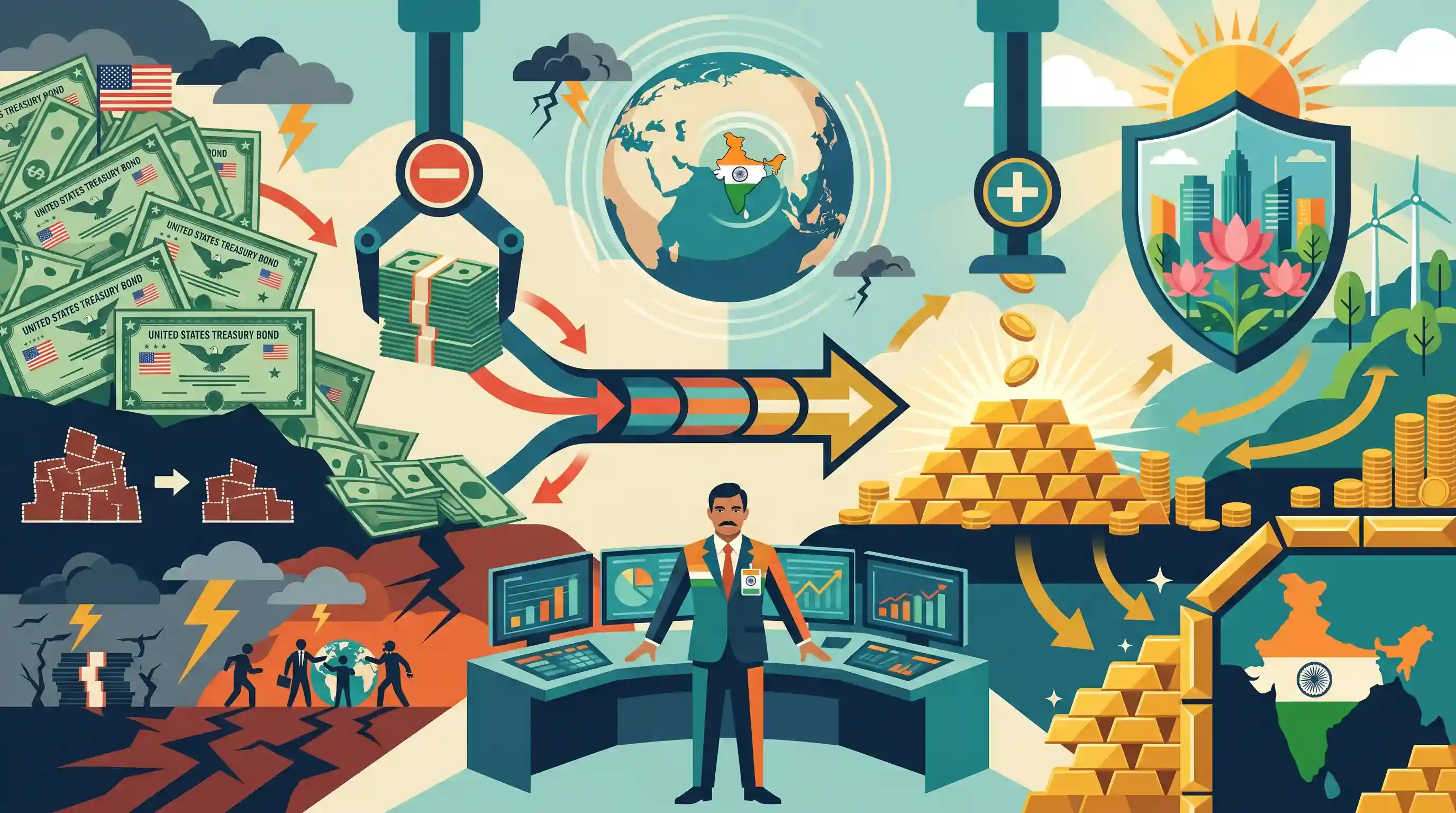
The Reserve Bank of India (RBI) reduced its investments in US Treasury bonds by over 18% in 2025, strategically shifting its focus toward accumulating gold reserves. This move is part of a broader "de-dollarization" trend aimed at diversifying India's foreign exchange reserves, mitigating geopolitical risks, and reducing reliance on the US dollar. Gold serves as a safe-haven asset, offering a hedge against global economic volatility, inflation, and external shocks while ensuring macroeconomic stability.
Key Points
- The RBI reduced its holdings of US Treasury securities by over 18% in 2025.
- The central bank is actively increasing its gold reserves to diversify its foreign exchange portfolio.
- This strategic shift aligns with the global "de-dollarization" trend, driven by geopolitical uncertainties and the increasing weaponization of the US dollar in international sanctions.
- Increasing gold reserves provides India with a reliable safe-haven asset, offering a hedge against global inflation, currency fluctuations, and external economic shocks.
Important Terms
Reserve Bank of India (RBI)

India's central bank and regulatory body responsible for monetary policy, issuing currency, and managing foreign exchange reserves as their legal custodian under the RBI Act, 1934.
UPSC context
GS Paper III: Indian Economy; essential for understanding monetary stability, inflation control, and external sector management.
US Treasuries
Marketable debt instruments (Bills, Notes, Bonds) issued by the US Department of the Treasury to finance government spending; widely considered the world's safest sovereign debt.
UPSC context
GS Paper III: External Sector; tests knowledge of global financial instruments and their impact on India's reserve management.
Foreign Exchange Reserves
Assets held by a central bank in foreign currencies, gold, Special Drawing Rights (SDRs), and IMF reserve positions to support the national currency and ensure balance-of-payments stability.
UPSC context
GS Paper III: Indian Economy; critical for topics related to Balance of Payments (BoP) and exchange rate volatility.
De-dollarization
A strategic effort by nations to reduce reliance on the US dollar as a primary reserve currency and medium of international trade to mitigate geopolitical and economic risks.
UPSC context
GS Paper II & III: International Relations and Economy; concerns India's strategic autonomy and diversification of global trade settlements.
Gold Reserves
Physical gold bullion held by central banks as a hedge against inflation and currency devaluation; it is a neutral asset immune to foreign freezes or sanctions.
UPSC context
GS Paper III: Economy; focuses on diversification strategies and "safe-haven" investing during global financial instability.
Safe-haven Asset
An investment expected to retain or increase in value during times of market turbulence, providing protection against losses in other asset classes.
UPSC context
GS Paper III: Indian Economy; relates to risk management and capital flight during global economic shocks.
Prelims Trap
Gold has now surpassed Foreign Currency Assets to become the largest component of India's Forex reserves.
Despite rapid gold accumulation and the strategic reduction of US Treasuries, Foreign Currency Assets (FCA) remain by far the largest component of India's Forex reserves.
Static Concepts Connected
What are the four components of India's Foreign Exchange Reserves?
- Foreign Currency Assets (FCA): The largest component, held in major global currencies like the US Dollar, Euro, Pound Sterling, and Japanese Yen.
- Gold Reserves: Held by the RBI as a safe-haven asset to hedge against global inflation, currency volatility, and geopolitical shocks.
- Special Drawing Rights (SDR): An international reserve asset created by the IMF, allocated to member countries in proportion to their IMF quotas.
- Reserve Tranche Position (RTP): The difference between a member's IMF quota and the IMF's holdings of that member's domestic currency.
What currencies make up the IMF's Special Drawing Rights (SDR) basket?
- The Five Currencies: The SDR value relies on five currencies: US Dollar, Euro, Chinese Yuan (Renminbi), Japanese Yen, and British Pound Sterling.
- Weightage & Review: The US dollar holds the highest weight, followed by the Euro and the Chinese Yuan. Weights are reviewed every five years.
Cross-Topic Patterns
De-dollarization + Rupee Vostro Accounts
RBI's reduction in US Treasuries structurally aligns with India's external sector efforts to internationalize the Rupee via Special Rupee Vostro Accounts (SRVAs) for bilateral trade settlement.
Geoeconomics of SWIFT + BRICS Alternatives
The weaponization of western financial networks (SWIFT) has accelerated the push by groupings like BRICS to develop alternative cross-border payment systems to bypass dollar reliance.

RBI Forex composition + BRICS alternative payment systems + Rupee internationalization will likely merge into a 2026 prelims question.
Linked PYQs · 3
Linked PYQs · 3
- 2013PrelimsGS1
Which one of the following groups of items is included in India's foreign-exchange reserves?
- 2025PrelimsGS1
Which of the following are the sources of income for the Reserve Bank of India? I. Buying and selling Government bonds II. Buying and selling foreign currency III. Pension fund management IV. Lending to private companies V. Printing and distributing currency notes Select the correct answer using the code given below.
- 2025MainsGS3
What are the challenges before the Indian economy when the world is moving away from free trade and multilateralism to protectionism and bilateralism? How can these challenges be met?
