Reserve Bank of India Foreign Exchange Reserves and Gold Accumulation
Source:Indian Express ↗
Why It Matters
The composition and management of India's foreign exchange reserves by the RBI are critical components of macroeconomic stability. Tracking the shift away from US Treasuries towards gold highlights India's strategy to navigate global financial risks and geopolitical shifts, which is a recurrent theme in UPSC economics questions.
Summary
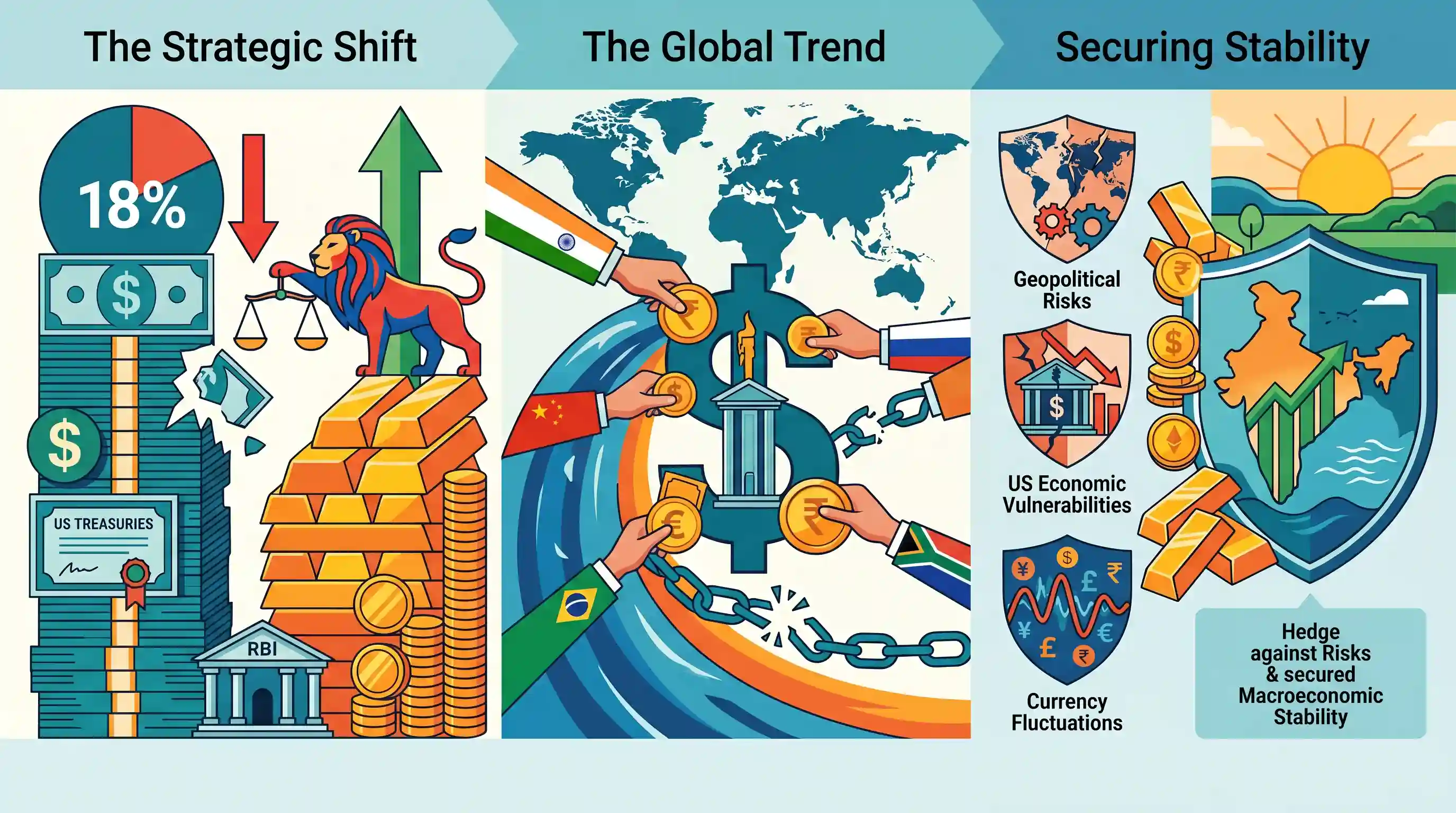
The Reserve Bank of India (RBI) has reduced its investment in US Treasuries by over 18% in 2025 as part of a strategic shift to diversify its foreign exchange reserves. Moving away from dollar-denominated assets, the central bank is increasingly stocking up on gold. This move reflects a broader global trend of 'de-dollarization', aimed at hedging against geopolitical risks, US economic vulnerabilities, and currency fluctuations, thereby securing India's macroeconomic stability.
Key Points
- The Reserve Bank of India reduced its investments in US Treasuries by over 18% in 2025.
- The RBI is systematically accumulating gold as part of a strategy to diversify its foreign exchange reserves.
- This strategic shift reflects a broader global 'de-dollarization' trend aimed at reducing dependence on the US dollar.
- The move helps hedge against geopolitical risks, currency fluctuations, and vulnerabilities in the US economy, ensuring greater macroeconomic stability for India.
Important Terms
Foreign Exchange Reserves (Forex)

Assets held by the central bank in foreign currencies, gold, and special assets. They provide a buffer for imports, stabilize the rupee, and manage external economic shocks.
UPSC context
GS Paper III (Economy); tested for components, import cover, and role in managing Balance of Payments (BoP) crises.
De-dollarization
The process of reducing reliance on the U.S. dollar as the primary global reserve currency and trade medium, often by shifting reserves into gold or local currencies.
UPSC context
GS Paper III (Economy/IR); relevant for India's strategic autonomy and the internationalization of the rupee.
US Treasury Securities
Debt instruments (bills, notes, bonds) issued by the U.S. Department of the Treasury. Historically considered the world's safest asset, they form a major part of global central bank reserves.
UPSC context
GS Paper III (Economy); important for understanding global safe-haven assets and the diversification of India's foreign assets.
Foreign Currency Assets (FCA)
The largest component of India’s forex reserves, comprising investments in foreign sovereign bonds, deposits with other central banks, and holdings in major currencies like the Dollar, Euro, and Yen.
UPSC context
GS Paper III (Economy); tested on the composition of reserves and the impact of valuation changes on total wealth.
Special Drawing Rights (SDR)
An international reserve asset created by the IMF in 1969. It is not a currency but a potential claim on the usable currencies of IMF members, based on a basket.
UPSC context
GS Paper III (Economy); frequently tested in Prelims regarding the IMF basket (Dollar, Euro, Yuan, Yen, Pound).
Reserve Bank of India (RBI)
India’s central bank and custodian of forex reserves under the RBI Act, 1934. It manages currency volatility and intervenes in markets to ensure macroeconomic stability.
UPSC context
GS Paper III (Economy); central to questions on monetary policy, exchange rate management, and financial sector regulation.
Prelims Trap
"Gold now forms the largest component of India's foreign exchange reserves due to recent RBI acquisitions."
Despite the RBI's aggressive gold accumulation and strategic pivot away from US Treasuries, Foreign Currency Assets (FCAs) remain overwhelmingly the largest component of India's reserves.
Static Concepts Connected
What are the four components of India's Foreign Exchange Reserves?
- FCA: Foreign Currency Assets (largest component; includes US Treasuries, other sovereign bonds, and deposits).
- Gold: Physical gold reserves accumulated and held strategically by the Reserve Bank of India.
- SDR: Special Drawing Rights, an international reserve asset created by the IMF.
- RTP: Reserve Tranche Position, which is India's immediately accessible quota at the IMF.
How do Special Rupee Vostro Accounts (SRVA) facilitate de-dollarization?
- Mechanism: Permits foreign correspondent banks to open accounts in authorized Indian banks to settle cross-border trade in INR.
- Bypass Dollar: Eliminates the need for an intermediary hard currency (like USD), buffering trade against exchange rate volatility.
Cross-Topic Patterns
De-dollarization & BRICS payment systems
The RBI's shift mirrors the broader BRICS agenda to bypass dollar hegemony, linking with alternative cross-border payment initiatives like Project mBridge and local currency settlement systems.
Gold reserves vs. CAD management
While the RBI buys gold to diversify reserves, the government promotes Sovereign Gold Bonds (SGBs) domestically to curb physical gold imports and manage the Current Account Deficit (CAD).

De-dollarization trends make Forex composition, SRVA mechanics, and US Treasury yields a prime candidate for a 2026 multi-statement Q.
Linked PYQs · 2
Linked PYQs · 2
- 2013PrelimsGS1
Which one of the following groups of items is included in India's foreign-exchange reserves?
- 2025PrelimsGS1
Which of the following are the sources of income for the Reserve Bank of India? I. Buying and selling Government bonds II. Buying and selling foreign currency III. Pension fund management IV. Lending to private companies V. Printing and distributing currency notes Select the correct answer using the code given below.
