RBI guidelines on fair practices for loan recovery agents
Source:The Hindu ↗
Why It Matters
The article underscores the RBI's regulatory stance on ensuring ethical lending and recovery practices. It is critical for UPSC aspirants studying the economy, as it highlights the balance between resolving non-performing assets and protecting consumer rights under the Fair Practices Code.
Summary
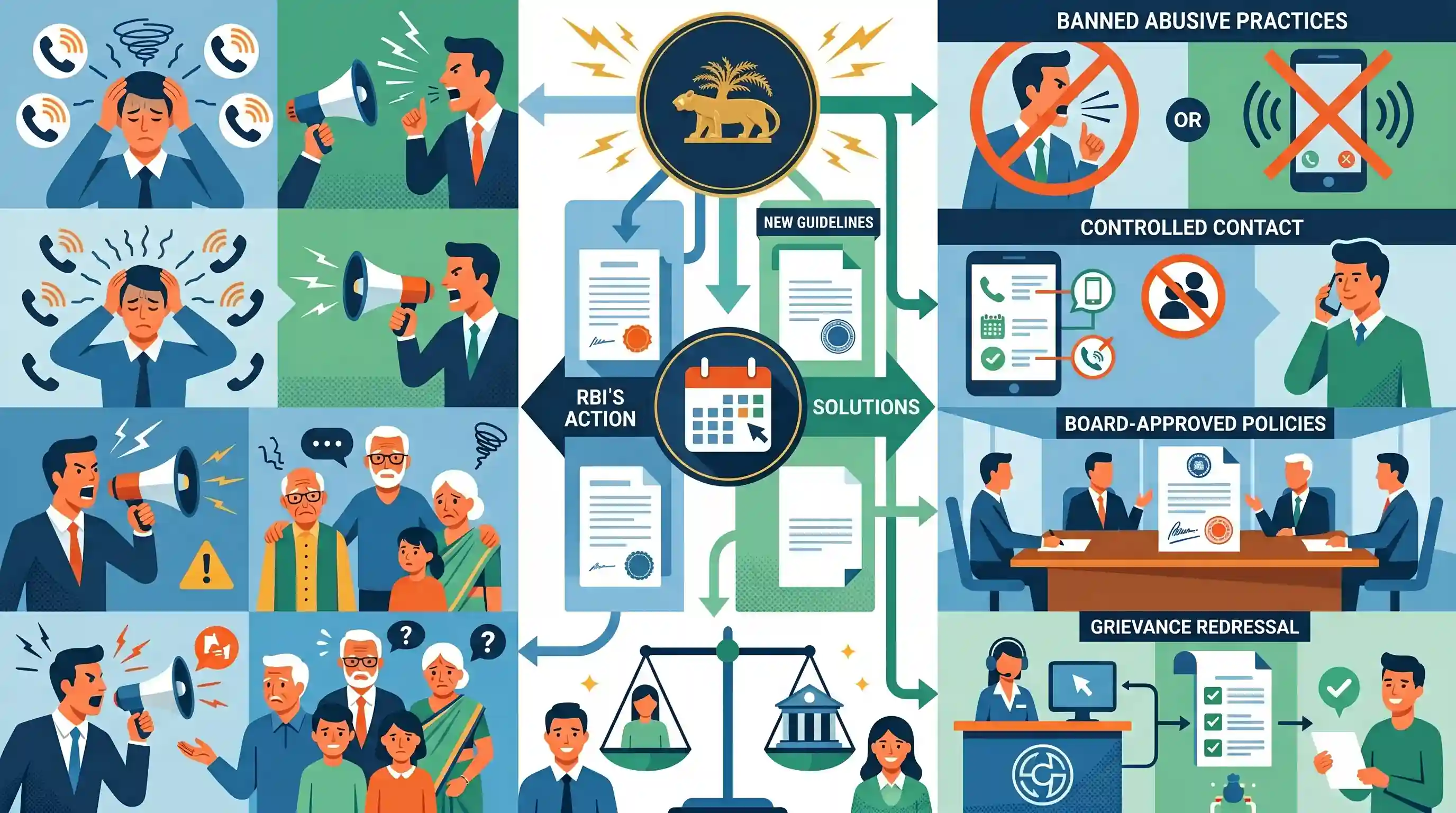
The Reserve Bank of India (RBI) has issued draft guidelines to curb harassment by loan recovery agents, prioritizing consumer protection in the banking sector. The "Reserve Bank of India (Commercial Banks - Responsible Business Conduct) Second Amendment Directions, 2026" ban abusive practices, excessive calling, and unsolicited contact with a borrower's relatives. Taking effect on July 1, 2026, the norms mandate Regulated Entities to establish board-approved policies governing recovery agents and to set up a dedicated grievance redressal mechanism for recovery-related disputes.
Key Points
- The RBI has proposed new draft directions to strictly regulate loan recovery practices by banks and their agents, effective July 1, 2026.
- The guidelines prohibit recovery agents from using abusive language, making excessive calls (limited to 3 unheeded calls per day), or contacting borrowers at unearthly hours.
- Agents are banned from calling anonymously; they must provide valid authorization and verifiable contact details.
- Regulated Entities (REs) must institute a dedicated grievance redressal mechanism specifically for complaints related to loan recovery practices.
- Banks are mandated to adopt a board-approved policy detailing the engagement, eligibility, and strict code of conduct for recovery agents.
Important Terms
Reserve Bank of India (Commercial Banks - Responsible Business Conduct) Second Amendment Directions, 2026

RBI-issued guidelines aimed at standardizing recovery agent conduct and ensuring borrower protection through mandatory board policies, conduct norms, and dedicated grievance redressal mechanisms for all commercial banks.
UPSC context
GS Paper III (Indian Economy). Tests understanding of banking reforms, consumer protection, and RBI’s regulatory role in managing NPAs.
Fair Practices Code (FPC)
A set of mandatory standards prescribed by the RBI to ensure transparency, ethical lending, and non-coercive loan recovery practices by banks and NBFCs.
UPSC context
GS Paper III (Banking). Relevant for questions on ethical banking, financial inclusion, and protection of borrower rights.
Regulated Entities (REs)
Financial institutions under RBI’s supervision, including Scheduled Commercial Banks, NBFCs, Regional Rural Banks, and Cooperative Banks, which must comply with central bank directives.
UPSC context
GS Paper III (Banking Sector). Tests knowledge of India’s institutional financial architecture and the scope of RBI’s oversight.
Recovery Agents
External agencies or individuals hired by financial institutions to collect overdue loans; they are legally bound by RBI conduct norms to prevent borrower harassment.
UPSC context
GS Paper III (Economy). Pertains to issues of banking ethics, consumer protection, and non-performing asset (NPA) recovery procedures.
Reserve Bank of India (RBI)
India's central bank and statutory regulatory body responsible for monetary policy, banking supervision, and maintaining the country's financial stability and consumer confidence.
UPSC context
GS Paper III (Statutory Bodies/Economy). Fundamental for any topic regarding Indian financial systems, inflation control, or credit regulation.
Prelims Trap
RBI regulates loan recovery agent conduct solely under powers granted by the Reserve Bank of India Act, 1934.
Directives regarding customer service and responsible business conduct for banks are primarily issued under Section 35A of the Banking Regulation Act, 1949, not the RBI Act.
Static Concepts Connected
What are RBI's powers under Section 35A of the Banking Regulation Act, 1949?
- Public Interest: Empowers the RBI to issue binding directions to banking companies to secure public interest or ensure proper banking policy.
- Depositor Protection: Acts as the statutory anchor for directives preventing detrimental actions by banks, such as coercive loan recovery practices and unfair business conduct.
How does the RBI Integrated Ombudsman Scheme (2021) protect consumers?
- Single Reference Point: Integrates former separate schemes for banks, NBFCs, and digital transactions into a centralized 'One Nation, One Ombudsman' portal.
- Deficiency in Service: Covers complaints involving 'deficiency in service', which includes unauthorized recovery agent harassment if internal bank grievance mechanisms fail.
- Appellate Authority: The RBI's Executive Director in charge of the Consumer Education and Protection Department acts as the Appellate Authority.
Cross-Topic Patterns
SARFAESI Act vs Retail Consumer Protection
While SARFAESI allows banks to bypass courts for asset recovery, RBI's Fair Practices Code acts as a vital regulatory counterweight to prevent coercive harassment of individual retail borrowers.
Digital Lending & Predatory FinTech
Parallel to regulating physical recovery agents, RBI's digital lending guidelines aim to curb predatory loan apps by mandating that credit flows only through officially Regulated Entities.

Expect a multi-statement Prelims question testing the statutory backing of RBI's consumer protection directives (Sec 35A of the BR Act).
Linked PYQs · 2
Linked PYQs · 2
- 2013PrelimsGS1
The Reserve Bank of India regulates the commercial banks in matters of 1. liquidity of assets 2. branch expansion 3. merger of banks 4. winding-up of banks Select the correct answer using the codes given below.
- 2026PrelimsGS1
Which one of the following correctly represents the three key sub-indices of the Financial Inclusion Index (FI-Index) of the Reserve Bank of India (RBI) ?
