RBI Swap Facility Generates Massive Forex Inflows for Economy
Source:The Hindu ↗
આ શા માટે મહત્વનું છે
This article provides a real-world case study of the RBI's exchange rate intervention and capital account management. For UPSC aspirants, understanding how the RBI uses special swap facilities, FCNR(B) deposits, and External Commercial Borrowings (ECBs) to counter capital flight, high import bills, and rupee depreciation is highly relevant for GS Paper 3 (Economy) and Prelims MCQ conceptual questions.
સારાંશ
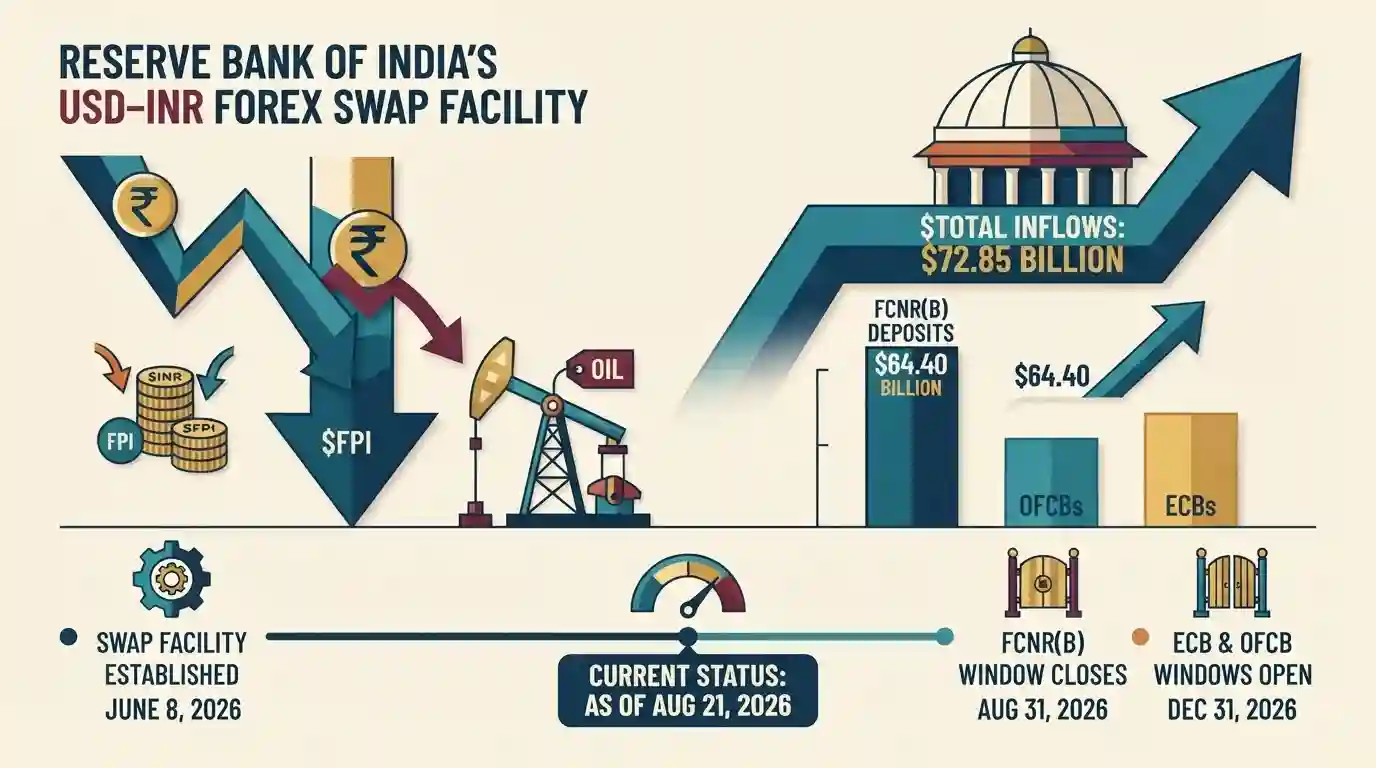
The Reserve Bank of India (RBI) announced that its special USD-INR Forex Swap facility has generated $72.85 billion in capital inflows as of August 21, 2026. The facility was established on June 8, 2026, to defend the depreciating Indian Rupee and shore up foreign exchange reserves squeezed by massive FPI outflows and rising oil import bills. The bulk of the inflows came from FCNR(B) deposits ($64.40 billion), with additional contributions from OFCBs and ECBs. The FCNR(B) swap window is set to close on August 31, 2026, whereas the ECB and OFCB windows remain accessible until December 31, 2026.
મુખ્ય મુદ્દા
- The RBI reported that its special USD-INR Forex Swap facility has successfully generated $72.85 billion in foreign exchange inflows as of August 21, 2026.
- The breakdown of the inflows includes $64.40 billion via FCNR(B) deposits, $4.86 billion via Overseas Foreign Currency Borrowings (OFCBs), and $2.59 billion via External Commercial Borrowings (ECBs).
- Launched on June 8, 2026, the swap facility aimed to build up India's foreign exchange reserves, which were under heavy pressure due to a depreciating rupee triggered by Foreign Portfolio Investment (FPI) outflows and a surging oil import bill.
- The operational windows for the swap facilities differ: the FCNR(B) deposit scheme remains open until August 31, 2026, while the window for ECBs and OFCBs continues until December 31, 2026.
- This intervention demonstrates the RBI's usage of capital account instruments and banking-sector swaps to absorb foreign currency and manage exchange rate volatility.
મહત્વપૂર્ણ શબ્દો
Foreign Currency Non-Resident (Bank) deposits (FCNR(B))

Fixed-term deposits maintained strictly in foreign currency by Non-Resident Indians (NRIs) in Indian banks, safeguarding depositors from Rupee depreciation since both principal and interest are repatriable in foreign currency.
UPSC context
GS Paper III (Indian Economy/External Sector). Tests concepts of foreign capital inflows, balance of payments, and NRI deposit-led forex management.
Special USD-INR Forex Swap Facility
An RBI-initiated concessional mechanism where commercial banks swap foreign currency mobilised via deposits or loans for Rupees, with the central bank absorbing hedging costs to bolster forex reserves and defend the Rupee.
UPSC context
GS Paper III (Monetary Policy/External Sector). Tests understanding of RBI's direct market interventions, swap mechanics, and exchange rate defense.
External Commercial Borrowings (ECBs)
Commercial loans raised by eligible resident Indian entities from recognised non-resident lenders in foreign currencies or Rupees, adhering to RBI-regulated parameters like minimum maturity and permitted end-uses.
UPSC context
GS Paper III (Capital Account/External Debt). Tests knowledge of corporate debt avenues, balance of payments components, and capital account flows.
Overseas Foreign Currency Borrowings (OFCBs)
Foreign currency loans or credit lines raised by Authorized Dealer Category-I banks from international markets, foreign branches, or financial institutions to manage liquidity and support domestic credit operations.
UPSC context
GS Paper III (Banking & External Sector). Tests banks' international fundraising channels and macroprudential regulations under the RBI framework.
Authorised Dealer Category-I Banks
Financial institutions (mainly scheduled commercial banks) licensed by the RBI under FEMA, 1999, permitted to undertake all current and capital account foreign exchange transactions in India.
UPSC context
GS Paper III (Trade & Forex Regulation). Tests roles of financial intermediaries in enforcing foreign exchange laws, export realization, and remittances.
પ્રિલિમ્સ ટ્રેપ
FCNR(B) deposits are denominated in Indian Rupees, thereby transferring all currency depreciation risk directly to the non-resident depositor.
FCNR(B) deposits are denominated in foreign currency (e.g., USD, GBP). The depositor bears no exchange rate risk; the risk is fully borne by the holding bank.
સંલગ્ન સ્થિર ખ્યાલો
How do FCNR(B) accounts differ from NRE accounts?
- Currency denomination: FCNR(B) accounts are held strictly in foreign currencies, whereas NRE accounts are denominated in Indian Rupees.
- Exchange risk: The exchange rate fluctuation risk is borne by banks for FCNR(B), but by depositors for NRE accounts.
- Taxation rules: Interest earned on both FCNR(B) and NRE accounts is entirely tax-free in India.
How do capital flows impact the Balance of Payments?
- Capital Account classification: FCNR(B) deposits, ECBs, and OFCBs are classified under the Capital Account as debt-creating capital inflows.
- Deficit financing: These inflows act as a crucial financing mechanism to bridge the Current Account Deficit (CAD).
- Reserve liabilities: They temporarily boost official foreign exchange reserves but represent future repatriation liabilities for the country.
આંતર-વિષય પેટર્ન
Forex swaps + Domestic Liquidity Management
Spot dollar purchases by RBI inject rupee liquidity, requiring sterilisation via Open Market Operations or MSS to prevent domestic inflationary pressures.
External Debt + Sovereign Ratings
Increased reliance on debt instruments like ECBs and FCNR(B) alters India's short-term external debt profile, directly impacting sovereign credit rating assessments.

Multi-statement questions will likely test the accounting classification of FCNR(B) in BoP alongside the mechanics of Forex swap operations.
સંલગ્ન PYQ · 4
સંલગ્ન PYQ · 4
- 2022PrelimsGS1
With reference to the Indian economy, consider the following statements: 1. If the inflation is too high, Reserve Bank of India (RBI) is likely to buy government securities. 2. If the rupee is rapidly depreciating, RBI is likely to sell dollars in the market. 3. If interest rates in the USA or European Union were to fall, that is likely to induce RBI to buy dollars. Which of the statements given above are correct?
- 2019PrelimsGS1
Which one of the following is not the most likely measure the Government/RBI takes to stop the slide of Indian rupee?
- 2022PrelimsGS1
Consider the following statements: 1. Tight monetary policy of US Federal Reserve could lead to capital flight. 2. Capital flight may increase the interest cost of firms with existing External Commercial Borrowings (ECBs). 3. Devaluation of domestic currency decreases the currency risk associated with ECBs. Which of the statements given above are correct?
- 2013PrelimsGS1
Which of the following constitute Capital Account? 1. Foreign Loans 2. Foreign Direct Investment 3. Private Remittances 4. Portfolio Investment Select the correct answer using the codes given below.
