Reserve Bank of India proposal for overseas Rupee lending to neighbors
Source:The Hindu ↗
Why It Matters
The internationalization of the Indian Rupee is a crucial macroeconomic objective for India to reduce dollar dependence, manage external shocks, and lower transaction costs for Indian businesses. Understanding the mechanisms (like Vostro accounts and overseas lending) and their geopolitical significance in South Asia is highly relevant for both GS2 (IR) and GS3 (Economy) in the Mains examination.
Summary
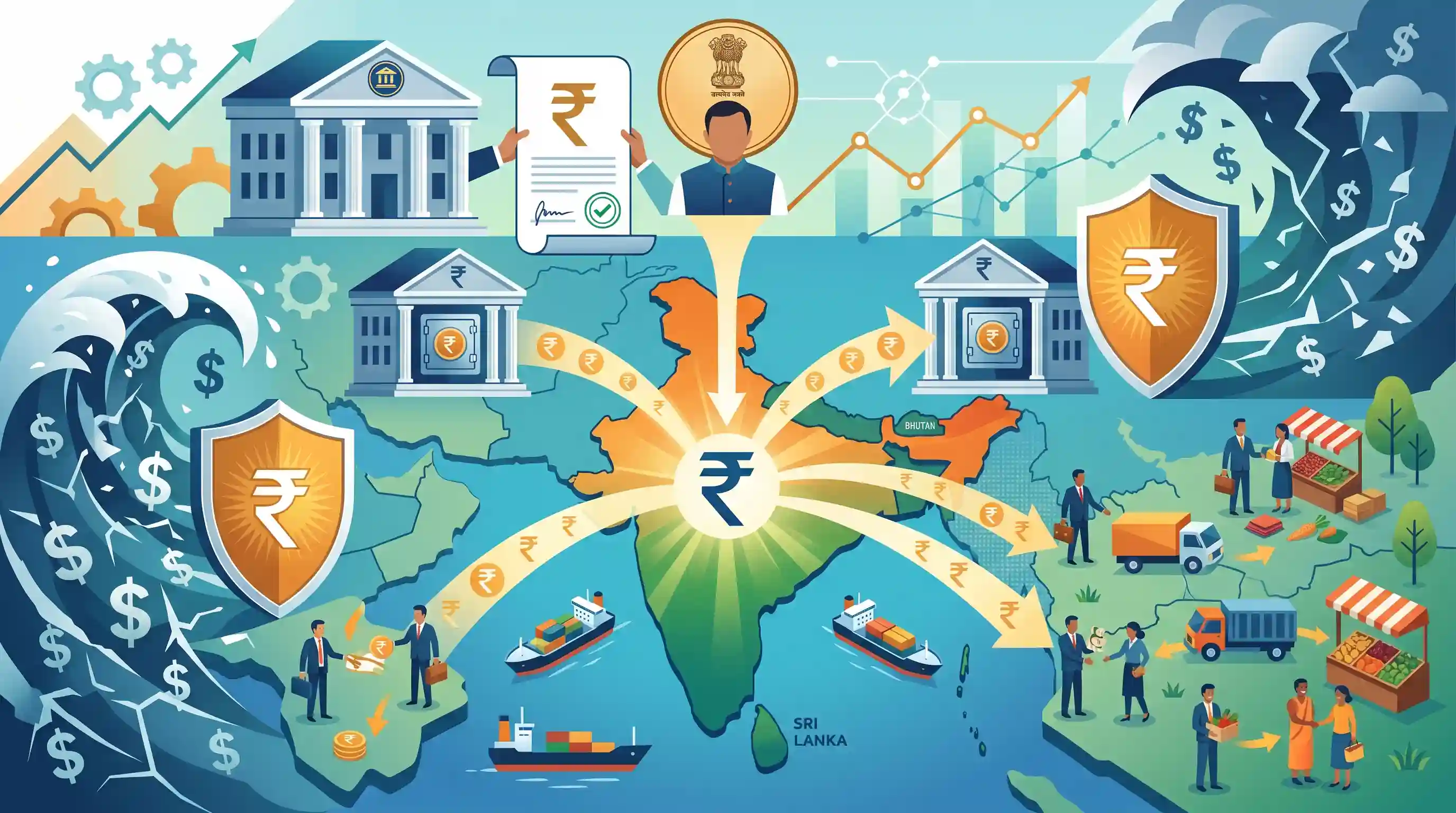
The Reserve Bank of India (RBI) has requested government approval to allow Indian banks to extend Rupee-denominated loans to foreign borrowers, particularly focusing on non-residents in neighboring countries such as Sri Lanka, Bangladesh, Bhutan, and Nepal. This initiative aims to advance the internationalization of the Indian Rupee by making Rupee liquidity available for trade settlements via Special Rupee Vostro Accounts. By enabling commercial banks to lend in Rupees on market terms, the RBI hopes to reduce reliance on sovereign credit lines or bilateral currency swap agreements, thereby stabilizing regional trade and protecting neighboring economies from US dollar-induced foreign exchange volatility.
Key Points
- The RBI has sought approval to allow domestic banks and their foreign branches to provide Rupee-denominated loans to overseas non-residents.
- The proposal initially targets neighboring countries like Bangladesh, Bhutan, Nepal, and Sri Lanka to support regional trade.
- This move is a major step toward the internationalization of the Indian Rupee, aiming to expand its acceptability for cross-border trade settlements.
- It intends to shift the burden of providing Rupee liquidity from government-backed sovereign credit lines and ad hoc currency swap agreements to market-based commercial bank lending.
- Providing access to Rupee loans will help neighboring nations manage foreign exchange volatility and reduce their dependence on the US Dollar.
Important Terms
Internationalization of the Rupee

The process of increasing the use of the Indian Rupee in cross-border transactions, including trade invoicing, settlement, and as a reserve asset, to reduce dependence on the US Dollar.
UPSC context
GS Paper III (Economy). Important for topics on external sector, exchange rate management, and India’s global economic footprint.
Special Rupee Vostro Accounts (SRVA)
Specialized bank accounts held by foreign banks in India, denominated in Rupees, allowing for the direct settlement of international trade without using intermediary global reserve currencies.
UPSC context
GS Paper III (Banking & Economy). Tests knowledge of trade settlement mechanisms and financial innovations to promote domestic currency.
Foreign Exchange Management Act (FEMA)
A 1999 legislation that regulates foreign exchange transactions in India, facilitating external trade and payments while ensuring the orderly development of the foreign exchange market.
UPSC context
GS Paper III (Economy). Crucial for understanding the regulatory framework governing capital and current account transactions.
Neighborhood First Policy
India's core foreign policy strategy focusing on improving relations and economic integration with its immediate neighbors like Sri Lanka, Bangladesh, Bhutan, and Nepal.
UPSC context
GS Paper II (International Relations). Relates to regional cooperation, bilateral agreements, and India's role in South Asia.
Reserve Bank of India (RBI)
India's central bank and regulatory body responsible for managing foreign exchange reserves, formulating monetary policy, and overseeing the country's banking system.
UPSC context
GS Paper III (Economy). Fundamental for understanding monetary policy functions and financial stability.
Prelims Trap
Special Rupee Vostro Accounts (SRVAs) are bank accounts opened by Indian commercial banks in foreign countries to facilitate cross-border Rupee trade.
Vostro means 'your money with us'. An SRVA is opened by a foreign correspondent bank with an authorized Indian bank situated IN India, not abroad.
Static Concepts Connected
What are Nostro, Vostro, and Loro accounts in cross-border banking?
- Nostro (Ours): An account that a domestic bank holds in a foreign country, denominated in that country's foreign currency (e.g., SBI holding USD in New York).
- Vostro (Yours): An account that a foreign bank holds in India, denominated in Indian Rupees (e.g., a Russian bank holding INR with SBI).
- Loro (Theirs): A third-party reference; for example, when Bank A refers to an account that Bank B holds with Bank C.
How do Central Bank Currency Swap Agreements function?
- Mechanism: Two central banks exchange a set amount of their respective currencies at a predefined exchange rate, agreeing to reverse the trade at a specified future date.
- Strategic Purpose: It provides short-term foreign exchange liquidity to nations to manage balance of payments crises or stabilize currency without relying on open markets.
- SAARC Facility: The RBI operates a specific swap facility for SAARC nations to ensure their short-term financial stability, which this new commercial lending aims to supplement.
Cross-Topic Patterns
Rupee diplomacy and Neighborhood First
Replaces ad-hoc bilateral currency swaps with market-based commercial credit, strengthening economic integration while shielding vulnerable SAARC economies from imported dollar-driven inflation.
FEMA and Capital Account Convertibility
Permitting cross-border commercial lending in Rupees is a major step in capital account liberalization, recalling the Tarapore Committee’s roadmap for easing capital flows under FEMA.

Expect a Prelims question combining SRVA mechanics (Nostro/Vostro) with RBI’s SAARC currency swap framework and capital account.
Linked PYQs · 4
Linked PYQs · 4
- 2025MainsGS3
What are the challenges before the Indian economy when the world is moving away from free trade and multilateralism to protectionism and bilateralism? How can these challenges be met?
- 2015PrelimsGS1
Convertibility of rupee implies
- 2025PrelimsGS1
Which of the following are the sources of income for the Reserve Bank of India? I. Buying and selling Government bonds II. Buying and selling foreign currency III. Pension fund management IV. Lending to private companies V. Printing and distributing currency notes Select the correct answer using the code given below.
- 2022MainsGS2
India is an age-old friend of Sri Lanka.’ Discuss India's role in the recent crisis in Sri Lanka in the light of the preceding statement.
