RBI Treasury Bill Auction Cancellation and Banking System Liquidity
Source:The Hindu ↗
Why It Matters
Understanding the functioning of money markets, Treasury bills, and the RBI's liquidity management tools (like VRR and LAF) is fundamental to the UPSC Economy syllabus. This scenario illustrates how statutory tax outflows impact systemic liquidity and how the central bank intervenes to stabilize yields and ensure credit availability.
Summary
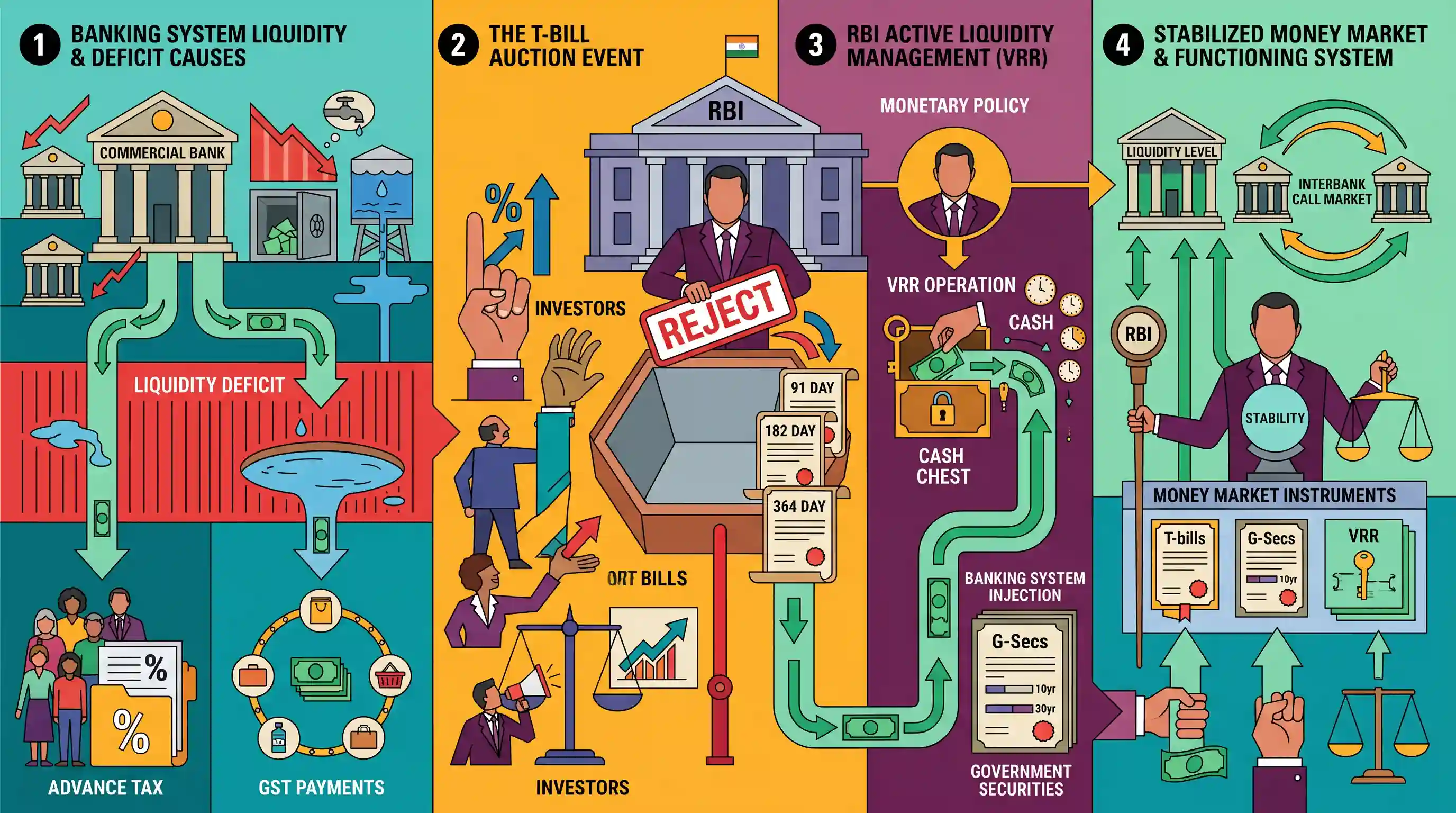
The Reserve Bank of India (RBI) recently rejected all bids for treasury bills offered at auction due to higher yield demands from investors, reflecting tight liquidity conditions in the banking system. This liquidity deficit is largely attributed to recent outflows for advance tax and GST payments. To manage this temporary shortfall and stabilize short-term money markets, the RBI has conducted Variable Rate Repo (VRR) auctions to inject transient liquidity into the banking system. The event highlights the practical functioning of money markets, the role of short-term government debt instruments (T-bills), and the RBI's active liquidity management operations.
Key Points
- The RBI scrapped the auction of ₹20,000 crore worth of Treasury bills (91-day, 182-day, and 364-day) as investors demanded yields higher than what the central bank was willing to offer.
- Treasury bills are short-term money market instruments issued by the Government of India at a discount to face value and redeemed at par, serving as zero-coupon promissory notes.
- Systemic liquidity in the banking system has tightened considerably due to substantial outflows for advance tax and Goods and Services Tax (GST) payments.
- To alleviate the liquidity deficit, the RBI injected transient liquidity into the banking system through Variable Rate Repo (VRR) auctions.
Important Terms
Treasury Bills (T-bills)

Short-term debt instruments issued by the Government of India in tenures of 91, 182, and 364 days; these zero-coupon securities are sold at a discount.
UPSC context
GS-3 Indian Economy; essential for understanding government borrowing, fiscal deficit management, and short-term money market instruments.
Variable Rate Repo (VRR)
An auction-based tool used by the RBI to inject liquidity into banks at market-determined rates, typically for 1 to 14 days.
UPSC context
GS-3 Economy; tests knowledge of RBI's fine-tuning operations and market-based liquidity management tools.
Banking System Liquidity
The availability of ready cash for banks; a deficit exists when banks are net borrowers from the RBI under the LAF framework.
UPSC context
GS-3 Economy; fundamental for understanding monetary transmission, inflation control, and seasonal impacts like tax outflows.
Liquidity Adjustment Facility (LAF)
RBI's primary tool for modulating short-term liquidity, allowing banks to borrow (Repo) or park funds (Reverse Repo/SDF) to manage daily mismatches.
UPSC context
GS-3 Economy; a core component of the monetary policy framework frequently appearing in Prelims.
Yield
The effective annualized return on a security; it shares an inverse relationship with the security's price and reflects market interest rate expectations.
UPSC context
GS-3 Economy; key for understanding bond market dynamics, interest rate cycles, and monetary policy impact.
Money Market
The financial market segment for short-term borrowing and lending (up to one year), involving high-liquidity instruments like T-bills and call money.
UPSC context
GS-3 Economy; crucial for understanding the financial system architecture and how RBI manages short-term interest rates.
Prelims Trap
State Governments can issue Treasury Bills to manage their short-term liquidity deficits.
Only the Central Government issues Treasury Bills in India. State Governments rely on State Development Loans (SDLs) for long-term borrowing and Ways and Means Advances (WMA) for short-term liquidity mismatches.
Static Concepts Connected
What are the core characteristics of Treasury Bills in India?
- Exclusive Issuer: Issued exclusively by the Central Government via the RBI. State governments cannot issue T-Bills.
- Pricing Mechanism: They are zero-coupon instruments paying no regular interest. Investors buy them at a discount and redeem them at face value.
- Standard Tenors: Strictly short-term instruments currently available in exactly three maturities: 91-day, 182-day, and 364-day.
How do statutory tax payments impact systemic banking liquidity?
- Liquidity Drain: Advance tax and GST payments move funds from commercial bank deposits into the government's account at the RBI, temporarily draining systemic liquidity.
- RBI Intervention: To offset this transient deficit and stabilize money markets, the RBI conducts Variable Rate Repo (VRR) auctions to inject short-term funds back into banks.
Cross-Topic Patterns
Fiscal drains and LAF operations
Advance tax cycles routinely cause sudden systemic liquidity deficits. UPSC frequently tests the mechanical impact of fiscal transfers (taxes moving to government RBI accounts) on commercial banking liquidity.
Yield expectations vs Monetary stance
When investors demand higher yields, RBI may scrap auctions to prevent anchoring high short-term borrowing costs, demonstrating the central bank's active role in yield curve management.

Expect a Prelims question testing the mechanical impact of advance tax outflows on systemic banking liquidity and the resulting VRR response.
Linked PYQs · 4
Linked PYQs · 4
- 2018PrelimsGS1
Consider the following statements: 1. The Reserve Bank of India manages and services Government of India Securities but not any State Government Securities. 2. Treasury bills are issued by the Government of India and there are no treasury bills issued by the State Governments. 3. Treasury bills offer are issued at a discount from the par value. Which of the statements given above is/are correct?
- 2023PrelimsGS1
Consider the following markets: 1. Government Bond Market 2. Call Money Market 3. Treasury Bill Market 4. Stock Market How many of the above are included in capital markets?
- 2024PrelimsGS1
Consider the following statements : 1. In India, Non-Banking Financial Companies can access the Liquidity Adjustment Facility window of the Reserve Bank of India. 2. In India, Foreign Institutional Investors can hold the Government Securities (G-Secs). 3. In India, Stock Exchanges can offer separate trading platforms for debts. Which of the statements given above is/are correct?
- 2020PrelimsGS1
If the RBI decides to adopt an expansionist monetary policy, which of the following would it not do ? 1. Cut and optimize the Statutory Liquidity Ratio 2. Increase the Marginal Standing Facility Rate 3. Cut the Bank Rate and Repo Rate Select the correct answer using the code given below:
