Reserve Bank Guidelines on Uniform Interest Rates for Bank Deposits
Source:The Hindu ↗
Why It Matters
Understanding RBI's regulatory actions on commercial banks is a core part of the GS3 Economy syllabus. This topic highlights how the central bank ensures consumer protection, transparency, and standardization in the banking sector (e.g., classifying deposits as liabilities and standardizing interest calculation).
Summary
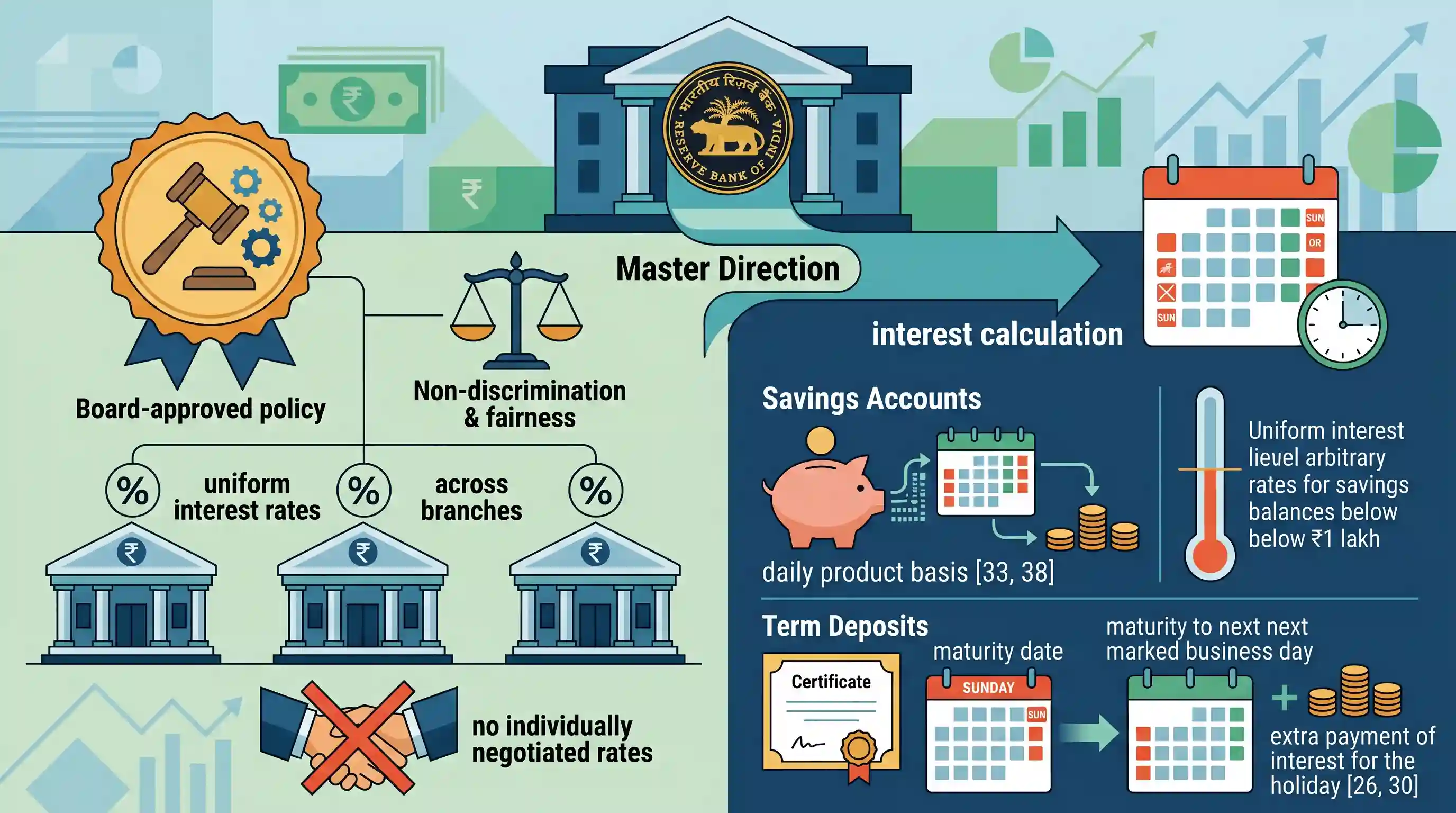
The Reserve Bank of India (RBI) has issued a comprehensive Master Direction regulating how commercial banks pay interest on deposits. Aimed at promoting transparency and preventing discrimination, the directive requires banks to have a Board-approved policy and offer uniform interest rates across all branches for similar deposits made on the same day. Rates cannot be individually negotiated. The RBI also clarified specific guidelines for interest calculation, including daily product basis for savings accounts, uniform rates for savings balances up to ₹1 lakh, and handling term deposits that mature on holidays or non-business days.
Key Points
- The Reserve Bank of India (RBI) issued a Master Direction mandating commercial banks to formulate a Board-approved policy for paying interest on all deposits, excluding current accounts.
- Deposit interest rates must be uniform across all branches; banks cannot discriminate between deposits of similar amounts accepted on the same date.
- Interest rates are non-negotiable between depositors and the bank, and the rates must be reasonable, consistent, and transparent.
- Interest on savings deposits must be calculated on a daily product basis. A uniform rate applies to savings accounts up to ₹1 lakh, while differential rates are permitted for balances exceeding this amount.
- For term deposits maturing on non-business days, interest will be paid at the original contracted rate for the intervening non-business day(s).
Important Terms
Master Direction on Interest Rate on Deposits

A consolidated regulatory framework issued by the RBI specifying how banks must determine, calculate, and disclose interest rates on domestic and non-resident deposits.
UPSC context
GS3 (Economy - Banking); important for understanding RBI’s regulatory powers and consumer protection in the financial sector.
Reserve Bank of India (RBI)
India's central bank and regulatory body responsible for regulating the Indian banking system and managing the country's monetary policy and foreign exchange reserves.
UPSC context
GS3 (Economy); core institution for topics on inflation, banking regulation, and monetary policy.
Daily Product Basis
A calculation method where interest is computed on the balance outstanding at the end of each day, rather than on a monthly minimum balance.
UPSC context
GS3 (Economy - Banking); technical detail regarding financial inclusion and fair banking practices.
Foreign Currency (Non-Resident) Accounts (Banks) Scheme (FCNR(B))
A term deposit scheme for NRIs allowing deposits in foreign currencies; it eliminates exchange rate risk as both principal and interest are maintained in foreign currency.
UPSC context
GS3 (Economy - External Sector); vital for understanding capital inflows and BoP management.
NRE and NRO Accounts
NRE accounts park foreign earnings tax-free with full repatriability; NRO accounts manage income earned in India, are taxable, and have restricted repatriation limits.
UPSC context
GS3 (Economy); common Prelims topic distinguishing between different types of NRI deposit accounts.
Prelims Trap
"Banks must pay a strictly uniform interest rate on all savings account balances regardless of the deposit amount."
This is false. Banks must offer uniform rates on savings balances up to ₹1 lakh, but are explicitly permitted to offer differential rates for balances above this threshold.
Static Concepts Connected
What are the core differences between Demand and Time liabilities (deposits) in India?
- Demand Deposits: Current and Savings accounts withdrawable on demand. Under RBI rules, current accounts earn zero interest to discourage their use for investments.
- Time Deposits: Fixed and recurring deposits with specific tenures. They earn higher interest but generally attract penalties for premature withdrawal.
What powers do Sections 21 and 35A of the Banking Regulation Act, 1949 grant RBI?
- Section 21: Empowers the RBI to dictate the policies of banking companies regarding advances and to mandate the rates of interest they pay or charge.
- Section 35A: Gives RBI sweeping powers to issue binding directions to banks to secure proper management, prevent detrimental affairs, and protect public interest.
Cross-Topic Patterns
Deposit Rates & Monetary Policy Transmission
Transparent, non-negotiable deposit rates ensure that changes in the RBI's repo rate are more smoothly transmitted to depositors, addressing a classic lag in India's monetary policy transmission.
Financial Inclusion & Small Depositors
Mandating uniform rates for savings up to ₹1 lakh protects small, rural depositors from being shortchanged, directly aligning with India's broader financial inclusion and JAM trinity agenda.

Expect a 2026 prelims statement testing the ₹1 lakh uniform rate threshold alongside the 'daily product basis' for interest calculation.
Linked PYQs · 4
Linked PYQs · 4
- 2019PrelimsGS1
Which of the following is not included in the assets of a commercial bank in India?
- 2021PrelimsGS1
Consider the following : 1. Foreign currency convertible bonds 2. Foreign institutional investment with certain conditions 3. Global depository receipts 4. Non-resident external deposits Which of the above can be included in Foreign Direct Investments?
- 2025PrelimsGS1
Which of the following are the sources of income for the Reserve Bank of India? I. Buying and selling Government bonds II. Buying and selling foreign currency III. Pension fund management IV. Lending to private companies V. Printing and distributing currency notes Select the correct answer using the code given below.
- 2024MainsGS3
What are the causes of persistent high food inflation in India? Comment on the effectiveness of the monetary policy of the RBI to control this type of inflation.
