RBI Revises Net Worth Norms for TReDS Operators
Source:The Hindu ↗
Why It Matters
Strengthening the financial health of TReDS operators ensures the stability of the payment and settlement system. This stability is critical for MSMEs seeking to monetize trade receivables and access working capital in a timely manner, which in turn supports inclusive economic growth.
Summary
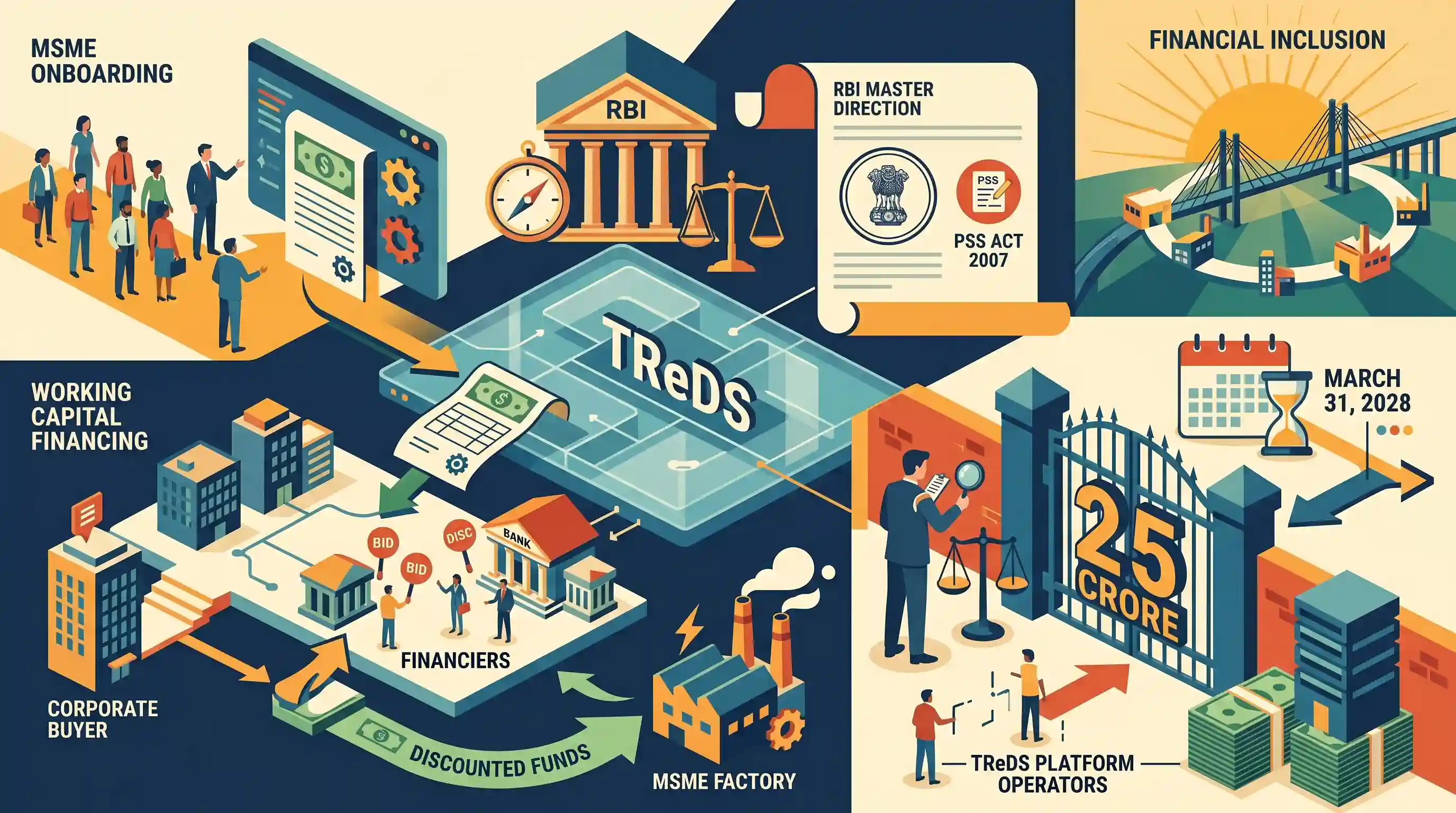
The Reserve Bank of India (RBI) has revised its guidelines for onboarding Micro, Small and Medium Enterprises (MSMEs) onto the Trade Receivables Discounting System (TReDS). The central bank mandated that entities facilitating invoice discounting on the platform must maintain a minimum net worth of ₹25 crore, which must be certified by a statutory auditor. Existing participants have been given a transition window until March 31, 2028, to comply with this requirement. TReDS serves as an electronic multi-financier platform enabling MSMEs to discount their trade receivables from corporate buyers, unlocking essential working capital. Platform operators are regulated by the RBI under the Payment and Settlement Systems Act, 2007.
Key Points
- The RBI issued revised guidelines for onboarding entities onto the Trade Receivables Discounting System (TReDS), tightening financial norms.
- Entities providing invoice discounting services on TReDS must now maintain a minimum net worth of ₹25 crore, backed by a statutory auditor's certificate.
- Existing participants on the platform are granted a transition period until March 31, 2028, to meet the new net worth threshold.
- TReDS platform operators are authorized and regulated by the RBI under the Payment and Settlement Systems (PSS) Act, 2007.
- TReDS functions as a multi-financier electronic platform allowing MSMEs to auction their trade receivables, alleviating working capital constraints.
Important Terms
Trade Receivables Discounting System (TReDS)

An RBI-regulated electronic platform enabling MSMEs to auction trade receivables (invoices) to multiple financiers, ensuring quick access to working capital without recourse to the seller.
UPSC context
GS-III: Indian Economy. Key for topics on MSME financing, credit gaps, and financial sector digital infrastructure.
Payment and Settlement Systems (PSS) Act, 2007
The primary legislation providing the legal framework for regulating and supervising payment systems in India, designating the RBI as the sole authority to authorize and oversee these systems.
UPSC context
GS-III: Economy and Digital Infrastructure. Crucial for understanding the regulation of fintech, UPI, and financial stability.
Micro, Small and Medium Enterprises (MSMEs)
Enterprises classified by investment and turnover; as of 2025, thresholds include 'Micro' (up to ₹2.5cr investment), 'Small' (up to ₹25cr), and 'Medium' (up to ₹125cr).
UPSC context
GS-III: Industry and Employment. Essential for discussions on inclusive growth, manufacturing output, and the 'backbone' of the Indian economy.
Reserve Bank of India (RBI)
India's central bank and regulatory body responsible for monetary policy, banking supervision, and the stability of the payment and settlement systems across the nation.
UPSC context
GS-III: Indian Economy. Tests knowledge of monetary management, banking regulations, and the regulator's role in financial inclusion.
Prelims Trap
"MSMEs must maintain a minimum net worth of ₹25 crore to participate in TReDS."
The ₹25 crore minimum net worth requirement applies strictly to the financial entities facilitating the discounting, not the MSMEs seeking the liquidity.
Static Concepts Connected
How does the TReDS platform function?
- Sellers vs Buyers: Only MSMEs can sell trade receivables. Buyers include corporates, Government departments, and PSUs.
- Financiers: Banks, NBFC-Factors, and other RBI-permitted financial institutions bid on the invoices.
- Without Recourse: Transactions are "without recourse", meaning the MSME is not liable to the financier if the corporate buyer defaults on the payment.
- Regulation: The platforms operate as payment systems authorized under the Payment and Settlement Systems (PSS) Act, 2007.
How does Invoice Discounting differ from traditional lending?
- Debt Creation: Discounting involves selling an asset (the unpaid invoice) for immediate cash. It is not a loan and does not add debt to the MSME's balance sheet.
- Collateral Reliance: It relies on the creditworthiness of the corporate buyer paying the invoice, rather than requiring the MSME to pledge hard collateral.
Cross-Topic Patterns
TReDS + NBFC Factoring Regulations
Connects to the Factoring Regulation Act which allowed more non-deposit taking NBFCs to participate as financiers on TReDS, drastically boosting MSME liquidity.
The MSME Formalization Trinity
TReDS operates alongside Udyam Registration and GSTN to create a verifiable digital footprint for MSMEs, shifting the ecosystem from collateral-based to cash-flow-based lending.

Expect a multi-statement 2026 Prelims question testing TReDS's "without recourse" nature, PSS Act 2007 regulation, and eligible entities.
Linked PYQs · 3
Linked PYQs · 3
- 2023PrelimsGS1
Consider the following statements with reference to India: 1. According to the 'Micro, Small and Medium Enterprises Development (MSMED) Act, 2006', the 'medium enterprises' are those with investments in plant and machinery between ₹ 15 crore and ₹ 25 crore. 2. All bank loans to the Micro, Small and Medium Enterprises qualify under the priority sector. Which of the statements given above is/are correct?
- 2023MainsGS3
Faster economic growth requires increased share of the manufacturing sector in GDP, particularly of MSMEs. Comment on the present policies of the Government in this regard.
- 2023PrelimsGS1
Which one of the following activities of the Reserve Bank of India is considered to be part of 'sterilization'?
