RBI Repo Rate Stance and Calibrated Monetary Policy Tightening
Source:Indian Express ↗
આ શા માટે મહત્વનું છે
It covers core macroeconomic concepts pertinent to GS3, specifically central banking, monetary policy tools, inflation targeting, and growth trade-offs, which frequently feature in UPSC Civil Services Mains.
સારાંશ
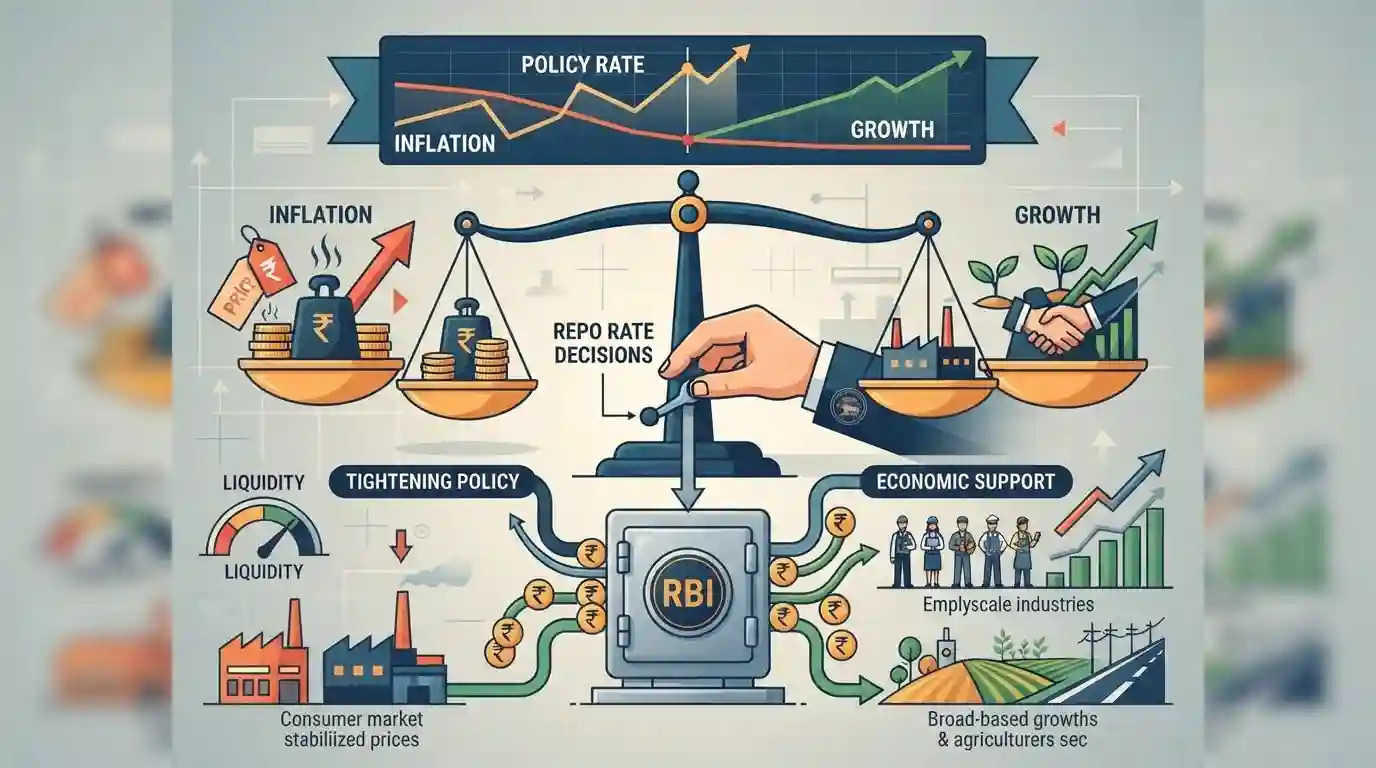
An editorial analysis of the RBI's repo rate decisions and calibrated monetary tightening policy aimed at managing inflation while supporting economic growth in India.
મુખ્ય મુદ્દા
- The article discusses the Reserve Bank of India's (RBI) stance on repo rate adjustments and monetary policy tightening.
- It highlights the calibrated approach adopted by the central bank to balance economic growth and inflation control.
- Monetary policy transmission and liquidity management remain crucial for addressing macroeconomic stability.
મહત્વપૂર્ણ શબ્દો
Reserve Bank of India

India's central banking institution, established in 1935 under the RBI Act, 1934, responsible for regulating the monetary system, issuing currency, and managing foreign exchange reserves.
UPSC context
Crucial for GS Paper III (Indian Economy); tests understanding of central banking, monetary management, inflation targeting, and financial sector regulation in India.
Monetary Policy Committee
A six-member statutory body constituted under the RBI Act, 1934, entrusted with fixing the benchmark policy repo rate to contain inflation within targeted bounds while supporting growth.
UPSC context
Important for GS Paper III (Banking and Monetary Policy); tests structural mechanisms of inflation targeting, institutional mandates, and interest rate decision-making.
Repo Rate
The interest rate at which the central bank lends short-term funds to commercial banks against government securities, acting as the key benchmark instrument for monetary policy operations.
UPSC context
Core concept for GS Paper III (Indian Economy - Growth and Inflation); tests tools of monetary policy and transmission mechanisms affecting credit cost and liquidity.
પ્રિલિમ્સ ટ્રેપ
The Central Government directly determines the policy repo rate and manages day-to-day liquidity management under the RBI Act.
Aspirants often confuse the statutory inflation target (4% with +/-2% band) as being managed by the Ministry of Finance, whereas the MPC is statutorily mandated to achieve it.
સંલગ્ન સ્થિર ખ્યાલો
What are the composition and mandate of the Monetary Policy Committee (MPC) in India?
- Statutory Basis: Statutory Body established under an amendment to the Reserve Bank of India Act, 1934.
- Composition: 6 members total: 3 officials from RBI and 3 external members appointed by the Central Government.
- Chairmanship: Governor of RBI acts as the ex-officio Chairperson with a casting vote in case of a tie.
- Core Mandate: Mandated to determine the policy repo rate required to achieve the targeted inflation rate.
What is India's flexible inflation targeting (FIT) framework and its statutory parameters?
- Legislative Origin: Adopted in 2016 by amending the RBI Act, 1934, making price stability the primary objective of monetary policy.
- Inflation Target: CPI headline inflation is targeted at 4 percent with a tolerance band of +/- 2 percent (upper limit 6%, lower limit 2%).
- Accountability Mechanism: Failure to meet the target for three consecutive quarters requires the RBI to submit a formal report to the Central Government explaining reasons and remedial actions.
આંતર-વિષય પેટર્ન
Monetary Tightening and Fiscal Deficit Trade-offs
Central banks balancing core CPI targets against growth shocks frequently intersect with fiscal deficit pressures and debt management under the FRBM Act.
Interest Rate Differentials and Capital Flows
Rising domestic interest rates impact foreign portfolio capital flows, linking domestic monetary policy decisions directly to exchange rate stability and RBI's forex reserves management.

MPC voting pattern, statutory inflation targets (4+/-2%), and quantitative vs qualitative tools are high-yield prelims concepts.
સંલગ્ન PYQ · 2
સંલગ્ન PYQ · 2
- 2024MainsGS3
What are the causes of persistent high food inflation in India? Comment on the effectiveness of the monetary policy of the RBI to control this type of inflation.
- 2019MainsGS3
Do you agree with the view that steady GDP growth and low inflation have left the Indian economy in good shape? Give reasons in support of your arguments.
