RBI Assessment Of Remittances And Balance Of Payments Resilience
Source:Indian Express ↗
Why It Matters
External sector stability is a core macroeconomic topic. Analyzing how structural factors like changing remittance geographies and services exports cushion India's Current Account Deficit against external shocks (e.g., energy price spikes, FPI dumping) is critical for Mains GS3 and Prelims economy questions.
Summary
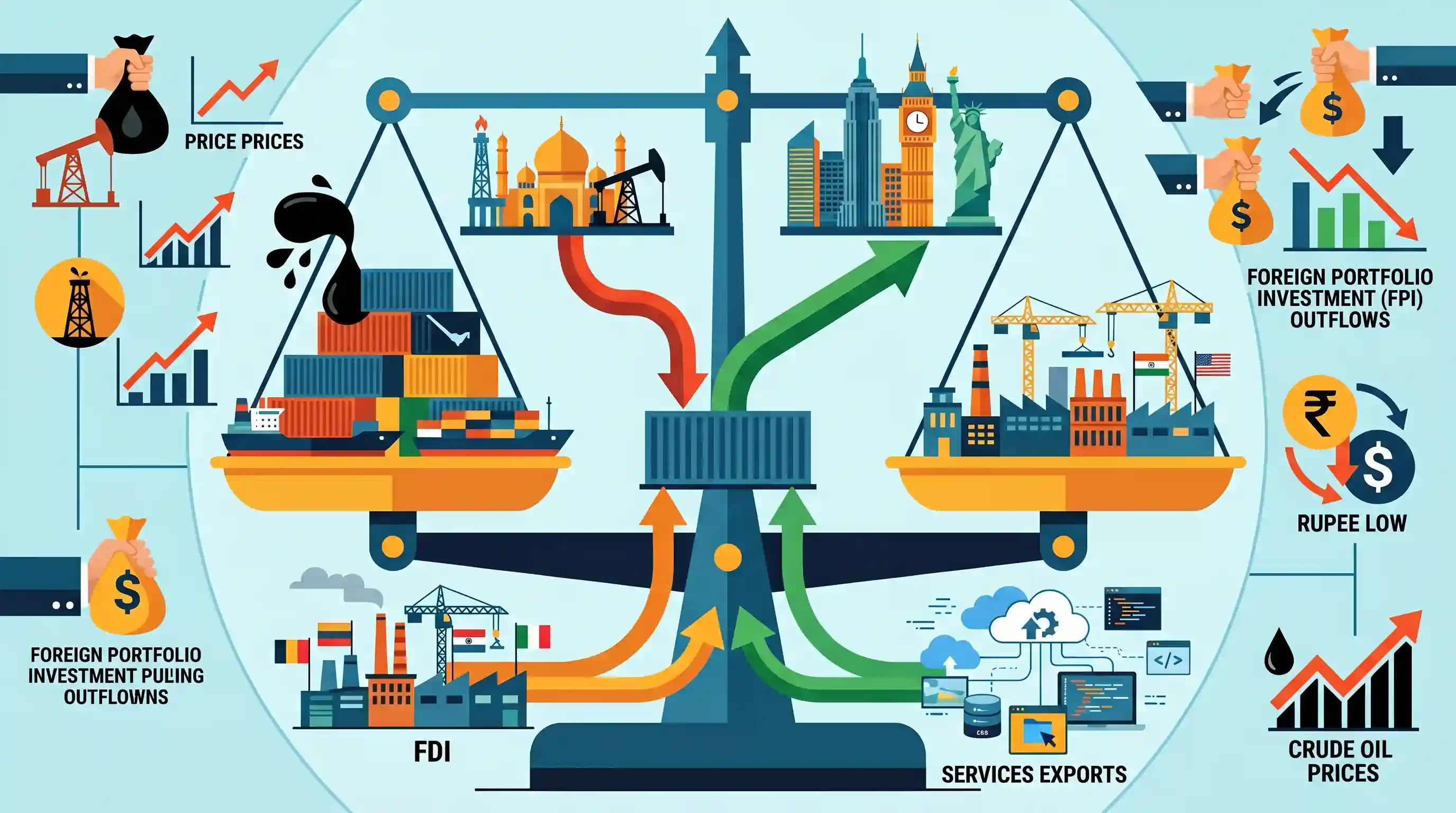
The Reserve Bank of India (RBI) has noted that India's balance of payments remains fundamentally strong despite concerns that the ongoing West Asia conflict could disrupt remittances. Geographic diversification of the Indian diaspora has provided stability, with the share of remittances from West Asia declining to 38% while inflows from advanced economies like the US and UK have risen. Alongside services exports and Foreign Direct Investment (FDI), these robust remittances structurally offset the country's goods trade deficit. This resilience provides a crucial buffer amid recent macroeconomic pressures, including the rupee hitting an all-time low against the dollar due to elevated crude oil prices and significant foreign portfolio outflows.
Key Points
- The RBI expressed confidence in the structural resilience of India's balance of payments despite geopolitical tensions in West Asia.
- India's inward remittances remain robust, aided by geographic diversification as the share of remittances from West Asia dropped to 38% in 2023-24, while those from advanced economies like the US and UK increased.
- The rupee reached an all-time low of 95.34 per dollar, pressured by rising global crude oil prices and sustained Foreign Portfolio Investment (FPI) outflows.
- Strong remittances, services exports, and Foreign Direct Investment (FDI) provide a cushion against the widening goods trade deficit.
Important Terms
Remittances

Non-commercial money transfers from migrants to their home country. India is the world’s top recipient (~$135bn), with 38% from West Asia and increasing shares from the US and UK.
UPSC context
GS Paper 3 (Economy); crucial for managing the Current Account Deficit and supporting foreign exchange reserves.
Balance of Payments (BoP)
A systematic record of all economic transactions between residents of a country and the rest of the world, comprising the Current Account and Capital Account.
UPSC context
GS Paper 3 (Economy); fundamental for understanding external sector stability and macro-economic health.
Trade Deficit
An economic condition where a country's merchandise imports exceed its exports. India structurally uses services exports and remittances to offset its large goods trade deficit.
UPSC context
GS Paper 3 (Economy); tested in the context of export-import policies and global trade shocks.
Foreign Portfolio Investment (FPI)
Investment in financial assets like stocks and bonds by foreign entities. Often termed 'hot money,' it is highly volatile and sensitive to global geopolitical tensions.
UPSC context
GS Paper 3 (Economy); impacts stock market volatility and exchange rate fluctuations.
Foreign Direct Investment (FDI)
Long-term investment by a foreign entity into a domestic business or infrastructure. It is considered a stable, non-debt creating capital inflow that brings technology and management expertise.
UPSC context
GS Paper 3 (Economy); key for resource mobilization and sustainable economic growth.
Exchange Rate Depreciation
The loss of value of a country's currency relative to others in a floating exchange rate system, recently driven in India by high oil prices and FPI outflows.
UPSC context
GS Paper 3 (Economy); relates to monetary policy and external vulnerability to global shocks.
Prelims Trap
More than half of India's inward remittances currently originate from West Asia and GCC nations.
West Asia's share has structurally declined to 38% by 2023-24. Advanced economies like the US and UK now drive the largest share of Indian remittances.
Static Concepts Connected
How are remittances classified in India's Balance of Payments (BoP)?
- Current Account: They are recorded under the Current Account, not the Capital Account.
- Invisibles: Remittances fall specifically under the 'Invisibles' category, alongside services and income.
- Unilateral Transfers: They are classified as 'Private Transfers' because they are one-way, unrequited transactions without any exchange of goods or services.
How do crude oil prices and FPI outflows depreciate the Rupee?
- Trade Deficit: Higher crude prices inflate the import bill, widening the trade deficit and increasing the demand for US Dollars to pay for imports.
- FPI Outflows: As 'hot money' exits the domestic market, investors sell Rupees to repatriate Dollars, creating an oversupply of Rupees and further depreciating its value.
Cross-Topic Patterns
Diaspora demographics & macroeconomic dividends
The shift from Gulf to US/UK remittances reflects India's transition from blue-collar to white-collar emigration, directly linking GS1 (Society/Diaspora) with GS3 (External Sector).
Geopolitics and imported inflation
West Asia tensions threaten India via a dual macroeconomic shock: potential blue-collar remittance disruption and widening trade deficits due to elevated crude oil prices.

A 2026 prelims question will likely test the structural shift of remittances from the Gulf to advanced economies against BoP components.
Linked PYQs · 5
Linked PYQs · 5
- 2021PrelimsGS1
Consider the following : 1. Foreign currency convertible bonds 2. Foreign institutional investment with certain conditions 3. Global depository receipts 4. Non-resident external deposits Which of the above can be included in Foreign Direct Investments?
- 2022PrelimsGS1
With reference to the Indian economy, consider the following statements: 1. An increase in Nominal Effective Exchange Rate (NEER) indicates the appreciation of rupee. 2. An increase in the Real Effective Exchange Rate (REER) indicates an improvement in trade competitiveness. 3. An increasing trend in domestic inflation relative to inflation in other countries is likely to cause an increasing divergence between NEER and REER. Which of the above statements are correct?
- 2022PrelimsGS1
With reference to the Indian economy, consider the following statements: 1. If the inflation is too high, Reserve Bank of India (RBI) is likely to buy government securities. 2. If the rupee is rapidly depreciating, RBI is likely to sell dollars in the market. 3. If interest rates in the USA or European Union were to fall, that is likely to induce RBI to buy dollars. Which of the statements given above are correct?
- 2016MainsGS3
Justify the need for FDI for the development of the Indian economy. Why there is gap between MOUs signed and actual FDIs? Suggest remedial steps to be taken for increasing actual FDIs in India.
- 2023MainsGS2
Indian diaspora has scaled new heights in the West. Describe its economic and political benefits for India.
