RBI monetary policy stance amid global supply chain shocks
Source:Indian Express ↗
Why It Matters
Understanding how the RBI balances its dual mandate of inflation targeting and growth support in the face of exogenous supply shocks (like geopolitical conflicts and crude oil price spikes) is fundamental to analyzing India's macroeconomic stability and monetary policy mechanics.
Summary
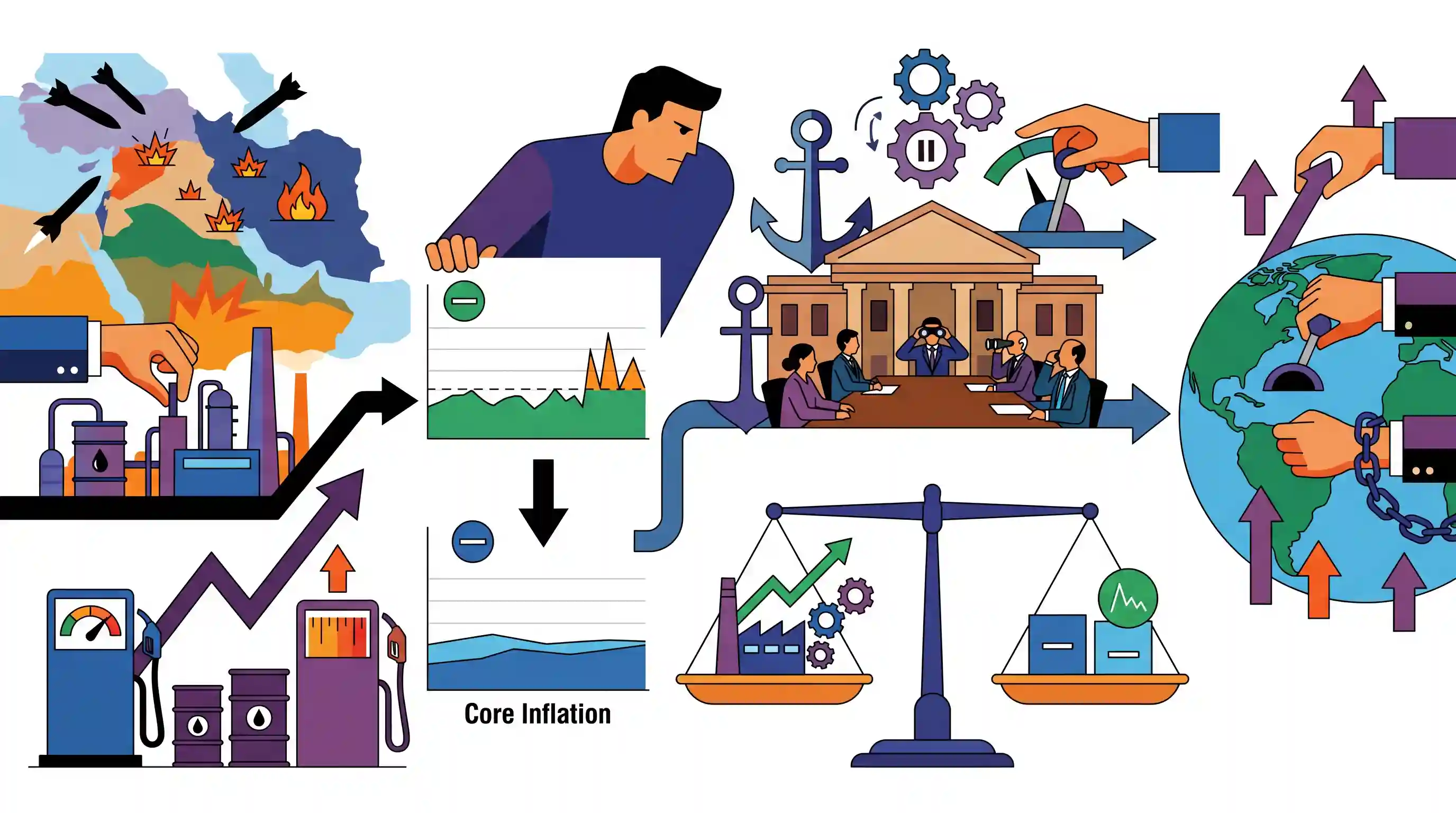
Despite mounting inflationary pressures driven by rising crude oil prices amid the US-Iran conflict in West Asia, the Reserve Bank of India's Monetary Policy Committee (MPC) is expected to maintain its current interest rates. The RBI is adopting a cautious wait-and-watch approach, balancing the need to support economic growth—projected below its 7% potential—against the risks of inflation. Because core inflation remains benign and retail inflation is below the 4% target, the RBI views the current price spikes as transient supply-side shocks rather than entrenched core inflation, even as global peers deliberate tightening their own monetary policies.
Key Points
- The RBI's Monetary Policy Committee (MPC) is expected to defer interest rate hikes and keep the repo rate steady, despite inflationary pressures from surging crude oil prices caused by the US-Iran conflict.
- The central bank aims to balance inflation targeting with supporting economic growth, viewing the energy shock as a transient, supply-side catalyst rather than a permanent driver of core inflation.
- India's retail inflation (CPI) remains below the 4% target at 3.48%, providing room for a wait-and-watch approach, though high WPI inflation and El Niño weather patterns pose risks of faster cost pass-through to consumers.
- Globally, central banks face similar dilemmas; while the US Fed kept rates unchanged amid uncertainty, several Asia-Pacific central banks have recently hiked rates to combat geopolitical and inflationary pressures.
Important Terms
Monetary Policy Committee (MPC)

A six-member statutory body (3 RBI, 3 Government nominees) under the RBI Act, 1934, mandated to fix the repo rate to achieve specific inflation targets.
UPSC context
GS Paper III (Economy); tests knowledge of institutional frameworks for price stability and the role of statutory bodies.
Core Inflation
A measure of inflation that excludes volatile food and fuel prices, used to identify underlying, long-term price trends and demand-side pressures in the economy.
UPSC context
GS Paper III (Economy); tests the ability to distinguish between transient supply shocks and entrenched structural price rises.
Headline Inflation
The total inflation figure in an economy, reflecting price changes across the entire Consumer Price Index (CPI) basket, including volatile food and energy costs.
UPSC context
GS Paper III (Economy); tests understanding of the primary indicator used in India's flexible inflation targeting (FIT) framework.
Repo Rate
The benchmark interest rate at which the RBI lends money to commercial banks; it is the primary tool for managing liquidity and controlling inflation.
UPSC context
GS Paper III (Economy); tests knowledge of indirect monetary policy instruments and their transmission to credit markets.
US Federal Reserve
The central bank of the United States, whose rate decisions significantly influence global capital flows, the Indian Rupee's value, and FPI investments.
UPSC context
GS Paper III (External Sector); tests understanding of global monetary spillovers and external macroeconomic stability.
Reserve Bank of India (RBI)
India’s central bank responsible for monetary policy, currency management, and financial regulation, balancing price stability with the objective of supporting economic growth.
UPSC context
GS Paper III (Economy); tests understanding of the central bank's dual mandate and its autonomy in managing macro-financial risks.
Supply-side Shock
An unexpected event, such as a geopolitical conflict or natural disaster, that reduces the supply of a commodity (e.g., oil), leading to sudden price increases.
UPSC context
GS Paper III (Economy); tests the distinction between cost-push and demand-pull inflation and the limits of monetary policy.
European Central Bank (ECB)
The central bank of the Eurozone, whose monetary policy impacts global liquidity and serves as a benchmark for international interest rate trends.
UPSC context
GS Paper III (External Sector); tests knowledge of the global economic environment and its impact on India's interests.
Prelims Trap
The RBI is legally mandated to target Core Inflation under its monetary policy framework.
Under the Flexible Inflation Targeting (FIT) framework, the RBI is legally mandated to target Headline CPI (Combined), not Core Inflation, despite closely monitoring core data.
Static Concepts Connected
What is the difference between Headline and Core Inflation?
- Headline Inflation: Measures total inflation in an economy, including volatile food and fuel components. It serves as the official anchor for the RBI.
- Core Inflation: Excludes highly volatile food and energy prices to reveal the economy's underlying, long-term structural price pressures.
What is the structure of the Monetary Policy Committee (MPC)?
- Statutory basis: A statutory body constituted under the amended Reserve Bank of India Act, 1934, tasked with determining the benchmark policy rate.
- Composition: Six members: three from the RBI (including the Governor as ex-officio chair) and three external members appointed by the Central Government.
- Voting mechanics: Decisions are made by majority vote. In the event of a tie, the RBI Governor has a casting vote.
Cross-Topic Patterns
West Asia crisis & Imported Inflation
Crude oil spikes due to US-Iran tensions trigger 'imported inflation,' directly widening India's Current Account Deficit and increasing input costs across domestic manufacturing sectors.
El Niño & Food Inflation spikes
Climate patterns like El Niño disrupt agricultural yields, causing transient food inflation spikes that complicate the RBI's ability to balance inflation control with economic growth.

Expect a 2026 Prelims question interlinking global crude shocks, imported inflation, and RBI's Headline vs Core CPI targeting mechanisms.
Linked PYQs · 4
Linked PYQs · 4
- 2017PrelimsGS1
Which of the following statements is/are correct regarding the Monetary Policy Committee (MPC)? 1. It decides the RBI's benchmark interest rates. 2. It is a 12-member body including the Governor of RBI and is reconstituted every year. 3. It functions under the chairmanship of the Union Finance Minister. Select the correct answer using the code given below:
- 2022PrelimsGS1
In India, which one of the following is responsible for maintaining price stability by controlling inflation?
- 2020PrelimsGS1
Consider the following statements: 1. The weightage of food in Consumer Price Index (CPI) is higher than that in Wholesale Price Index (WPI). 2. The WPI does not capture changes in the prices of services, which CPI does. 3. Reserve Bank of India has now adopted WPI as its key measure of inflation and to decide on changing the key policy rates. Which of the statements given above is/are correct?
- 2023PrelimsGS1
Consider the following statements: Statement-I: In the post-pandemic recent past, many Central Banks worldwide had carried out interest rate hikes. Statement-II: Central Banks generally assume that they have the ability to counteract the rising consumer prices via monetary policy means. Which one of the following is correct in respect of the above statements?
