RBI MSME Loan Limit Revision and REIT Lending Guidelines
Source:The Hindu ↗
Why It Matters
The article covers crucial updates to RBI regulations impacting MSME credit and alternative investment vehicles (REITs/InvITs). These topics are recurrent in GS3, mapping directly to syllabus areas like 'Indian Economy and issues relating to mobilization of resources, growth, development' and 'Investment Models'. Understanding the regulatory framework for InvITs and REITs is especially important for Prelims.
Summary
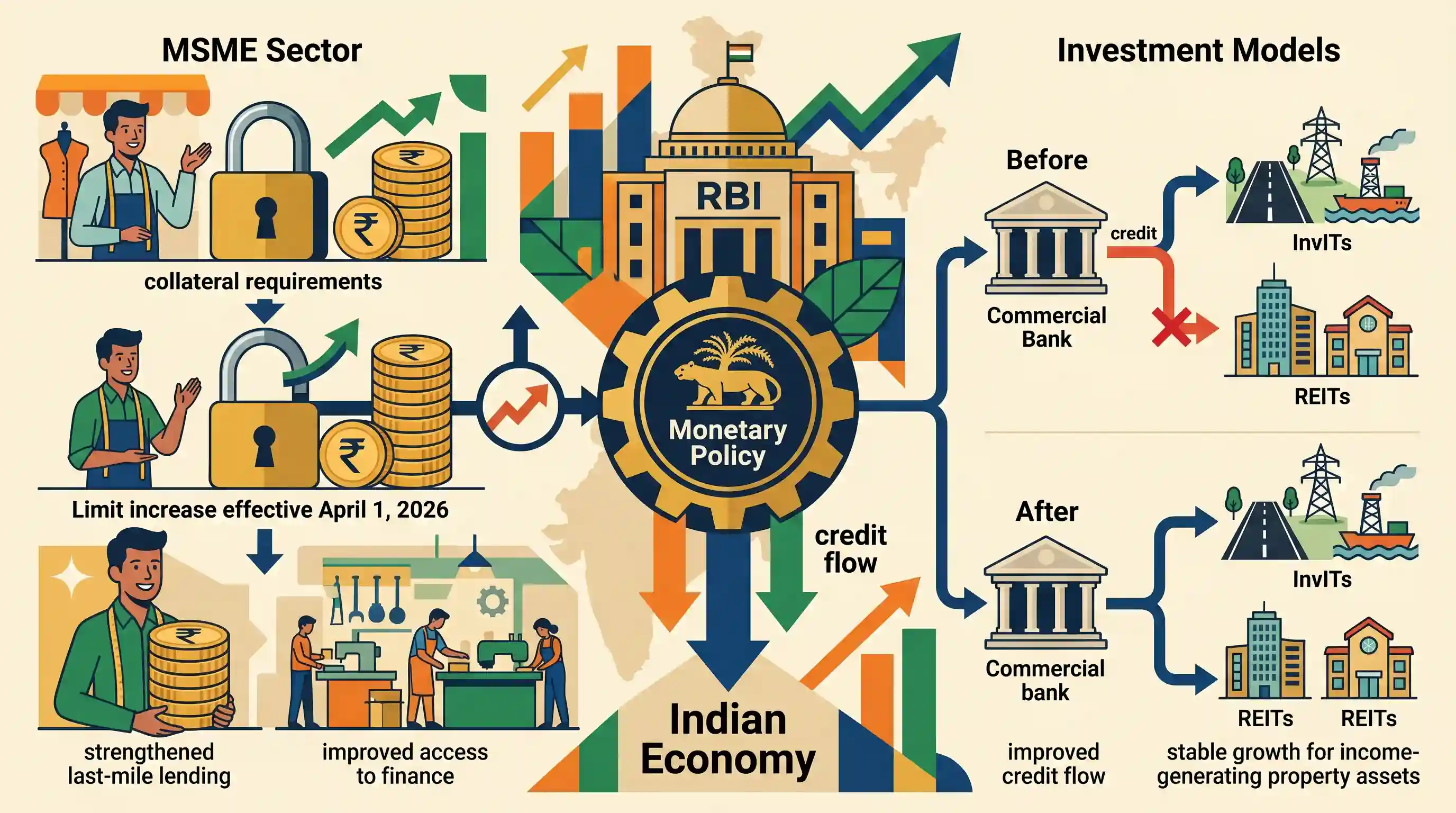
The Reserve Bank of India (RBI) has announced new measures to boost credit flow to small businesses and the real estate sector. The central bank proposed doubling the limit for collateral-free loans to micro and small enterprises to ₹2 million (₹20 lakh) from ₹1 million, effective April 1, 2026. In another significant move, the RBI permitted commercial banks to extend finance to Real Estate Investment Trusts (REITs), extending a lending facility previously restricted to Infrastructure Investment Trusts (InvITs). The decision, aligned with SEBI's recent move to treat REITs as equity, aims to strengthen last-mile lending, improve access to competitive long-term bank finance, and ensure stable growth for income-generating property assets.
Key Points
- The RBI doubled the collateral-free loan limit for small businesses from ₹1 million (₹10 lakh) to ₹2 million (₹20 lakh) to enhance formal financing.
- The revised MSME loan norms will apply to loans sanctioned or renewed from April 1, 2026.
- Commercial banks are now permitted to lend to Real Estate Investment Trusts (REITs) under prudential safeguards, extending a facility already available to Infrastructure Investment Trusts (InvITs).
- SEBI recently allowed REITs to be treated as equity, enabling mutual fund investments into the asset class.
- The move to allow bank finance for REITs aims to reduce refinancing needs, support stable balance sheets, and spur fresh funding into the real estate sector.
Important Terms
Reserve Bank of India (RBI)

India's central bank and regulatory body responsible for regulating the Indian banking system, managing monetary policy, and maintaining financial stability through tools like interest rates and credit control.
UPSC context
GS Paper 3: Indian Economy. Key for questions on monetary policy, banking regulations, and credit flow to priority sectors.
Securities and Exchange Board of India (SEBI)
The statutory regulator for India's securities market that protects investor interests and regulates stock exchanges and financial intermediaries to ensure transparent and efficient capital markets.
UPSC context
GS Paper 3: Capital Markets. Important for topics regarding regulatory reforms and investor protection in investment vehicles.
Real Estate Investment Trust (REIT)
A company or trust that owns, operates, or finances income-generating real estate, allowing small investors to earn dividends from commercial property without direct ownership.
UPSC context
GS Paper 3: Investment Models. Relevant for infrastructure financing and real estate sector transparency and liquidity.
Infrastructure Investment Trust (InvIT)
An investment vehicle similar to a mutual fund that enables individual and institutional investors to invest in infrastructure projects to earn a portion of the income generated.
UPSC context
GS Paper 3: Infrastructure and Investment Models. Crucial for understanding asset recycling and long-term financing strategies.
Micro and Small Enterprises (MSEs)
Small-scale industrial or service units categorized by specific investment and turnover limits, acting as a critical sector for employment and GDP in India.
UPSC context
GS Paper 3: MSME Sector. Focuses on government/RBI initiatives for financial inclusion and industrial growth.
Collateral-free Loans
Loans provided by financial institutions that do not require the borrower to pledge any assets or security, often used to support small businesses and entrepreneurs.
UPSC context
GS Paper 3: Financial Inclusion. Tests knowledge of credit accessibility and risk management in priority sector lending.
Prelims Trap
"SEBI has classified both REITs and InvITs as equity-related instruments to boost mutual fund participation."
SEBI reclassified only REITs as equity-related. InvITs remain classified as 'hybrid' instruments due to their private placement nature and stable cash flows.
Static Concepts Connected
How are REITs fundamentally distinct from InvITs in India?
- Underlying Asset: REITs invest primarily in completed, income-generating commercial real estate. InvITs invest in long-term infrastructure assets like highways and transmission lines.
- Classification: SEBI treats REITs as 'equity-related instruments' for mutual funds, whereas InvITs retain a 'hybrid' classification.
- Lending Restrictions: Banks can now lend to both, but bank funds to REITs are strictly prohibited from being used for land acquisitions.
What is the 2020 composite definition of Micro and Small Enterprises?
- Micro Enterprise: Investment in Plant and Machinery or Equipment up to ₹1 crore, and annual turnover up to ₹5 crore.
- Small Enterprise: Investment in Plant and Machinery or Equipment up to ₹10 crore, and annual turnover up to ₹50 crore.
Cross-Topic Patterns
Cash-flow lending via Account Aggregator
Raising collateral-free MSME limits synergizes with the RBI Account Aggregator framework, shifting Indian banking from asset-backed lending to purely cash-flow-based lending using digital trails.
InvITs and National Monetisation Pipeline
While REITs unlock real estate capital, their sister-instrument InvITs are heavily utilized by NHAI and PowerGrid to monetize brownfield infrastructure assets under the National Monetisation Pipeline.

Expect a 2026 Prelims multi-statement question distinguishing REITs from InvITs based on SEBI classification and bank lending norms.
Linked PYQs · 3
Linked PYQs · 3
- 2023PrelimsGS1
Consider the following statements with reference to India: 1. According to the 'Micro, Small and Medium Enterprises Development (MSMED) Act, 2006', the 'medium enterprises' are those with investments in plant and machinery between ₹ 15 crore and ₹ 25 crore. 2. All bank loans to the Micro, Small and Medium Enterprises qualify under the priority sector. Which of the statements given above is/are correct?
- 2023PrelimsGS1
Consider the following statements: Statement-I: Interest income from the deposits in Infrastructure Investment Trusts (InvITs) distributed to their investors is exempted from tax, but the dividend is taxable. Statement-II: InvITs are recognized as borrowers under the 'Securitization and Reconstruction of Financial Assets and Enforcement of Security Interest Act, 2002'. Which one of the following is correct in respect of the above statements?
- 2023MainsGS3
Faster economic growth requires increased share of the manufacturing sector in GDP, particularly of MSMEs. Comment on the present policies of the Government in this regard.
