RBI Proposes Customer Compensation Framework for Small Digital Frauds
Source:The Hindu ↗
Why It Matters
Financial digitalization has led to increased instances of cyber frauds, bringing consumer protection and digital security to the forefront of RBI's regulatory priorities. For UPSC aspirants, understanding the mechanisms to secure digital transactions (e.g., lagged credits), RBI's regulations on loan recovery/mis-selling, and efforts to reform the UCB sector (Mission SAKSHAM) is crucial for both Prelims (Economy) and Mains (GS3 - Indian Economy, Cybersecurity).
Summary
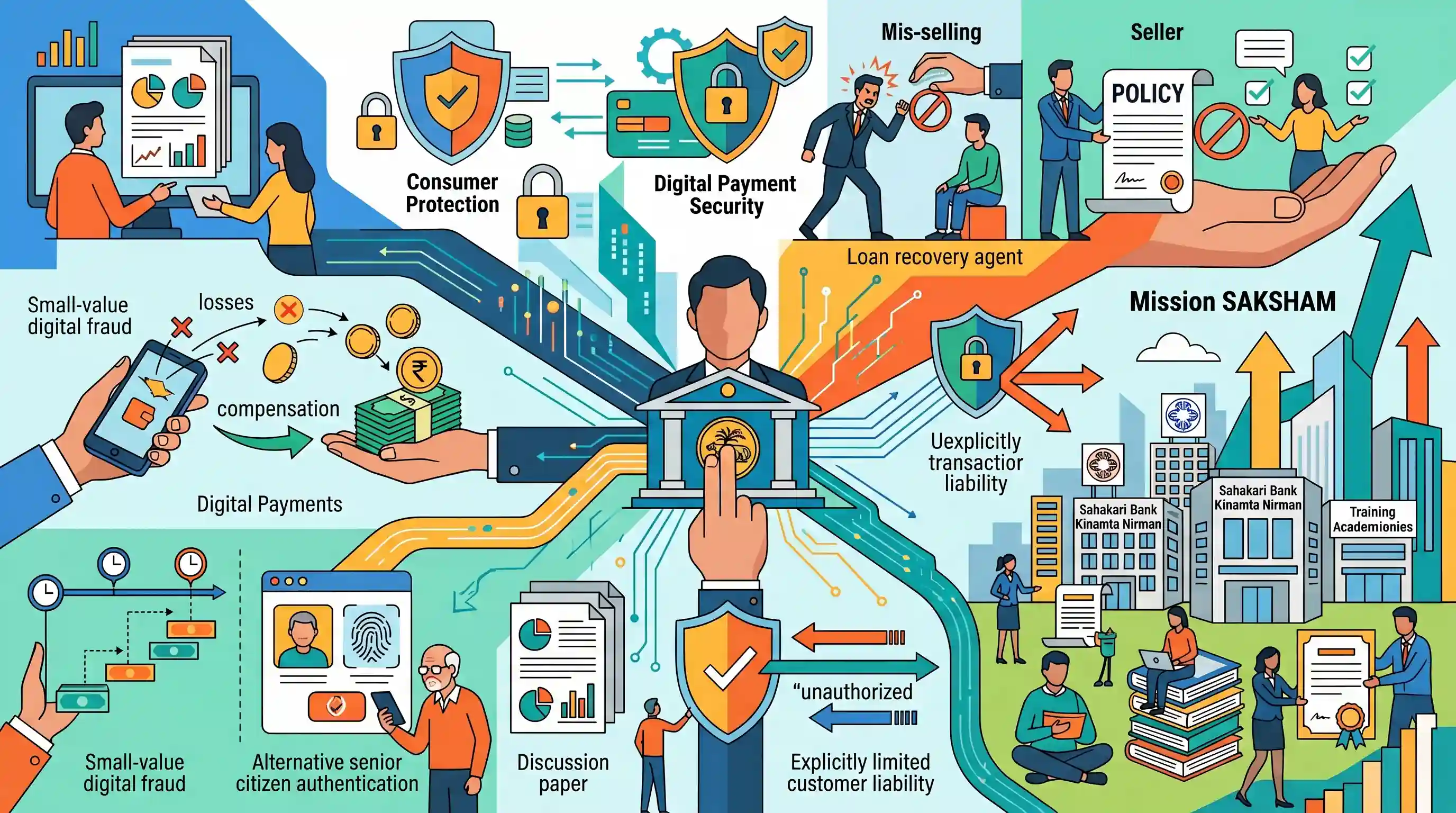
The Reserve Bank of India (RBI) has announced a slew of initiatives aimed at enhancing consumer protection and bolstering the security of digital payments. Central to these measures is a proposal to compensate customers up to ₹25,000 for losses stemming from small-value digital frauds. To systematically combat the rise in electronic fraud, the RBI will release a discussion paper proposing safeguards such as lagged credits and alternative authentication for senior citizens. Additionally, the central bank will introduce comprehensive guidelines to tackle the mis-selling of financial products, regulate the conduct of loan recovery agents, and explicitly limit customer liability in unauthorized electronic banking transactions. Shifting focus to cooperative banking, the RBI launched Mission SAKSHAM (Sahakari Bank Kshamta Nirman) to provide structured capacity-building and certification for Primary (Urban) Co-operative Banks (UCBs).
Key Points
- The RBI proposed a framework to compensate customers up to ₹25,000 for financial losses arising from small-value fraudulent digital transactions.
- A discussion paper is planned to explore measures like lagged credits and additional authentication methods for senior citizens to counter digital fraud.
- New draft guidelines will be issued to address the mis-selling of financial products, curb malpractices by loan recovery agents, and limit customer liability in unauthorized electronic banking.
- The RBI announced Mission SAKSHAM, a comprehensive capacity-building and certification program aimed at strengthening Primary (Urban) Co-operative Banks (UCBs).
Important Terms
Reserve Bank of India (RBI)

India's central bank and regulatory body for the financial system. It manages monetary policy, supervises banks, and ensures payment system security and consumer protection.
UPSC context
GS Paper III: Indian Economy. Crucial for understanding monetary policy, banking regulation, and financial stability.
Mission SAKSHAM (Sahakari Bank Kshamta Nirman)
A nationwide capacity-building initiative launched by the RBI (April 2026) to train over 1.4 lakh Urban Co-operative Bank (UCB) personnel in governance, risk management, compliance, and cybersecurity.
UPSC context
GS Paper III: Banking Sector Reforms. Tests knowledge of specialized institutional strengthening programs in the cooperative sector.
Primary (Urban) Co-operative Banks (UCBs)
Cooperative credit institutions serving urban and semi-urban areas. They follow a dual regulatory structure (RBI and State/Central Registrars) and primarily target small borrowers and MSMEs.
UPSC context
GS Paper III: Economy/Financial Inclusion. Tests understanding of differentiated banking structures and recent regulatory shifts (e.g., BR Amendment Act 2020).
Mis-selling
The unethical practice of selling financial products (like insurance or mutual funds) that are unsuitable for a customer's profile, risk appetite, or financial literacy levels.
UPSC context
GS Paper III: Indian Economy. Important for consumer protection, financial ethics, and recent draft guidelines on responsible business conduct.
Customer Liability (Unauthorized Transactions)
A regulatory framework determining financial loss responsibility for transactions made without customer consent. RBI mandates 'zero liability' for customers who report third-party breaches within three working days.
UPSC context
GS Paper III: Economy/Cybersecurity. Relevant for digital payment safety, consumer rights, and mitigating risks in a cashless economy.
Depositor Education and Awareness (DEA) Fund
A fund created by the RBI (2014) to utilize unclaimed deposits for depositor education. Recent proposals suggest using this fund to compensate victims of small-value digital frauds.
UPSC context
GS Paper III: Indian Economy. Tests knowledge of banking safety nets and innovative use of financial resources for consumer welfare.
Prelims Trap
"Mission SAKSHAM is a centrally sponsored scheme launched by the Ministry of Women and Child Development."
While 'Saksham Anganwadi' is a WCD scheme, RBI's 'Mission SAKSHAM' (Sahakari Bank Kshamta Nirman) is exclusively meant for the capacity building of Urban Co-operative Banks.
Static Concepts Connected
How are Primary (Urban) Co-operative Banks (UCBs) regulated in India?
- Dual Control: Banking functions are regulated by the RBI, while incorporation and management fall under the Registrar of Cooperative Societies (State or Central).
- Enhanced RBI Powers: The 2020 Banking Regulation Act amendment granted the RBI enhanced powers over UCBs, including the ability to supersede boards and conduct stringent audits.
What dictates customer liability in unauthorized electronic banking transactions?
- Zero Liability: The customer bears no loss if the fraud originates from bank negligence, or from a third-party breach reported within 3 working days.
- Customer Negligence: If the customer shares their payment credentials, they bear the entire financial loss until the unauthorized transaction is formally reported to the bank.
- Limited Liability: If a third-party breach is reported between 4 to 7 working days, liability is capped based on the specific type of bank account.
Cross-Topic Patterns
Lagged credits & I4C cybersecurity network
RBI's proposed 'lagged credits' mechanism directly complements the MHA's Indian Cyber Crime Coordination Centre (I4C) by intercepting real-time social engineering frauds before funds exit the banking system.
Mission SAKSHAM & Ministry of Cooperation
RBI’s capacity-building push for UCBs mirrors the broader national formalization of cooperative institutions under the Ministry of Cooperation, emphasizing grassroots financial resilience.

Mission SAKSHAM for UCBs and RBI's 'lagged credits' for digital fraud will likely form a multi-statement Prelims question in 2026.
Linked PYQs · 4
Linked PYQs · 4
- 2023MainsGS3
What is the status of digitalization in the Indian economy? Examine the problems faced in this regard and suggest improvements.
- 2020MainsGS3
Discuss different types of cyber crimes and measures required to be taken to fight the menace.
- 2021PrelimsGS1
With reference to Urban Cooperative Banks' in India, consider the following statements : 1. They are supervised and regulated by local boards set up by the State Governments. 2. They can issue equity shares and preference shares. 3. They were brought under the purview of the Banking Regulation Act, 1949 through an Amendment in 1966. Which of the statements given above is/are correct?
- 2013PrelimsGS1
The Reserve Bank of India regulates the commercial banks in matters of 1. liquidity of assets 2. branch expansion 3. merger of banks 4. winding-up of banks Select the correct answer using the codes given below.
