RBI Fraud Compensation Limit and Financial Consumer Protection
Source:The Hindu ↗
Why It Matters
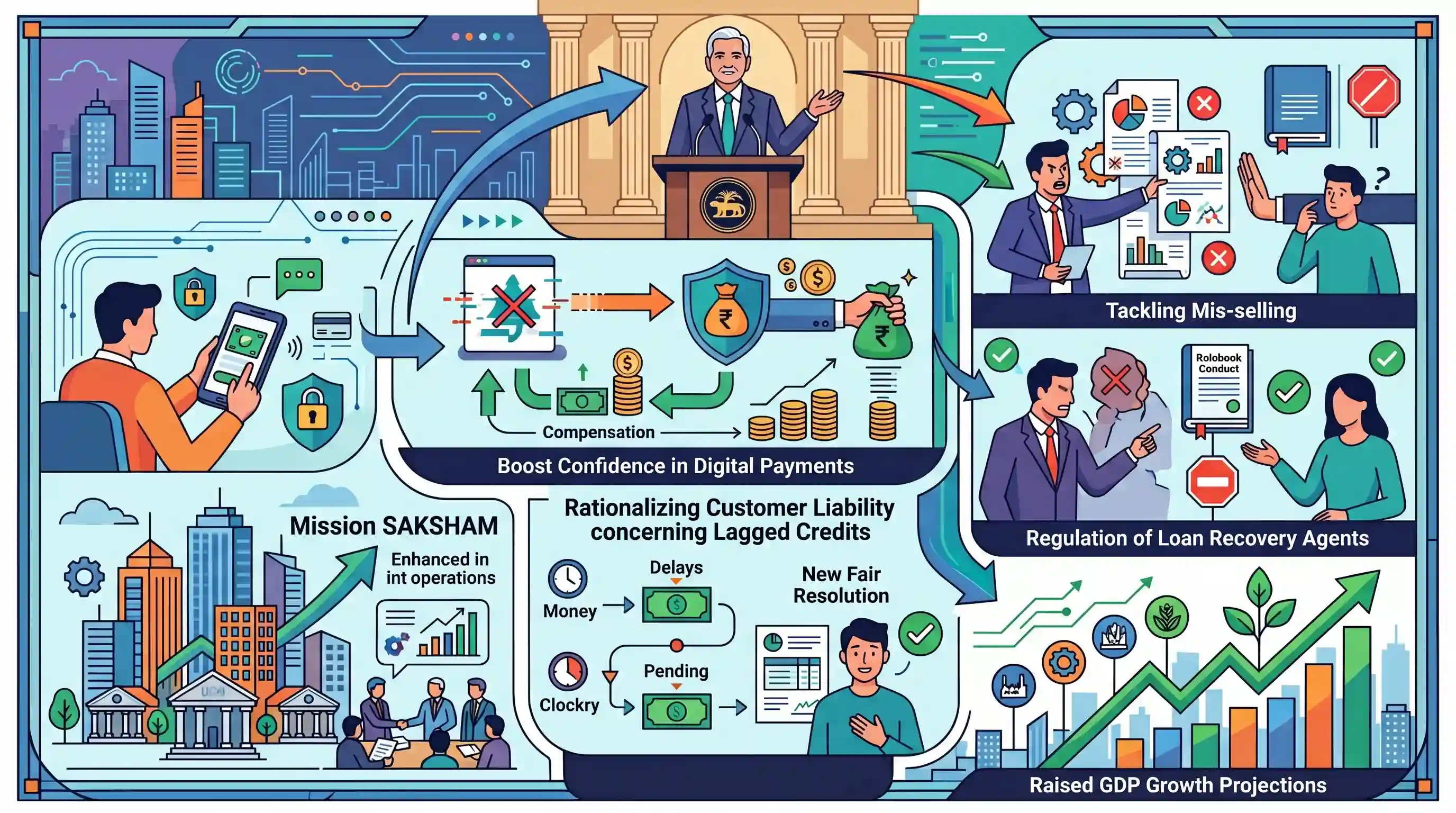
With India's rapid digital transformation, consumer protection against cyber frauds and unauthorized banking transactions is a major regulatory challenge. The RBI's steps to limit customer liability (compensating up to ₹25,000), along with regulating recovery agents and tackling the mis-selling of financial products, are pivotal for sustaining trust in the financial system. These measures are highly relevant for GS-3 (Indian Economy) questions concerning banking regulation, digital payments, and financial inclusion.
Summary
The Reserve Bank of India (RBI), under newly appointed Governor Sanjay Malhotra, announced multiple consumer-centric proposals during its latest monetary policy review. To boost confidence in digital payments, the RBI proposed a framework to compensate customers up to ₹25,000 for losses due to unauthorized electronic banking transactions. Additionally, draft guidelines are being prepared to tackle the mis-selling of financial products, regulate the deployment of loan recovery agents, and rationalize customer liability concerning lagged credits. The RBI also announced Mission SAKSHAM to enhance the capacity and governance of Primary (Urban) Co-operative Banks (UCBs) and raised its GDP growth projections for the upcoming quarters.
Key Points
- The RBI plans to issue a framework compensating customers up to ₹25,000 for losses incurred in small-value digital payment frauds.
- Draft guidelines are forthcoming on rationalizing customer liability in unauthorized electronic banking transactions, lagged credits, and alternative authentication mechanisms.
- The central bank will issue draft directions to curb the mis-selling of financial products and draft guidelines governing the deployment of recovery agents.
- Mission SAKSHAM (Sahakari Bank Kshamta Nirman) was announced to support capacity building for Primary (Urban) Co-operative Banks (UCBs).
- These proposals were unveiled during the final bi-monthly monetary policy for the fiscal year by newly appointed RBI Governor Sanjay Malhotra.
Important Terms
Mission SAKSHAM

A mission-mode capacity-building initiative launched by the RBI (2026) to strengthen Urban Co-operative Banks (UCBs). It provides standardized training and certification to stakeholders in governance, risk management, and regulatory compliance.
UPSC context
GS Paper III: Banking reforms and Cooperative sector; tests understanding of institutional resilience and governance in financial inclusion.
Reserve Bank of India (RBI)
India's central bank and regulatory body responsible for monetary stability, currency issuance, and banking supervision. It manages the nation's payment systems and acts as the lender of last resort.
UPSC context
GS Paper III: Indian Economy; fundamental for topics like monetary policy, inflation management, and financial sector regulation.
Primary (Urban) Co-operative Banks (UCBs)
Primary cooperative banks operating in urban/semi-urban areas, serving small borrowers and MSMEs. They face dual regulation by the RBI (banking functions) and the Registrar of Cooperative Societies (management).
UPSC context
GS Paper III: Financial Inclusion; relevant for cooperative movement history and recent regulatory shifts (Banking Regulation Amendment Act).
Monetary Policy Committee (MPC)
A six-member statutory body (constituted under the RBI Act, 1934) that determines the policy interest rate (repo rate) required to achieve the inflation target while supporting economic growth.
UPSC context
GS Paper III: Monetary Policy; tests knowledge of inflation targeting framework and macroeconomic stability.
Depositor Education and Awareness (DEA) Fund
A fund created by the RBI to utilize unclaimed deposits (inactive for 10+ years). It is used to promote depositor interests, education, and recently, to compensate victims of small-value digital frauds.
UPSC context
GS Paper III: Banking/Consumer Protection; tests awareness of grievance redressal mechanisms and financial literacy initiatives.
Customer Liability
The legal responsibility of a bank customer for unauthorized electronic transactions. RBI’s 2026 proposal limits this by offering compensation up to ₹25,000 for small-value frauds to boost digital payment confidence.
UPSC context
GS Paper III: Digital Payment Ecosystem; relevant for consumer protection and the security of digital financial infrastructure.
Prelims Trap
Mission SAKSHAM is an initiative by the Ministry of Cooperation to digitize Primary Agricultural Credit Societies.
Aspirants see 'Sahakari' and naturally assume the Ministry of Cooperation. However, Mission SAKSHAM is strictly an RBI initiative aimed at Urban Co-operative Banks (UCBs).
Static Concepts Connected
What is the Depositor Education and Awareness Fund (DEAF)?
- Statutory basis: Created by the RBI under the provisions of the Banking Regulation Act, 1949.
- Source of funds: Balances in bank accounts that have not been operated for 10 years or more are transferred to this fund.
- Utilization: Primarily used for promoting depositors' interests, awareness campaigns, and is now proposed for digital fraud compensation payouts.
How are Urban Co-operative Banks (UCBs) regulated in India?
- Dual Regulation: They face dual control from the RBI (banking functions) and the Registrar of Cooperative Societies (management/incorporation).
- Recent Shift: 2020 amendments to the Banking Regulation Act brought UCBs under stricter, more direct regulatory supervision of the RBI to prevent collapses.
Cross-Topic Patterns
Digital Public Infrastructure + Cybersecurity
Expanding Digital Public Infrastructure (DPI) like UPI requires parallel frameworks for consumer trust. The proposed ₹25,000 compensation marks a shift toward institutionalizing digital transaction safety alongside financial inclusion.
Cooperative Federalism + Banking Reforms
RBI's Mission SAKSHAM for UCBs highlights the ongoing central push to professionalize cooperative banks, acting in tandem with recent Banking Regulation Act amendments to tighten oversight.

Expect a Prelims 2026 statement-based question linking DEAF fund utilization with RBI's zero-liability norms in digital transactions.
Linked PYQs · 3
Linked PYQs · 3
- 2020PrelimsGS1
In India, under cyber insurance for individuals, which of the following benefits are generally covered, in addition to payment for the loss of funds and other benefits? 1. Cost of restoration of the computer system in case of malware disrupting access to one's computer 2. Cost of a new computer if some miscreant wilfully damages it, if proved so 3. Cost of hiring a specialized consultant to minimize the loss in case of cyber extortion 4. Cost of defence in the Court of Law if any third party files a suit Select the correct answer using the code given below:
- 2021PrelimsGS1
With reference to Urban Cooperative Banks' in India, consider the following statements : 1. They are supervised and regulated by local boards set up by the State Governments. 2. They can issue equity shares and preference shares. 3. They were brought under the purview of the Banking Regulation Act, 1949 through an Amendment in 1966. Which of the statements given above is/are correct?
- 2021PrelimsGS1
Consider the following statements: 1. The Governor of the Reserve Bank of India (RBI) is appointed by the Central Government. 2. Certain provisions in the Constitution of India give the Central Government the right to issue directions to the RBI in public interest. 3. The Governor of the RBI draws his power from the RBI Act. Which of the above statements are correct?
